


Good morning. If you recall our discussion about boomer watches, you’ll be glad to know Bloomberg is now talking about “boomer art”:
“The art we keep will stay in the canon; the art we discard will be lost to history. A tiny proportion of the art we inherit will be treasured and valued, and a bit more will find a good home elsewhere, perhaps slowly accumulating historical value even if it loses cultural cachet. But most of it will probably acquire signs of physical deterioration and neglect.”
This applies to watches, too, and it’s one reason to be thoughtful about what we collect. Because the stuff we don’t keep, the stuff we overlook or simply miss, that’s what’s lost.
In today’s letter: The most impressive dive watch ever made is 40 years old, sub-$10k, and I sure hope it isn’t forgotten. (Also, if you squint, you can find its DNA in a modern Moser.)
ICYMI


🎁 Unpolished Members get: (1) Welcome Care Package; (2) 10% off the Unpolished Store; (3) $50 off Watchcheck, + 2 newsletters/week, comments, and Q&As. Find info on all your benefits HERE.
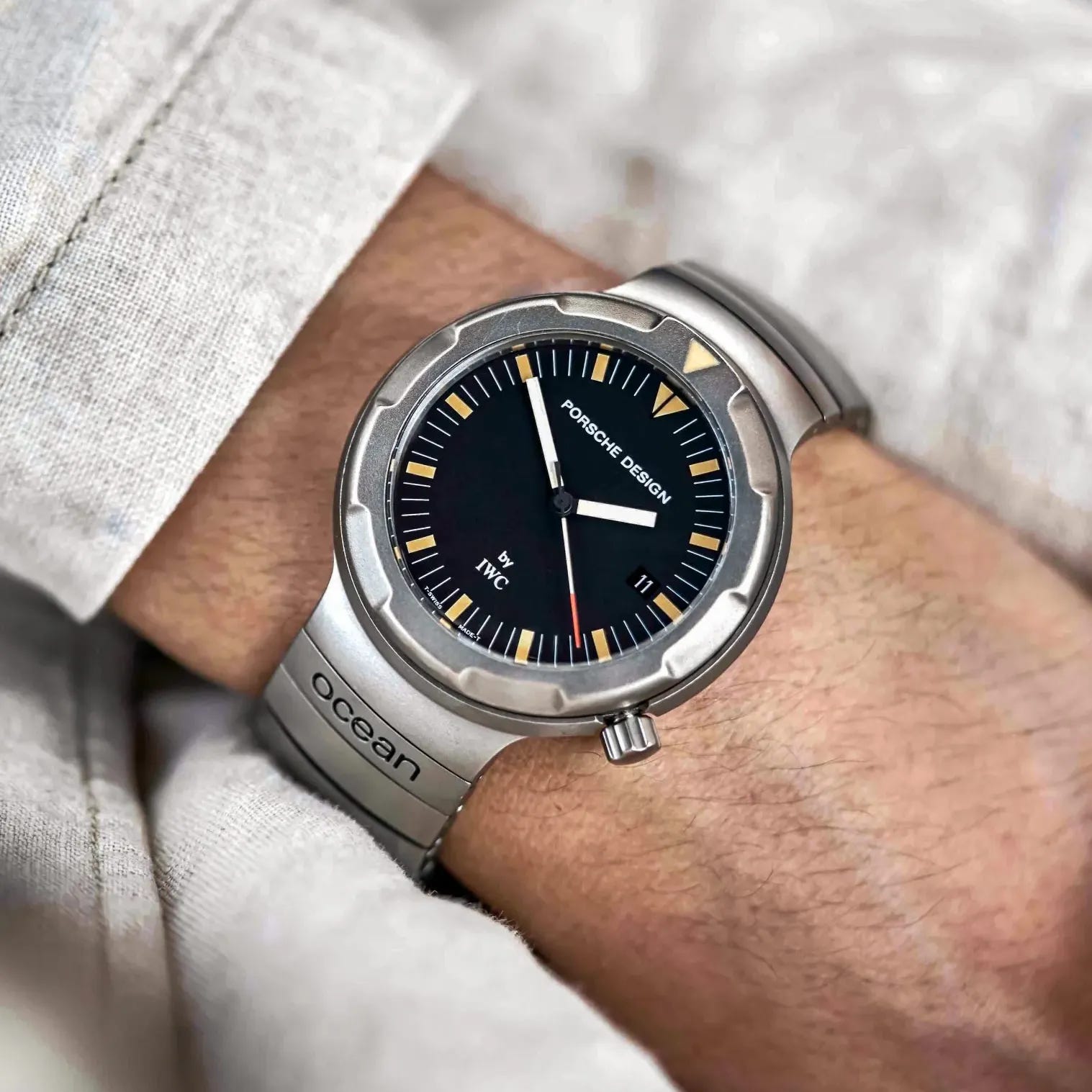
Porsche Design created some of the most innovative watches in the world in the 1980s and 90s. Today, it’s basically caught in the middle of making watches for (1) Porsche guys to match to their cars (mostly corny), or (2) watch guys who are nostalgic for those 80s-90s watches (sometimes corny).
Chris, aka Time the Destroyer, recently put together an excellently researched piece on the history of Porsche Design.
It starts with a bit of myth busting, always fun—dubious origin dates, model names, founder stories. But beyond any myth, Porsche Design’s contribution to watches is very real. Read his whole piece.
It’s easy to undervalue Porsche Design because it was a design studio—not watchmakers, manufacturers, or craftspeople. It didn’t exactly do anything first, even though it was successful with early commercialization of titanium and blacked-out watches. As Chris writes:
“It wasn’t production control Porsche Design was seeking. It was creative control.”
This is why its 20-year partnership with IWC, from 1978 through 1997, represented its creative peak. IWC provided the production and watchmaking. Günter Blümlein, at the helm, was a commercial genius with an eye for creative talent.
To me, this is best illustrated with one watch: the Ocean 2000. I haven’t found a decent guide detailing the evolution of dials, bracelets, and design so here it is.
💸 There are also a few on the market right now, featured at the end for paid subscribers.
The Ocean 2000; or, how is the most innovative diver ever made 40 years old?
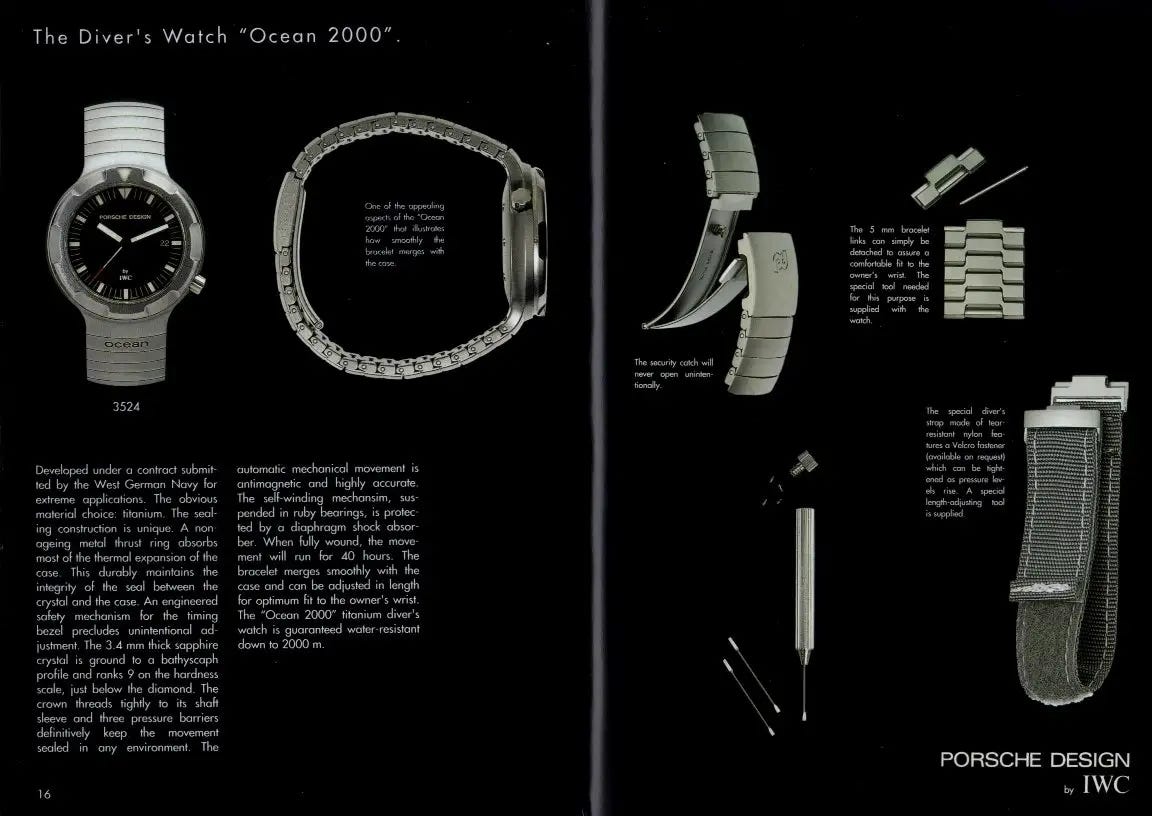
The IWC / Porsche Design Ocean 2000 was officially introduced to the public at 1983’s Basel Fair. However, a Porsche Design press release announced it in 1981, and PD sold it through its own channels for a couple of years.
The Ocean 2000 was originally built to meet German Navy (Bund) specs, and these military-issued examples are particularly collectible—distinguished by a flat sapphire crystal, black bezel, and orange hand.
Specs: They’re impressive: 2,000 meters of water resistance at 42mm diameter and only ~11mm thick.1 Push-to-turn bezel. Titanium case and bracelet, a case shape that’s UFO-meets-pebble, but a stark design to remind you it’s German. Fluid and futuristic in a Disney World Tomorrowland sort of way.
Modern comps: I can’t think of a modern watch that matches these specs in an equally compact package?
The Ocean 2000’s bracelet is unmistakable. A few weeks ago, I put a question to followers: What’s the most recognizable watch bracelet ever?
I expected about five answers (three of them being Rolex bracelets), and I was mostly right, but one answer with multiple responses surprised me: The Ocean 2000.2
That hidden-lug, integrated bracelet design, with the bead-blasted titanium wrapping around your wrist like an armadillo giving you a hug.
This bracelet was also one of the Ocean 2000’s weak points and underwent multiple redesigns, resulting in four distinct styles—more on those below.
First, let’s look at the Ocean 2000’s evolution—
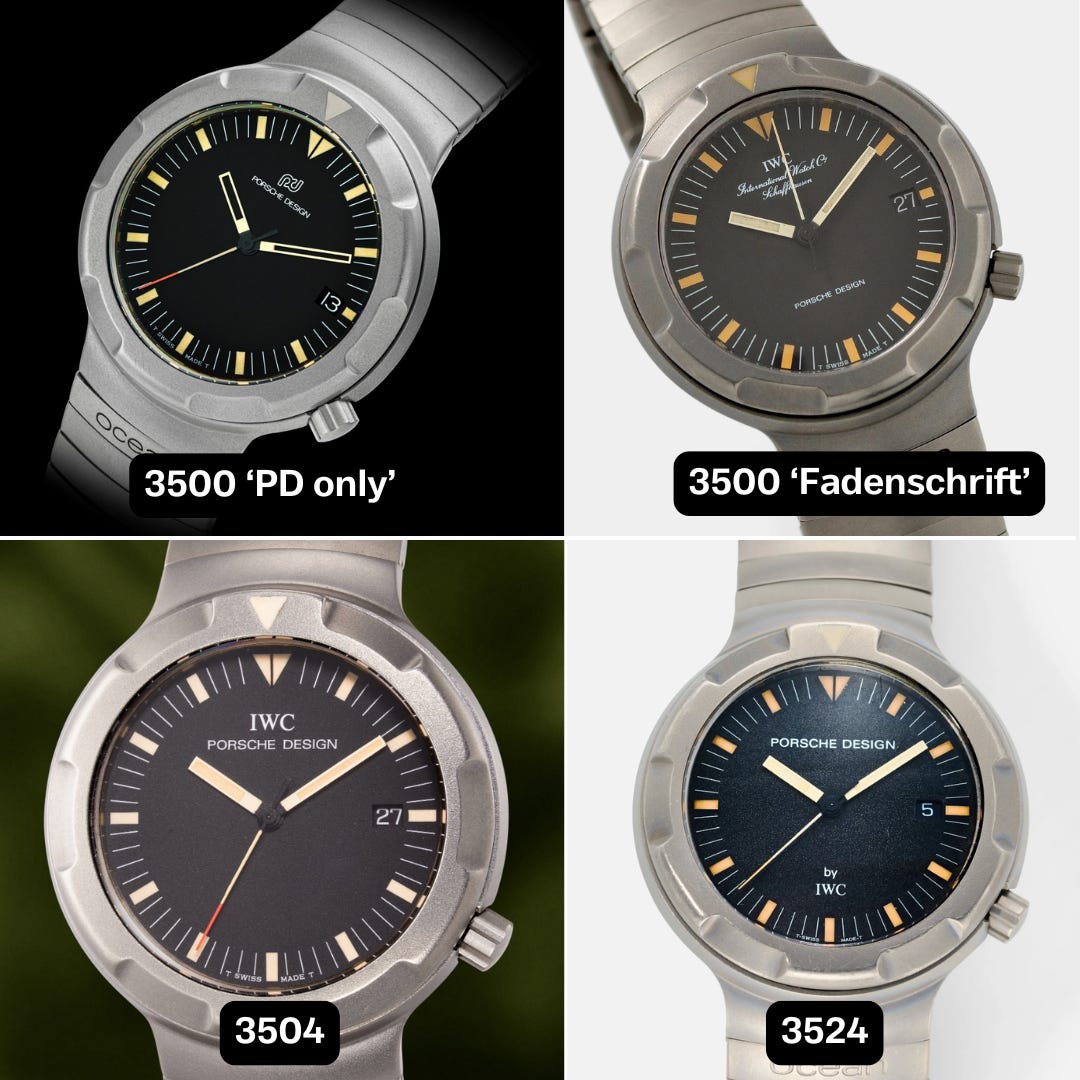
Ref. 3500 (Early 80s)
‘Porsche Design’ only. The earliest examples, produced in the early 80s before IWC officially introduced the Ocean 2000 as part of its own lineup.
Script: When IWC added the Ocean 2000 to its lineup, it featured script IWC, International Watch Co., Schaffhausen at 12 o’clock (the “Fadenscrift”), and Porsche Design at 6 o’clock.
Bracelet: Geometry 1 or 2 (more below)
Collector’s tip: The market doesn’t always get that those early Porsche Design-only Ocean 2000s are rare and only made for a couple of years, so sometimes you can scoop one up for the same price as a later example. Because of the clean look and history, I think these Porsche Design-only Ocean 2000s should get higher prices.
Ref. 3504 (mid-80s to Early 90s)
Dial: IWC / Porsche Design dual branding lockup at 12.
Bracelet: Geo 2/3 (service swaps can also muddy these timelines)
Ref. 3524 (1990s)
Dial: Inverted Porsche Design by IWC branding (don’t you love the jostling of corporate egos in the dial evolution??).
Bracelet: Geo 3/4
Lume note: The Ocean 2000 uses tritium lume until the very latest ref. 3524s, which use Luminova. That means most dials are signed T Swiss Made T, and Swiss Made can tip you off to a service dial. I see a lot of bezels with relumed triangles.
Ocean 500: The mid-size option
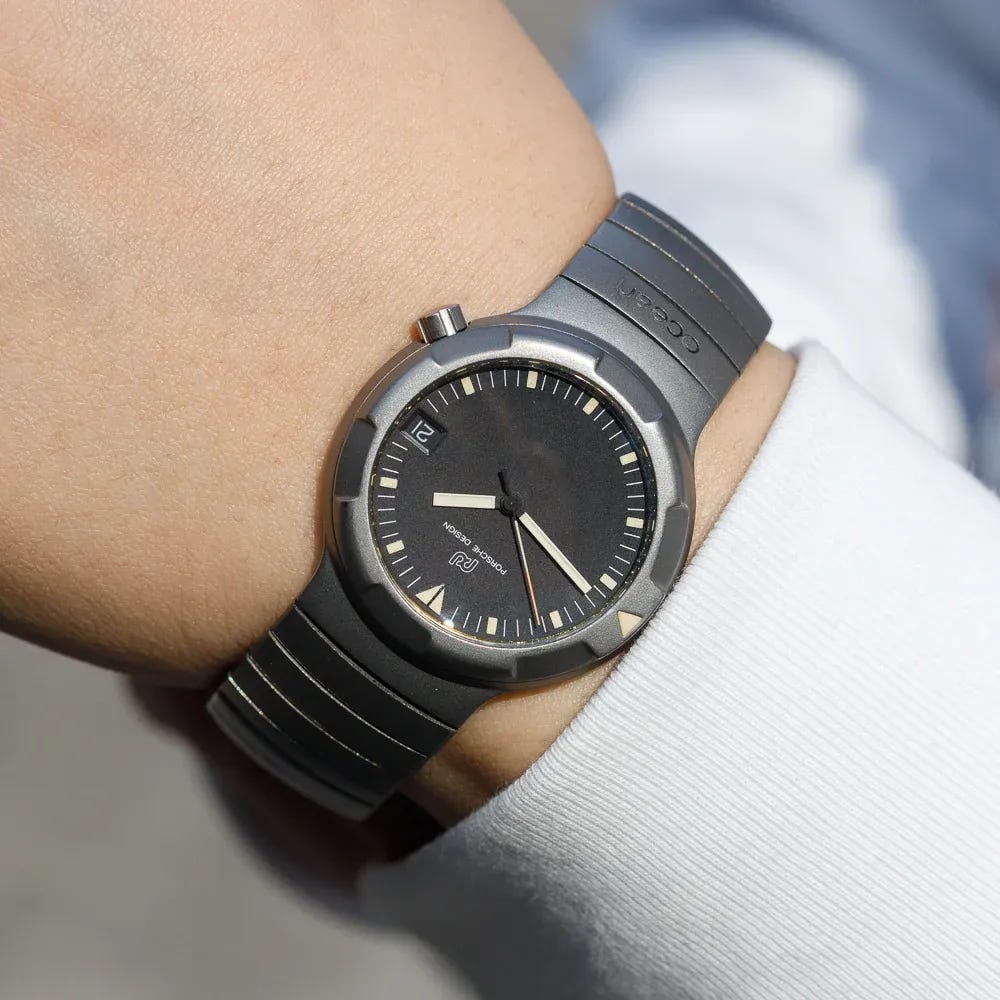
Introduced shortly after the Ocean 2000, the Ocean 500 (refs. 3502/ 3503) is the 34mm counterpart, with its lesser water resistance also in the name. Still pretty impressive for a midsize diver. Dial variants follow the same general pattern as the Ocean 2000. There’s also a two-tone version that’s pretty ugly in a 90s TAG Heuer kinda way.
It’s the one I want! While the Ocean 2000 has a sleek look, the bracelet means it wears larger—I’ve tried on a few, and I’d bet the effective lug-to-lug is 50mm+.
The Ocean Grails
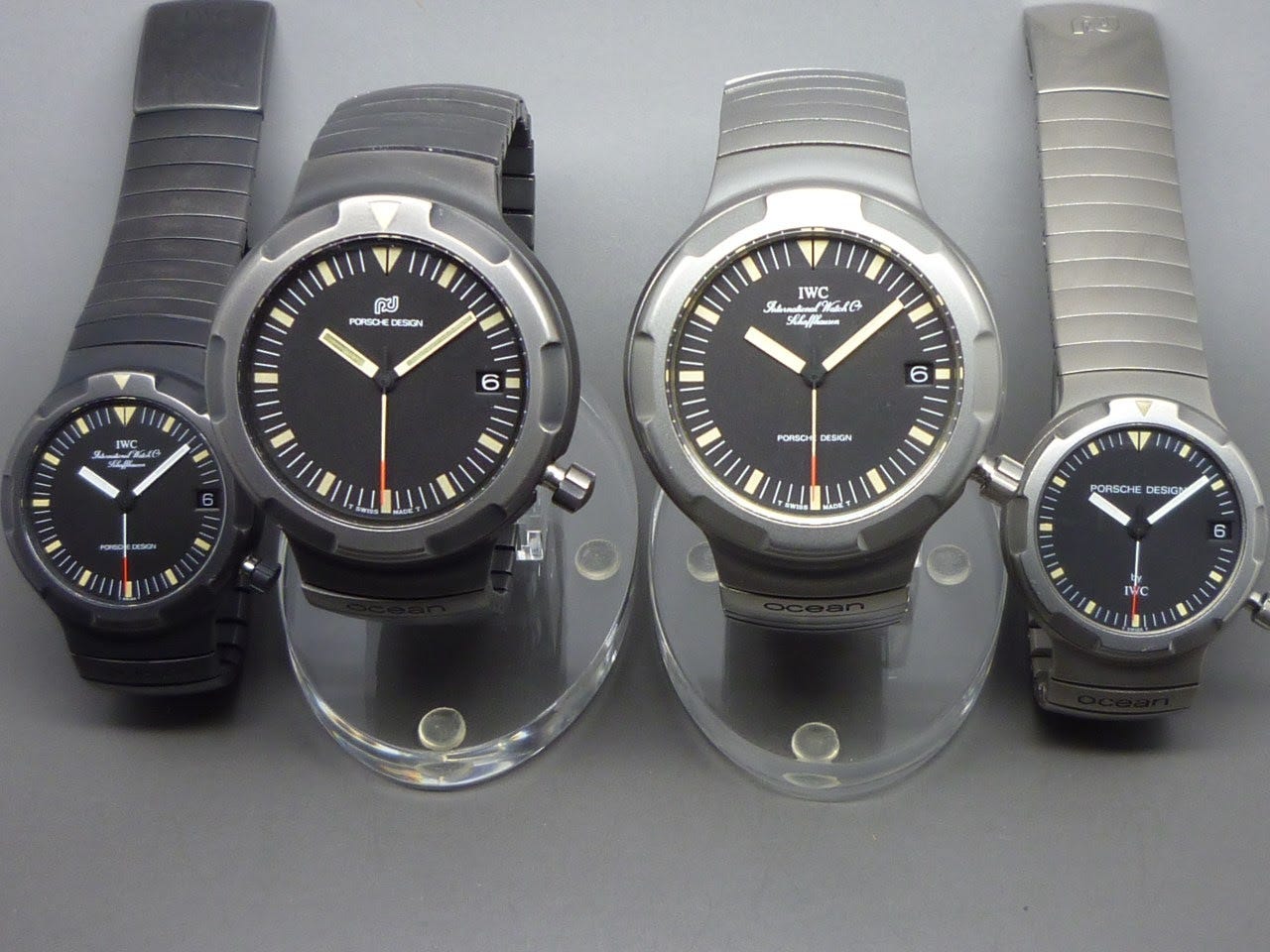
In 1985, IWC began experimenting with a new titanium blackening process called TiCon and produced a few Ocean 2000s and 500s with this process. It quickly realized the thin coating would wear off and it couldn’t be easily reapplied. Super rare watches today.
Know your Ocean bracelets
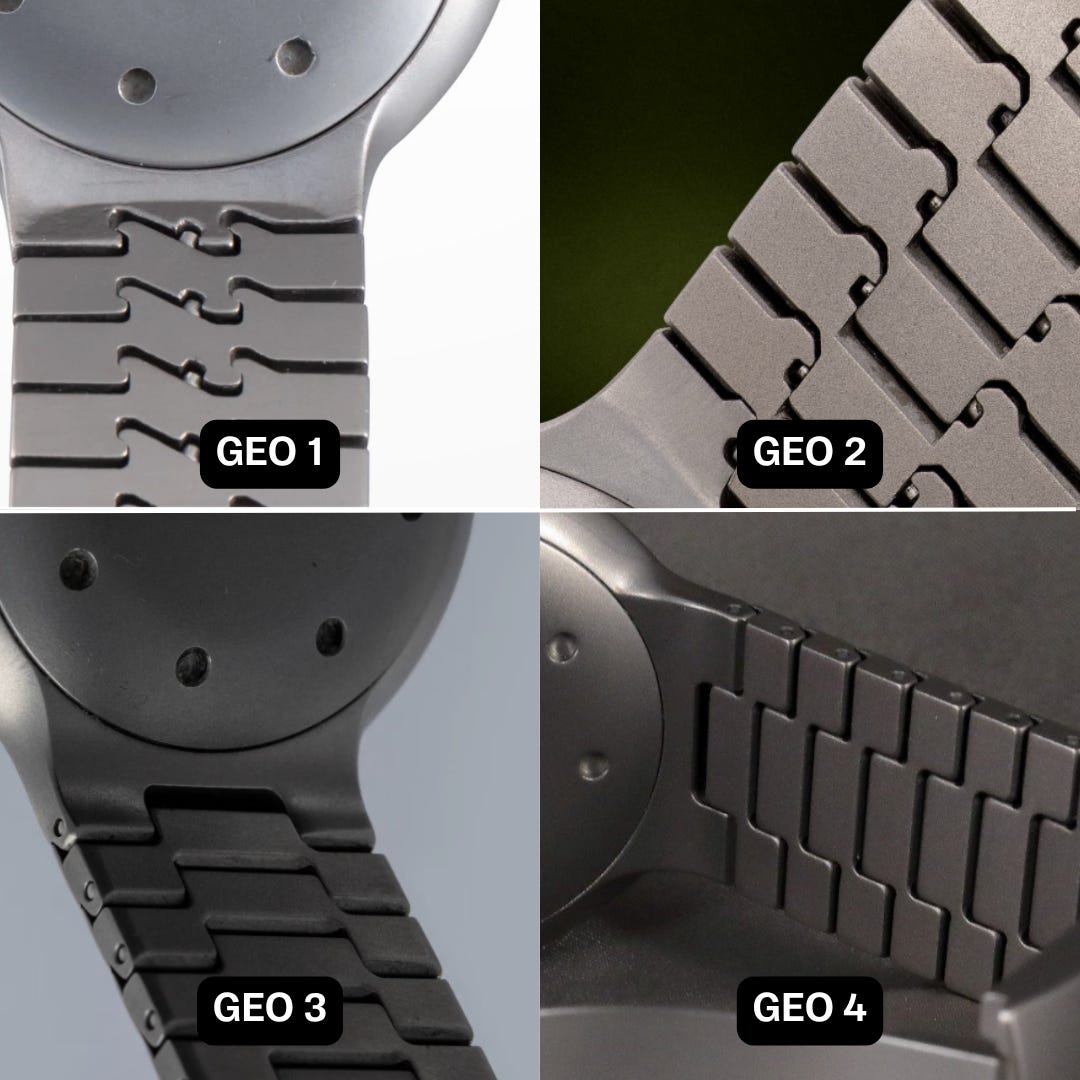
On the Ocean 2000, bracelet evolution is almost as important as the watch itself:
Geometry 1 (Early 3500): One push pin in the center, with links held together by a spring-loaded pin. A paperclip could be used to remove links.
Problem: These spring-loaded pins wore down or corroded over time.
Geo 2: Held together by two metal pins. A special claw tool was provided to remove links, but still had the same durability problem as Geo 1. Introduced 1984.
Fun fact: Lothar Schmidt is listed as the inventor on the patent for this design. Schmidt would go on to acquire Sinn in 1994.3
Geo 3 (Ref. 3504): Solid pins. The full set came with a special tool to remove links, but other tools can be used today. Introduced 1991.
Geo 4 (ref. 3524): Same pin system as Geo 3, but the gaps between links are smaller. Introduced 1997.
Straps, too: The Ocean 2000 could also be delivered on a Velcro strap with a special titanium end link. IWC forums suggest these end links can still be bought directly from IWC, but I’m not 100% sure.
Collector’s tip: In a service, IWC can change older Geo 1-2 bracelets to the latest Geo 4, but it requires swapping out the entire midcase. This seems to typically require a trip to Switzerland, which means more $$$. It’s the classic collector dilemma: Do you prioritize originality or practicality?
The End of Porsche Design and IWC
The very success of Porsche Design watches like the Ocean 2000 proved to be the undoing of its collaboration with IWC. Georges Kern, CEO of IWC, later said in a 2002 interview:
“[Porsche Design by IWC was] overshadowing the IWC brand and had reached a dangerous proportion.”
By the 1990s, “Porsche Design by IWC” had a hierarchy problem—the licensed name meant more than the manufacturer’s own. Porsche Design was 20% of IWC’s production. You can see it on the dials: IWC is up top in early refs, then a shared lockup, then by IWC is demoted to 6 o’clock in the final ref. 3524.
The Eterna Epilogue
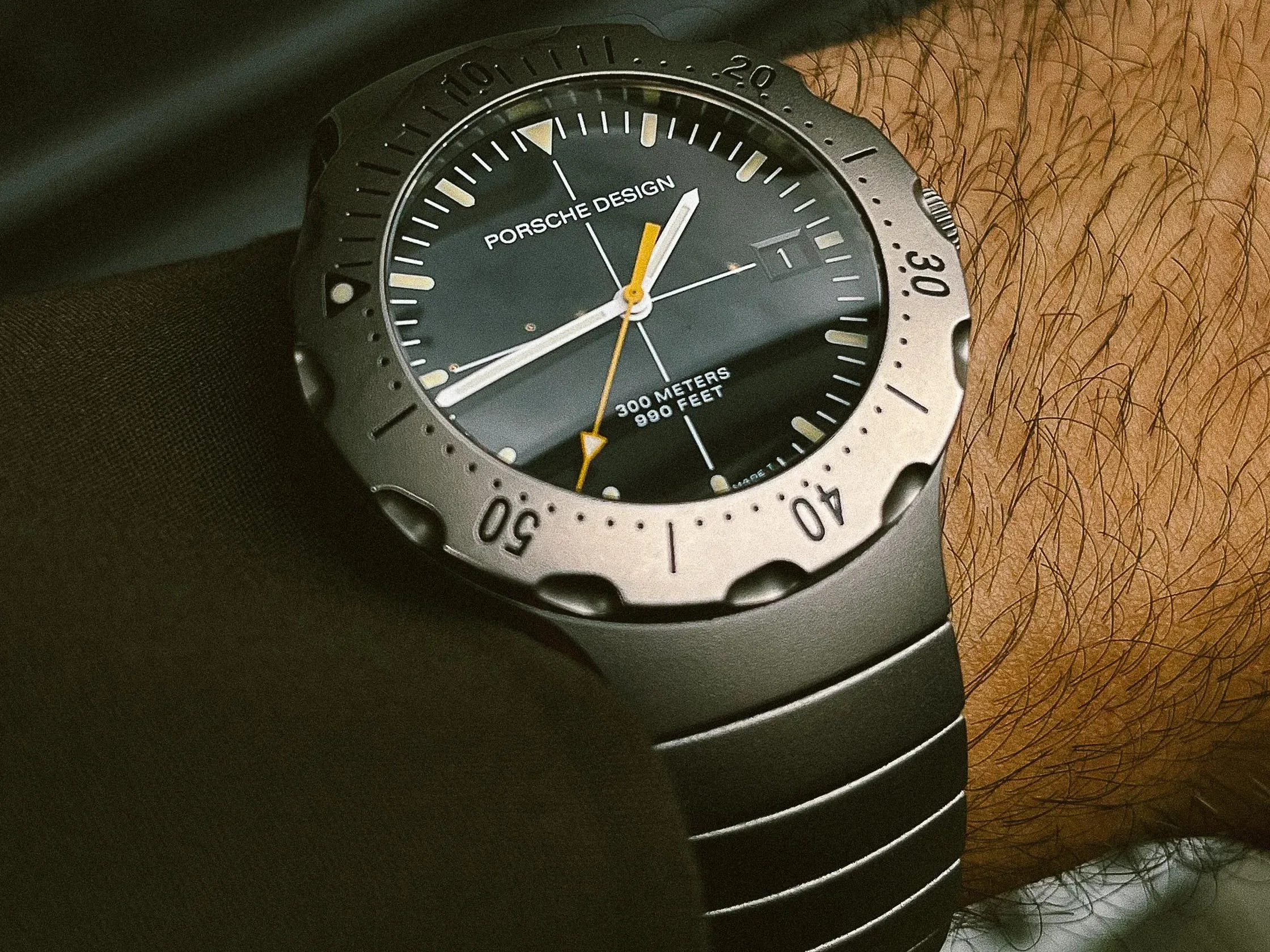
Porsche Design also wanted more control. The Porsche family bought Eterna in 1995 to build its own in-house manufacture as the IWC partnership was winding down. It’s an odd, intriguing epilogue to IWC–Porsche Design. I’d mostly written this era off, but in that article Chris says he has a deep fondness for Eterna–PD as a clean expression of the original ethos at accessible prices. The ref. 6501.10 is the obvious successor to the Ocean 2000:
Both of them wanted more control, even though the partnership that made them both worth remembering was built on the opposite—each doing the one thing it did best and outsourcing the rest. That’s been the trajectory of the entire industry over the past few decades: everyone reaching for control over manufacturing, marketing, boutiques.
Today, some of the watches that remind me most of the old Porsche Design–IWC approach come from microbrands like Ming with uncompromising designers who mostly outsource the making. (Some are really marketing departments that market themselves as designers, but that’s another letter).
The Ocean 2000 showed how a real, military-issued diver didn’t have to look like a Milsub. It’s titanium, minimal, rated to 2000m, and still one coherent idea. Since the split, neither IWC nor Porsche Design has made anything half as interesting as the Ocean 2000.
A modern Moser footnote: I recently spent about a week wearing around the new H. Moser Streamliner 34. It’s one of the better renditions of the we’ve-gotta-do-a-sports watch—different enough that it’s not a Genta rehash. The shape and bracelet already reminded of the Porsche Design Ocean 2000, perhaps with a sprinkle of the Ebel Wave. Then, Justin Hast mentioned that a designer who worked at IWC in the 1990s works at Moser today. It’d certainly make sense, and there are only so many watch designers (and watch companies) in Schaffhausen.
The Ocean 2000 Market Right Now
Here are 5 Ocean 2000s and 500s for sale right now:
