


Before we get to the story of American watchmaking as a story of the American spirit—good, bad, and always enterprising:
🎁 Care package for paid subscribers. If you pay for this newsletter (thank you!), a July 4 gift: Get a free Unpolished polishing cloth and sticker in the mail. I’m also dropping 10 Canvas Straps in random envelopes—even more reason to become a paid subscriber:
🏷️ Free shipping for everyone else in the U.S.: All our Leather and Canvas Straps are made and stitched in the United States, so we’re giving free shipping on all orders through the holiday weekend:
🪩 Chicago Windup Party. I’m co-hosting a party next Friday, July 10, after Windup Chicago. Details and RSVP here.
👀 First look: Berneron bracelet. Since Berneron has posted images of its upcoming gold bracelet, which fits both the existing Mirage 38 and the to-be-announced Miroir, here are a couple photos of the stainless steel prototype shown during Watches & Wonders:

The story of American watchmaking is a very American story.
1876. It’s the 100th anniversary of the Declaration of Independence. The United States is celebrating with a Centennial Exposition in Philadelphia, its first world’s fair, to showcase its industrial prowess.
A statement that, yea, we might’ve had that row amongst ourselves, but the New World is the future.
Probably to show off, but in that demure Swiss kind of way, Longines sends one of its new fully machine-made lever-escapement watches to be displayed at the Centennial Exposition.
But instead of coming back feeling good about its position atop the watchmaking world, Longines and the rest of the Swiss attendees sail home scared by what they’d seen in Philly. Writes one:
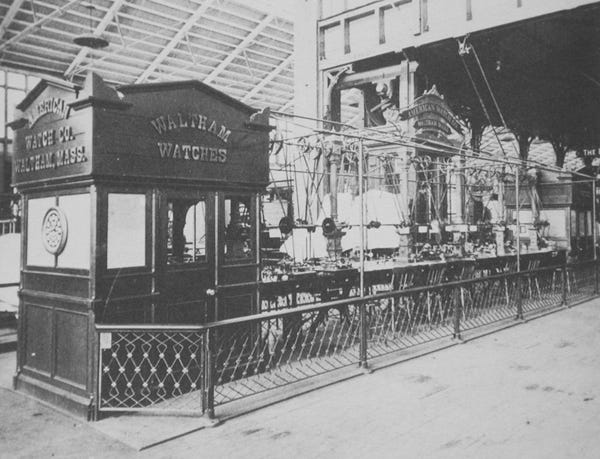
“I’ve been examining the products and tools of the Waltham Watch Company, and I must admit I was filled with admiration for their watches, and for its splendid machines and tools. We have been left behind by our New World competitors.”
Waltham is showing the first automatic screw-making machine at the Exposition, pumping out a screw every five seconds.
But this was America, so its unbridled confidence in itself was doing some of the heavy lifting the machines hadn’t quite figured out yet.
After the Exposition, Longines’ Technical Director, Jacques David, stayed in the U.S. for three months to study its watchmaking industry and tour its factories. He returned and wrote a detailed report, one that was kept secret until 1992 (now translated here). The translator called it “the most important document in the history of modern watchmaking,” and David the “father of modern Swiss watchmaking.”
The report is blunt. David doesn’t hide the truth, writing that Swiss watch exports to the U.S. have declined, and that they soon “will be reduced to zero”:
Feb. 1875 exports to U.S.: Chf 743k
Feb. 1876: Chf 401k
Feb. 1877: 170k1
He ends with a warning to his Swiss colleagues:
“Let us take their tools, imitate their workmen and their methods, but especially let us group together to obtain the kind of progress that the individual industrialist, in his tiny room with his own efforts, cannot achieve.” [emphasis mine]
Not so fast
David was something like an Alexis de Tocqueville of the nascent watch industry. After touring U.S. factories, he was able to see it more clearly than it saw itself—good and bad.
What he saw was something more complicated and unstable than a booming industry ready to conquer the world.
“At present the American industry does not have the state of prosperity and stability that it itself says it has, but we are convinced that with the methods it employs it will not be long before it acquires the qualities currently missing.”—Jacques David (1876)
What David sees is something more like a gold rush or the AI frenzy. He lists 15+ watch companies that have started in the past few years, before pointing out that many have already disappeared or are in liquidation.
One, Cornell Watch Company, was actually most useful as “an instrument for land speculation.”
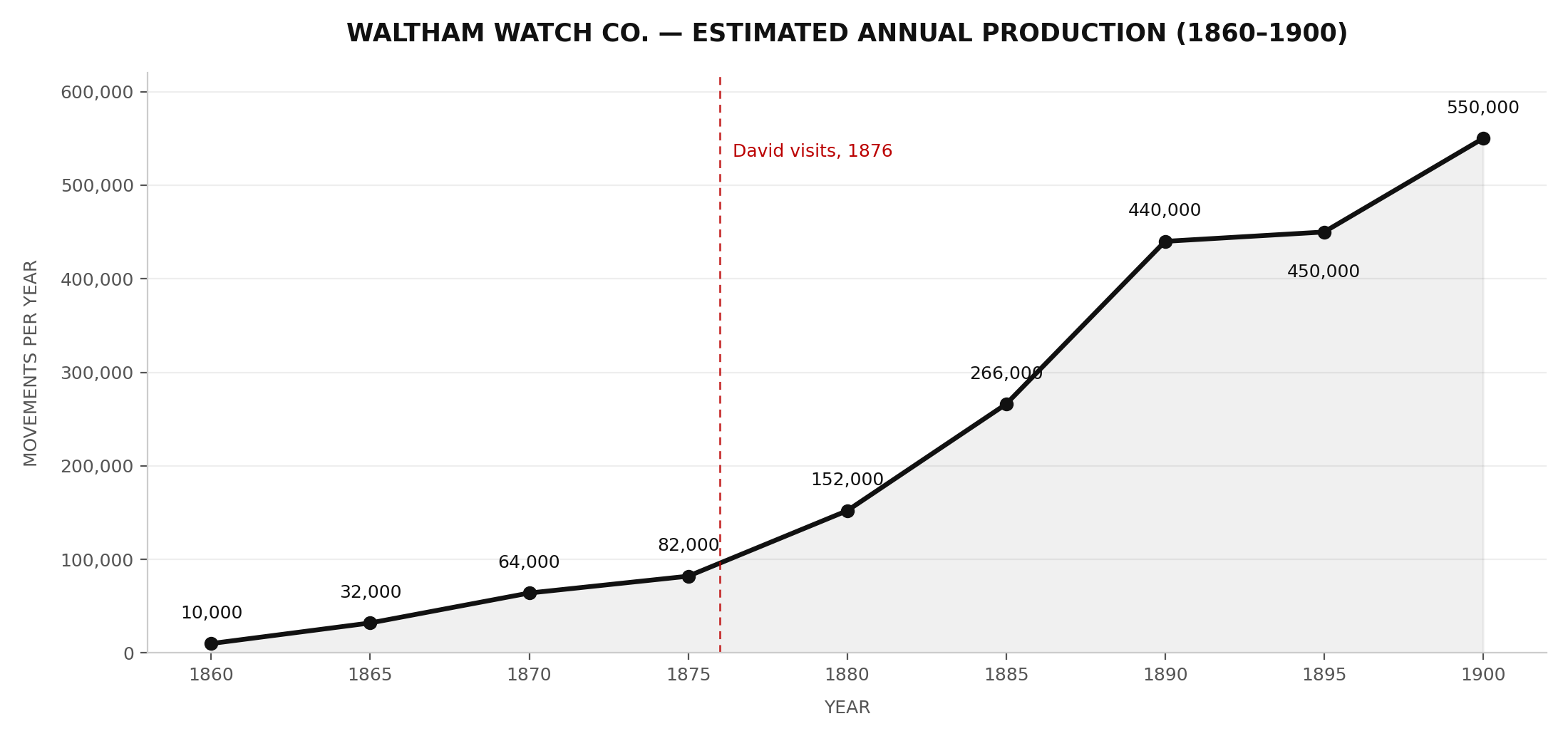
But the winners are winning big, and the biggest is Waltham. In 1865, its capital triples in just 12 months. Waltham is the OpenAI of ‘65, raking in cash, and as other enterprising Americans see its success, they race into the gold rush that is the watchmaking industry. Most fail.
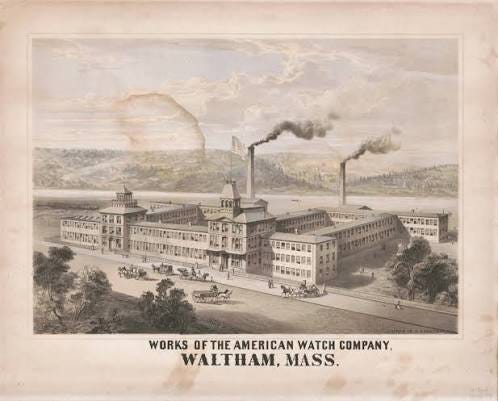
David didn’t come to look at the watches, but at the factories that made them. The Americans had taken the industrial method already making guns and blue jeans, and pointed it at the craft of watchmaking.
David notes that Waltham and Elgin had technical offices comparable to those in the new industrial behemoths of Europe, and “there is no example in the watch industry."
American factories hired employees who knew nothing about watches, often women, and paid them 70 cents a day, operating machines that did one thing and one thing only.
The system ran on seven rules: machine everything, kill hand work, standardize sizes, keep caliber numbers down, build in huge quantities, and the big one—make every part identical so any piece drops into any watch.
This was interchangeability. The idea was that, by obtaining uniformity across manufacturing, these factories could produce millions of watches at a scale the world had never seen before.
But here’s the catch: It wasn’t true yet.
Correcting the Record
While Waltham showed that uniformity was possible, it wasn’t real yet, and wouldn’t truly arrive until the turn of the 20th century. In 1876, smaller parts—pivots, balance staffs, jewels—were still turned and fitted by hand.
So the Americans faked it.
The fix was a system Waltham called the Record, which David explains at length. For every single movement, a worker measured the pivots on all five wheels, logged the exact dimensions, all tied to the movement's serial. They did the same for the impulse pin. Then they picked jewels to fit that one watch, pulled from bins sorted by hole size.
If a part breaks in 5 years? Just send the movement serial to the factory, and they can pull these measurements and cut a piece to match the size.
While the American system touted uniformity, the Record shows that each watch was still unique, requiring a precise, individual measurement.
David writes that “this is a special operation completely unique to the American factories and which has had a great influence on the success that their movements have obtained.”
The Americans hadn’t achieved true interchangeability, but hacked it together with very detailed bookkeeping.
And it worked. From the outside, it already looked like a well-oiled industrial machine. On the inside, one of America’s booming industries hung together on a ledger and workarounds with plenty of ways to fall apart.
On the Ball


For all the clever bookkeeping and hand-fitting, the American system eventually achieved what it set out to—it just took a disaster to get there.
On April 18, 1891, a mail train collided head-on with a passenger train near Kipton, Ohio. Nine people died. An investigation placed the blame on the conductor’s watch, which, without the conductor realizing it, had stopped running for four minutes and then started again.
The railroads brought in a young Cleveland jeweler named Webb Ball to figure out what happened and ensure it didn’t happen again.2 He created the standards that became the railroad chronometer system: 17+ jewels, accurate to 30 seconds a week, temperature compensating, Breguet hairspring, magnetic resistance, white dial with black Arabic numerals.
Waltham, Hamilton, and Elgin—the American Holy Trinity—all started making watches to this standard. By the early 1900s, the quality and uniformity had become real.
American railroad watches were arguably the best working watches on Earth.
The individual industrialist
In his final recommendation, David also saw the opportunity for the Swiss:
“Let us group together to obtain the kind of progress the individual industrialist, in his tiny room with his own efforts, cannot achieve.”
The American system drove towards industrial behemoths, each pursuing uniformity at massive scale. It’s a great way to make a million identical railroad watches, but not so good if the market turns or tastes change.
(It’s perhaps no coincidence that the next generation’s great entrepreneur, Henry Ford, was also a self-taught watch repairer; he visited Waltham in the early 1900s.)
This, of course, is when the wristwatch came along, and the Americans never totally adapted.
David made 10 specific recommendations, many of which came to pass: patents; standardize the screw and caliber sizes; regulate gold and silver to stop the proliferation of fake hallmarks.
But perhaps his most important was on the structure of the industry itself, and something the Americans would never copy: Cooperation to establish groups of manufacturers or associations. This begins to happen in the early 20th century with the formation of Ebauches SA, SSIH, and others.
It’s still the structure of the Swiss industry today: a broad base of manufacturers and suppliers, with a rotating cast of brands sitting on top. Even today, a new crop of independents is leveraging this very structure, drawing on a deep well of suppliers.
American spirit
The American watch industry’s greatest strength was also its fatal flaw: The audacity to build a world-beating industry in just 25 years, even if it was sometimes held together with duct tape and a dream. It’s the gold rush that filled 15 factories in just a few years, and saw many of them liquidated almost as fast.
David saw both halves in 1876. The Americans were winning big and building fast. They were also over-leveraged, unstable, and a little full of it.
And right there in his prescription, he made a recommendation that was very Swiss: Group together. Cooperate.
A new nation built by individual industrialists, each racing towards the same gold rush, could never.
The fall of American watchmaking isn’t some great tragedy, but another chapter in the American story. The United States built the foundation for the modern watch industry, but eventually wandered off towards building lightbulbs, skyscrapers, airplanes; Wall Street, nuclear bombs, and computers.
That restless, enterprising spirit is the entire American engine—why we’re so capable of building modern marvels, and why we often can’t hold onto them.
Happy Fourth of July; happy 250th!
-Tony
UNPOLISHED STORE
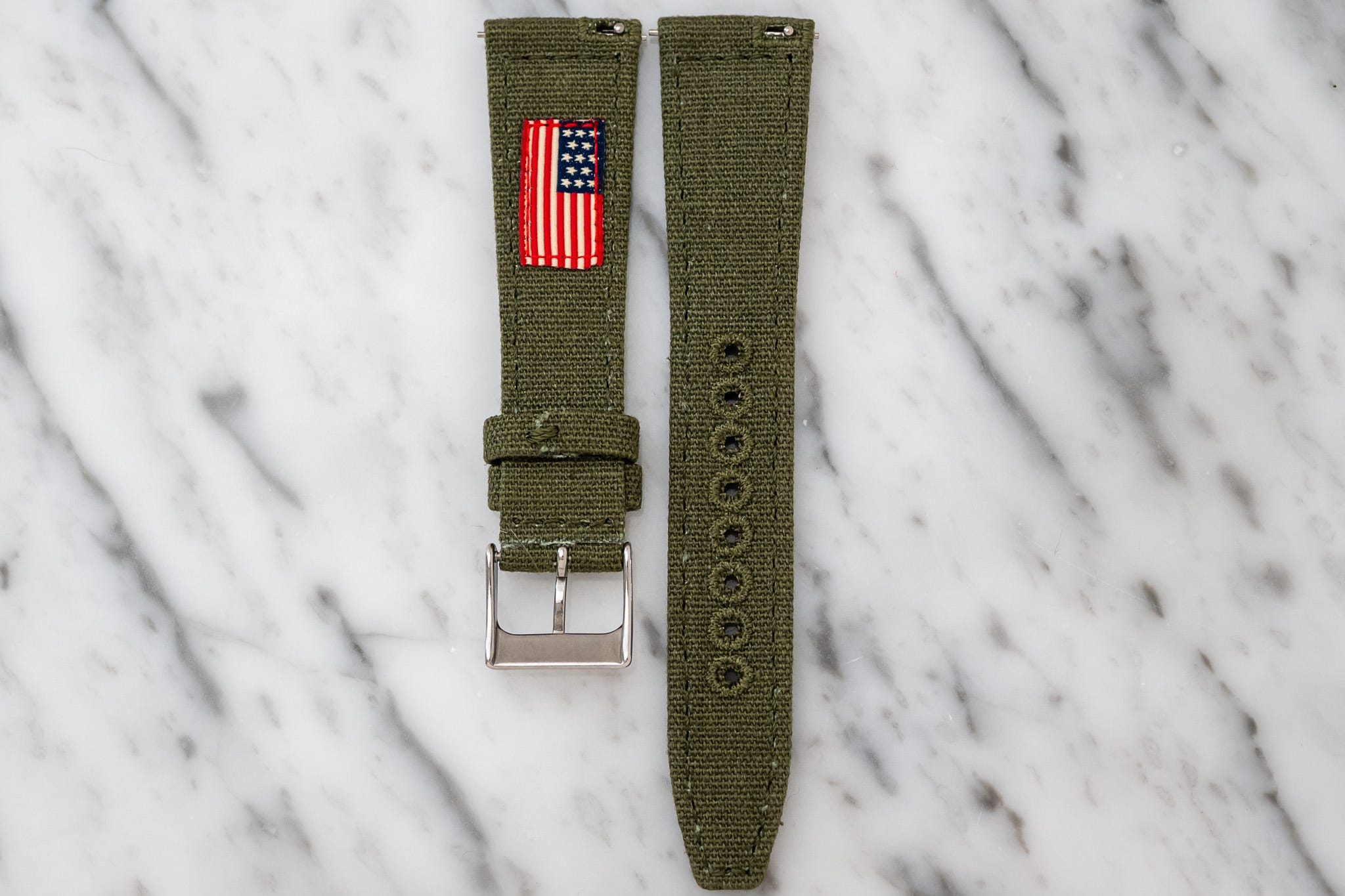
Stitched right here in the United States. The Unpolished Canvas Strap is perfect for summer. Lightweight, 100% cotton. Available in charcoal, green, or khaki,—18, 19, 20mm, or 22mm lug width. Free shipping all weekend:
More on American watchmaking:
Jacques David’s 1876 Report on Swiss and American Watchmaking makes for a fascinating read.
Forget American, These Guys Just Wanna Make Great Watches, on Josh Shapiro, Zach Smith, and a new generation of American makers.
Inside the Cottage Industry of American Watchmaking, a conversation with indie watchmaker Keaton Kyrick.
Watchmaking’s Crisis—and Comeback, the closing of one U.S. watchmaking school and opening of the Rolex training center tell the story of a profession struggling to meet booming demand.
David points out that, while the U.S. has protective tariffs to help its industry, “we should not exaggerate the advantages of this position.” Labor in the United States is more expensive, which more than makes up the difference from duties. The implementation of machines reduces the labor cost of American watchmakers, allowing them to compete. In this statement, I hear a warning to the Swiss industry of 2026!
His namesake lives on as Ball Watch Company.
Happy 4th and great story Tony. From the prototype/first mass produced American watch, Warren Manufacturing Company (Waltham) SN-18, in the early 1850s, on through the 1876 Expo and past WW-II with the watch that was perhaps the ultimate realization of the American System of Manufacturing, the Hamilton 992B, which was produced into the 1970s, American watches had a great 120 year run. I'd say this was way more a success story than a failure. The 992B was probably as close to an interchangeable parts, mass produced watch as any watch of its quality ever. Maybe the greatest thing about this history is that there were so many Hamilton 992Bs made that a watch collector can still find a nice well running example for well under 500 bucks and parts are still readily available. Cheers.
It must be remembered that the US watch industry reoriented for the requirements of fighting WW2, making not just watches but other precision instruments for an allied force that saw 80 million people don the uniform.
Swiss watchmaking continued during 1939-1945 and afterwards enjoyed a fixed cheap exchange rate of the SFr from 1946 to 1973 which was favorable for exports.
Soon, low-priced Swiss watches (remember Switzerland made the whole range) flooded into the US market.
Meanwhile yes the Cold War and the high technology revolution provided ample venues for ambitious people and/or capital. It’s a feature not a bug that the US as a whole let others make watches and other simple goods, so that firms like Intel Xerox TI and Apple could be born.