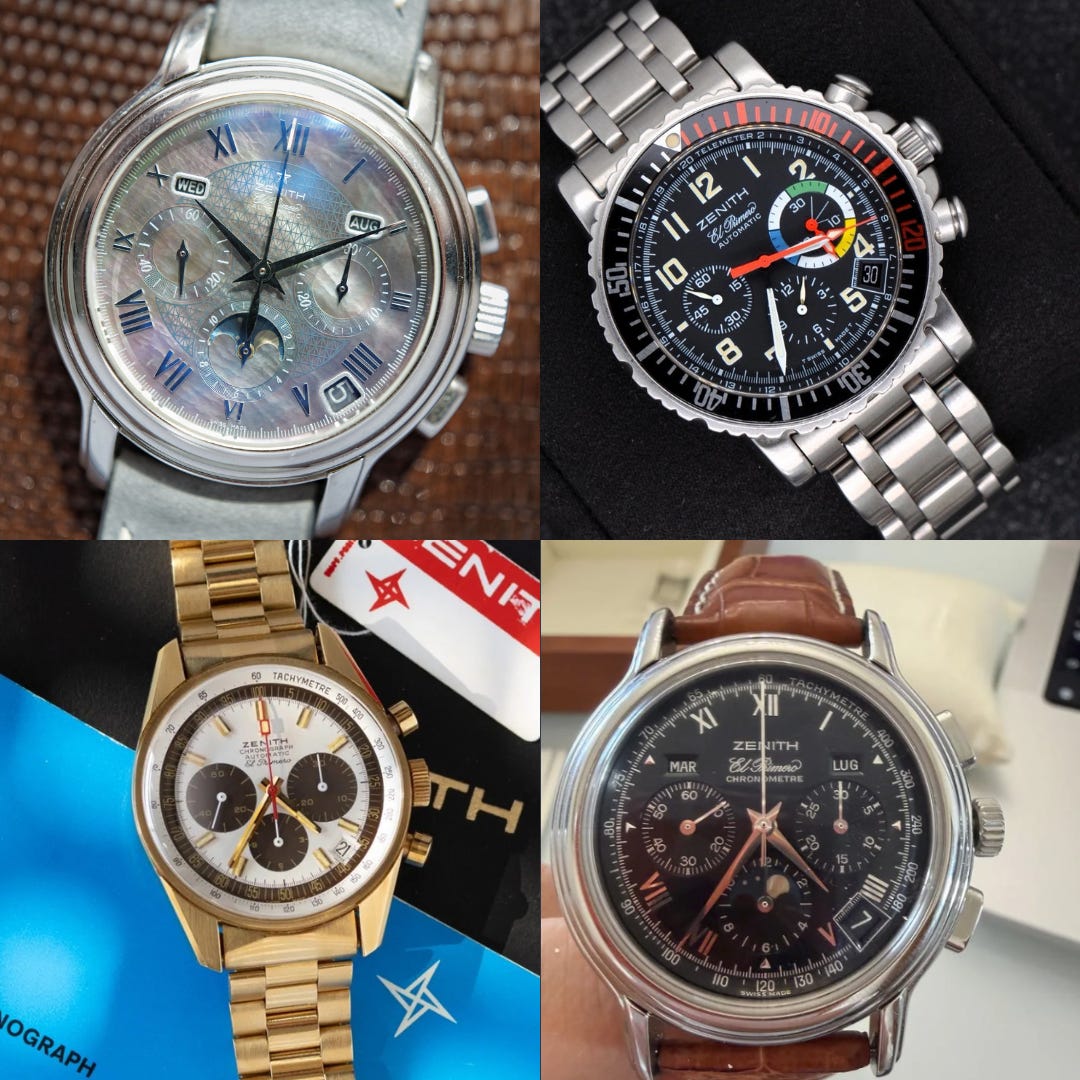
Good afternoon. So-called neovintage watches from the 80s-90s have gotten popular over the past few years, with the focus usually on: (1) complicated watches from Patek Philippe, Breguet, AP, etc., or (2) five-digit Rolex. But I’m equally intrigued by the era’s tool watches from brands like Sinn, Porsche Design–IWC, or Bell & Ross. They often have distinct designs, solid mechanics, and offer a ton of value. That’s the focus of today’s issue: 90s Zenith El Primeros.
📆 CALENDAR OF EVENTS
I’ll be in New York for a couple days for its unofficial Watch Week. Here’s a—surely incomplete—list of some stuff going on. Watchtime (Gotham Hall) and Windup (Center 415) anchor the weekend, but I’ll be at tons of satellite events, some open to the public and others not. I’ve come a few times now, and I think Thursday is the low-key best day:
THURSDAY (10/15)
Cellini Watch Fair, 11-5pm
Indies.NYC, 2:45-9pm (RSVP required)
FHH Summit, 2:30-9pm (RSVP required)
Analog Shift After Hours, 6-9pm (RSVP required)
Papar at Time+Tide, 5-7pm (RSVP required)
FRIDAY (10/16)
Antiquorum preview, 2-5pm
Keris at Time+Tide, 5-7pm (RSVP required)
SATURDAY (10/17)
Antiquorum preview, 1-6pm
The best neovintage El Primeros weren’t made by Ebel.
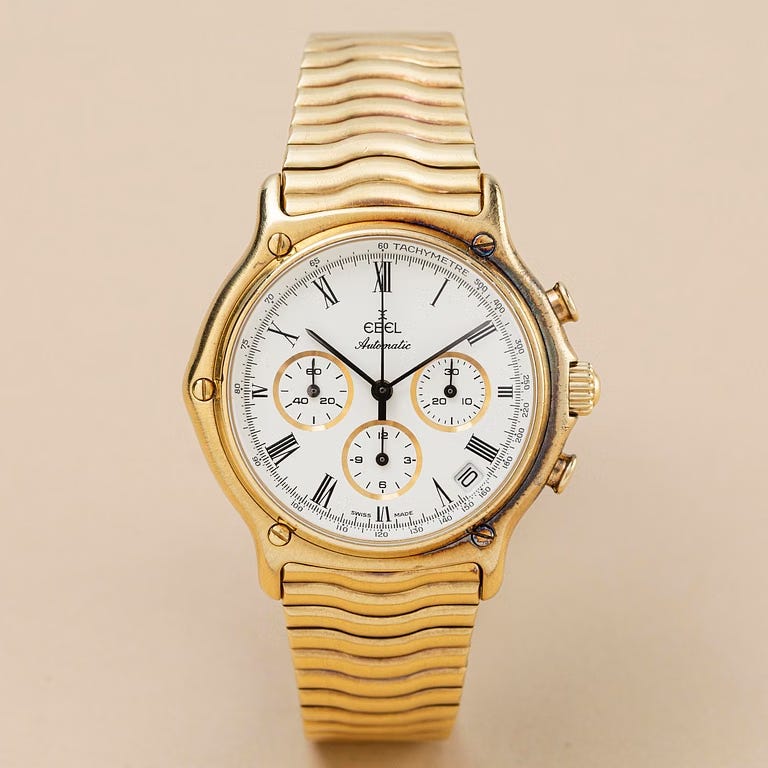
Ebel is one of those neovintage brands people have been trying to “make happen” in fits and starts the last few years. No doubt some of it comes from genuine passion—80s or 90s kids raised in a confusing stew of Rubik’s Cubes, mullets, and Wave bracelets. For others, it’s simply another market opportunity.
Either way, it hasn’t really caught on because, let’s be real, 80s-90s Ebel is mostly ugly. Not ugly-pretty like Porsche Design–IWC or Oakley. Just ugly.
But Ebel and then-CEO Pierre-Alain Blum rightly get credit for knocking on Zenith’s door in the depths of the 80s and placing an order for the then-forgotten El Primero caliber. Rolex followed in 1988 when it finally updated the Daytona. Around the same time, Zenith also brought the El Primero back to its own collection.
LVMH would acquire Ebel and Zenith in 1999. The acquisition prices sound surprising:
Zenith: $48.4m
Ebel: ~$150m
It got Ebel as part of a deal to buy Chaumet (the real prize) for $460m, about one-third of which is generally attributed to Ebel.
It shows you just how little brand equity Zenith had (or has!). Still, I think its neovintage El Primero efforts are more successful than Ebel’s. While Zenith never really carved out a brand identity in the 90s like IWC or Hublot, it was making solid engines. And since Andre Agassi or Sonny Crockett never wore a Zenith, they’re comparatively affordable.
I spotted one of these El Primeros at the last Unpolished meetup here in Chicago, and it got me thinking about the best neovintage EPs. Here they are, followed by a few for sale right now in the Watchlist.
👉 Unpolished doesn’t run brand ads. Members get: (1) Welcome Care Package; (2) 10% off the Unpolished Store; (3) $50 off a Watchcheck service + comments and Q&As. Benefits info HERE.
Zenith De Luca (1988–96)
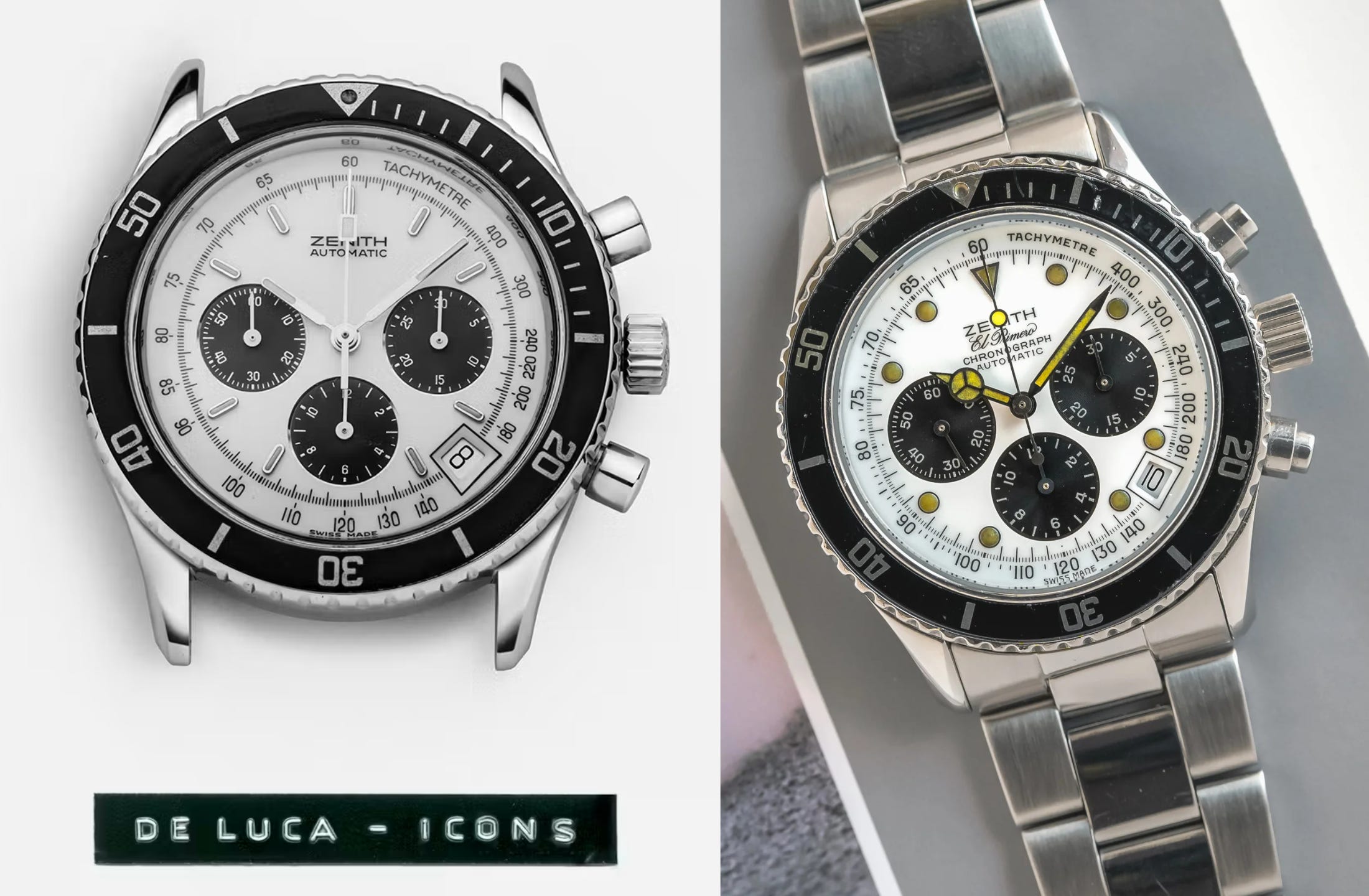
Zenith launched its own sporty El Primero chronograph in 1988, the same year as the Rolex Daytona ref. 16520, and it starts to look a lot like one. The nickname comes from Zenith’s Italian agent, a Mr. Giuseppe De Luca, who pushed the brand to make a chronograph his clients would actually buy. In late-80s Italy, that meant a Daytona.
The De Luca had a 40mm steel case, black rotating dive bezel, and black or white dial with contrasting subdials. Just 6,435 were made from 1988–1996 across four series (4,085 black dials; 2,350 white dials). This low production is probably a testament to Zenith’s relative obscurity more than anything else. It started by using the original El Primero cal. 3019 PHC, which soon became the updated Zenith caliber 400.
Beyond that, there’s tons of variation: text, hands, crowns, screw-down pushers added to later models, etc. The first series is most like a vintage Zenith (it feels kinda like a parts watch), and it slowly evolves into something more modern, which is to say more like a Rolex.
The De Luca is divided into four series, with Marks 1 and 3 the most distinct:
Mark 1 (88–89): The Original
Domed acrylic crystal, paddle or dauphine hands, pump pushers, push-pull crown, no “El Primero” on the dial (ref. 01.0040.400)
Mark 2 (90–92): The Rolex-ification
Mercedes hands, mineral crystal, screw-down crown, steel bracelet option (refs. 01/02.0310.400)
Mark 3 (92–93): The Rarest
Mercedes hands, dot indices, pump pusher “sleeves” (ref. 02.0310.400)
Mark 4 (94–96): The Modern Update
Sapphire crystal, screw-down crown and pushers
I’ll leave production numbers by series in this footnote, but generally, black outnumbers white 2:1.1 Like some Zenith Daytonas, the white dial has a porcelain effect, which I find especially compelling:
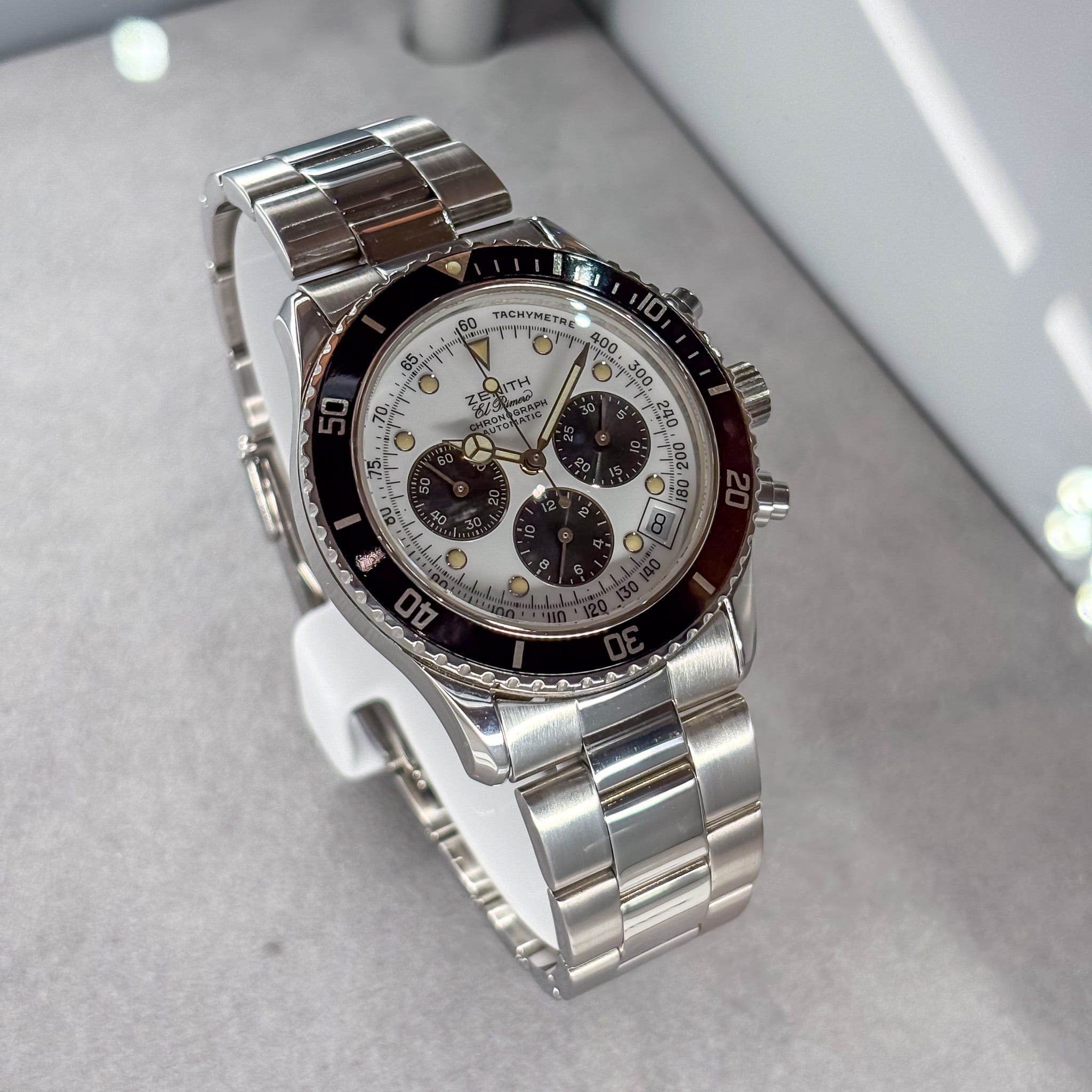
Other collector’s notes:
The De Luca’s rotating dive bezel keeps it distinct enough—and it’s a direct nod to its own Super Sub Sea Chronographs—that it stands on its own merits and isn’t just a Daytona homage. Zenith leaned further into Daytona lookalike territory with the De Luca II and its fixed tachymeter bezel, but those get a little knock-offy for me.
22mm lug width is a bit wide, but the bracelets do taper to a tasty 16mm.
The Mk 3 is my favorite De Luca—the updates make it feel more modern and less like a vintage homage (which the Mk 1 can feel like).
It’s weird to set the El Primero because the date is set with the second crown position, while the time is set in the first position.
Market: The few De Lucas on the market are listed around $6k, with a premium for Mk 1s. They don’t turn up much in North America.
Rainbow Flyback (1997–2000)
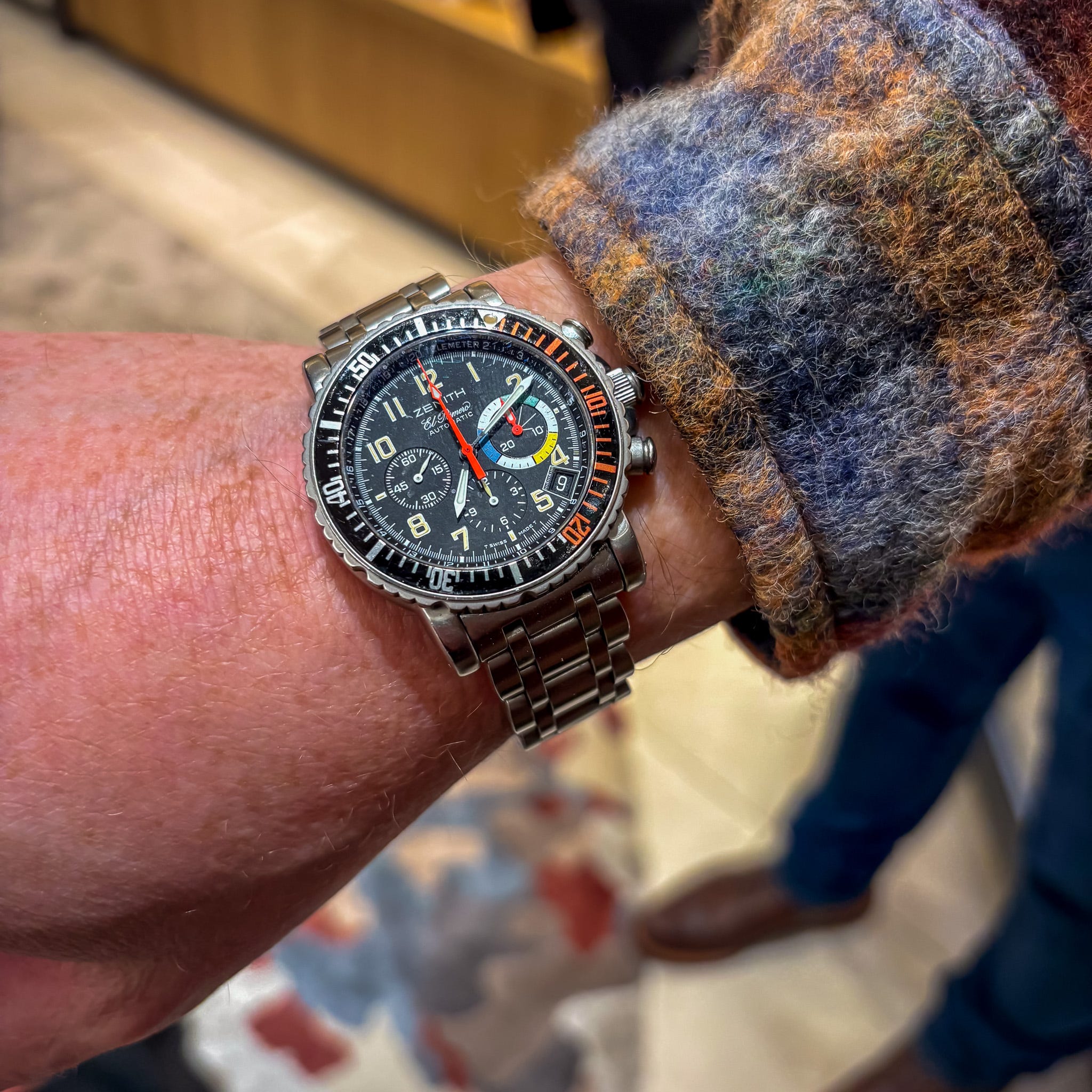
The Rainbow took over from the De Luca as Zenith’s mainline sports chronograph in the 90s, named after some boat that won the 1934 America’s Cup. Zenith’s historian told The Deep Track the name was “chosen to convey the chic and sporty universe of yachting.”
The one to buy is the Rainbow Flyback, ref. 02.0480.405, which Zenith introduced at Basel in 1997.2
Specs: 40 x 12.6mm (it feels chunkier); red chrono hand, minute counter sliced into colorful nautical wedges like a game of Trivial Pursuit
Zenith built the flyback caliber 405, which lets you reset the chrono with a single pusher press, for a French Air Force tender that never really got off the ground—I guess it had to do with military conscription being phased out in France around the same time.
No matter, Zenith decided to produce its colorful new flyback chrono for us civilians from 1997 until the early 2000s:
~5,000 colorful “military” examples were made
Another 4,000 boring black versions were made 🥱
Zenith has at least acknowledged the Rainbow Flyback in the modern era, referencing it with the 2023 Pilot Big Date Flyback, but that release is a bit sad and stale.
Market: Rainbow Flybacks aren’t expensive—under $5,000—but again, hard to find, especially in the U.S. A couple are on the market right now, included in the Watchlist, below.
El Primero Chronomaster Triple Calendar Moonphase (1994–2000s)
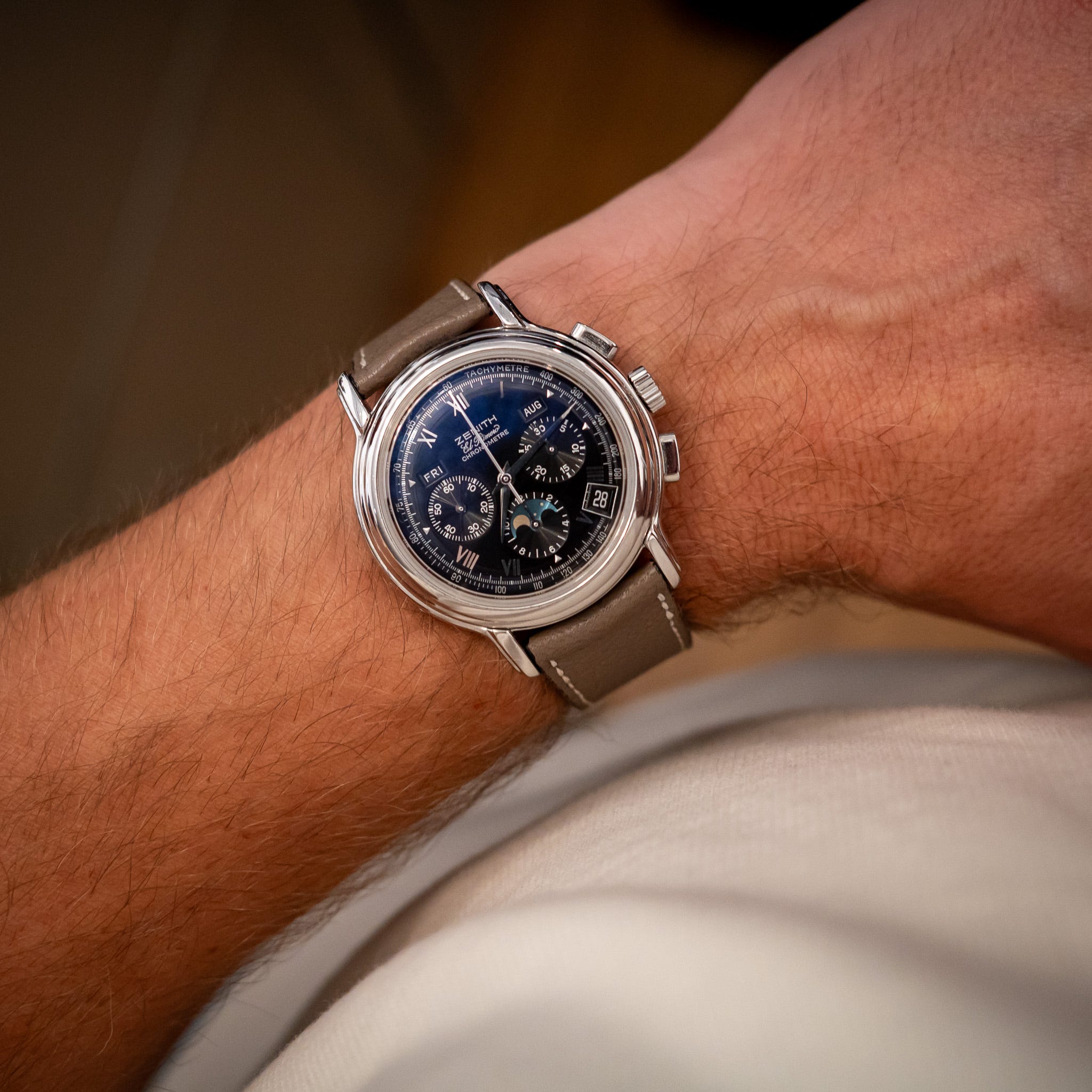
This is the neovintage El Primero that made me want to write this newsletter after showing up at the last Unpolished meetup: an El Primero Chronomaster Triple Calendar.
The deep, glossy black drew me in, but I also think the case is compelling—the stepped lugs and fluted bezel are interesting without overdoing it.
Specs: 40x13mm (manageable 47mm lug-to-lug). The caliber 410 triple calendar chrono is built on the El Primero
Chronometer-certified: The Chronomaster might’ve even been the first time Zenith went to the trouble of getting its El Primero COSC-certified?
Applied Romans and dauphine hands complete the dressy look.
Early Chronomasters (1994–98) are chronometer-certified and say “Chronometre” with an additional number engraved on the rotor, as dictated by COSC. Chronomaster (or ChronoMaster) was an entire collection of chronometers, but the triple cal moonphase is the flagship.
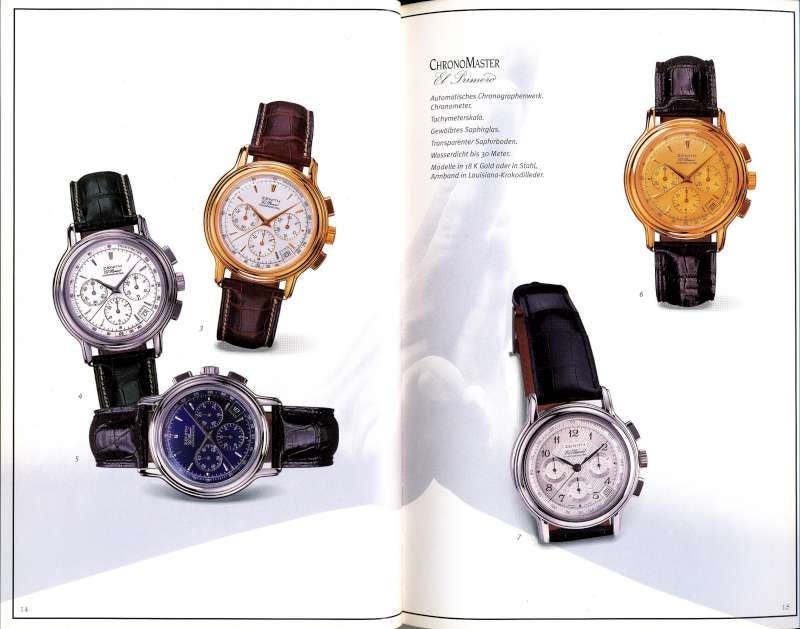
The main steel reference (ref. 01.0240.410) came with a silver or black dial; there was also a gold reference (ref. 30.0243.410).
Things started to change after LVMH acquired Zenith. It discontinued the Rainbow Flyback, but kept the Chronomaster. But it evolved from its classic style to something more modern, with crude guilloche, open-heart dials, and larger cases. Something you’d see at a mall kiosk, not a suave and sophisticated Unpolished event. The absolute legend Thierry Nataf took over in 2001 and turned Zenith into something like haute horology meets Ed Hardy.
Production numbers: Zenith made 24,010 cal. 410s from 1994–2001.3
After the acquisition, numbers become harder to track, in part because Zenith stopped getting COSC certification (tsk tsk).
Of these three El Primeros, the Chronomaster is the one I’d buy.
Watchlist: 6 El Primeros you can buy right now