



Just think about all the midsize time-telling integrated bracelets we’ve gotten over the past few years:
Parmigiani Fleurier Tonda PF 36 (2022)
Vacheron Constantin Overseas 34.5 (2023)
Rolex Land-Dweller (36 w/ 40mm in 2025);
IWC Ingenieur 35 (2025);
H. Moser Streamliner 34 (2026);
Girard-Perregaux Laureato Fifty 36 (2026)
Bulgari Octo Finissimo 37 (2026)
Audemars Piguet and Patek Philippe have long offered a range of sizes for the Royal Oak and Nautilus. We could name others, down to the ubiquitous Tissot PRX.
These midsizers are often advertised—and priced—as the sized-down equivalent of their big brothers. For example, the Vacheron Constantin Overseas 41mm is $29,200 and the 34.5mm is $26,600.
But are they really the same? Salim (The Deadbeat Seconds) recently noted the discrepancy between Overseas movements:
41mm (cal. 5100): Geneva Seal, 60-hour power reserve
34.5mm (cal. 1088/1): non-Geneva Seal, 40-hour power reserve
The caliber 1088 is compact and industrial, based on a Richemont-owned ValFleurier movement. In addition to better performance, the larger caliber 5100 shows the hallmarks of high-end industrial finishing and architecture:
🎁 Unpolished Members get: (1) Welcome Care Package; (2) 10% off the Unpolished Store; (3) $50 off Watchcheck, + 2 newsletters/week, comments, and Q&As. Find info on all your benefits HERE.
NEW! Buy a 3 Canvas Strap Bundle for just $159 in the Unpolished Store.
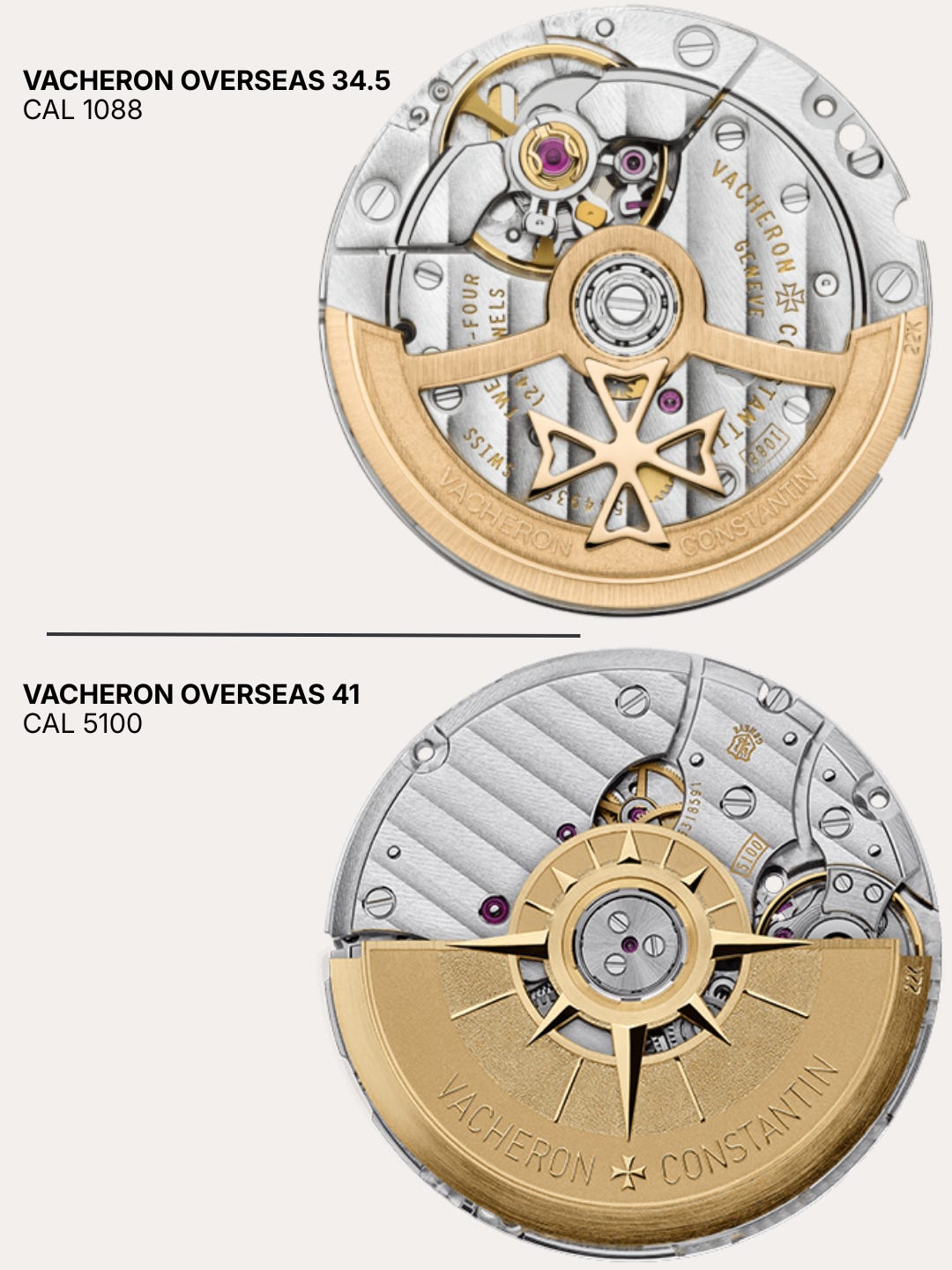
Similarities: Both have a soft iron casing ring to increase anti-magnetism. Both movements are index-regulated: the cal. 1088 has an Etachron-style regulator, while the cal. 5100’s regulator is built and finished to meet the Geneva Seal.
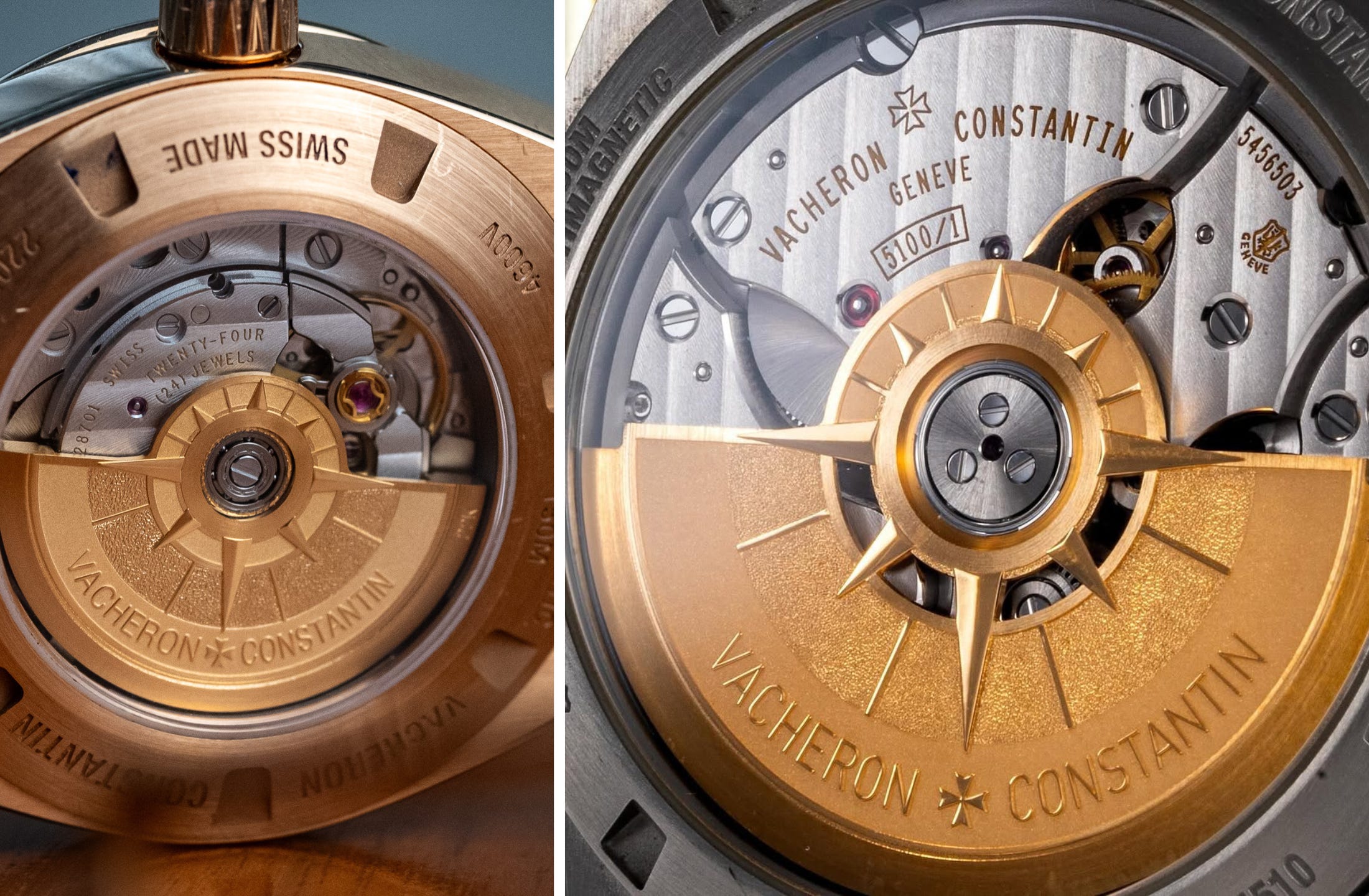
Finishing: The cal. 5100 has twin barrels; a more complex bridge architecture with wide, polished anglage; mirror-polished screw and jewel sinks, along with polished screws. In contrast, the ValFleurier cal. 1088 has a simpler layout with narrower bevels and unpolished countersinks. The cal. 5100’s Geneva stripes are crisp and broad, giving the entire movement more of a glow:
Movements are just one part of a watch, and with integrated bracelets, fit and finish of the case and bracelet are also important. We want the design, the vibe, the tie to Gerald Genta (or whoever).1 But movements still matter.
Many of you know my penchant for smaller watches, so I get asked about these a lot. Many/most brands didn’t start taking midsize watches seriously again until a few years ago. That meant finding external or shared suppliers—Vaucher and ValFleurier appear a few times below—for movements to fit these slimmed-down dimensions.
And that means trade-offs.
Take Audemars Piguet: When AP updated the Royal Oak in 2022, it chose the calibers 5800/5900 for the midsize. They’re based on Vaucher movements, the same used by the Parmigiani Tonda PF 36. But they were chosen for their thinness—just 3.9mm—compared to the AP caliber 3120 (4.26mm) in the previous generation. Thinness is more important than some blind obligation to “in-house,” so it’s a reasonable trade-off.
But does the price follow? The Royal Oak 37 is 95% the price of the 41. The Overseas, Tonda PF, and Ingenieur are ~90% of their full-size counterparts. The Streamliner 34 costs exactly the same as the Streamliner 40. One brand charges 93% and gives you the exact same caliber—no compromise. You can probably guess which one wears that Crown.
But that’s just one percentage. The other one is harder to put a number on: How much watch are you actually getting?
Below: How Rolex, Patek Philippe, Vacheron Constantin, Audemars Piguet, Parmigiani Fleurier, IWC, and H. Moser approach the movements in their integrated-bracelet collection. Plus, two brands I think do it best.
DIFFERENT MOVEMENT, REAL DOWNGRADE
Vacheron Constantin Overseas
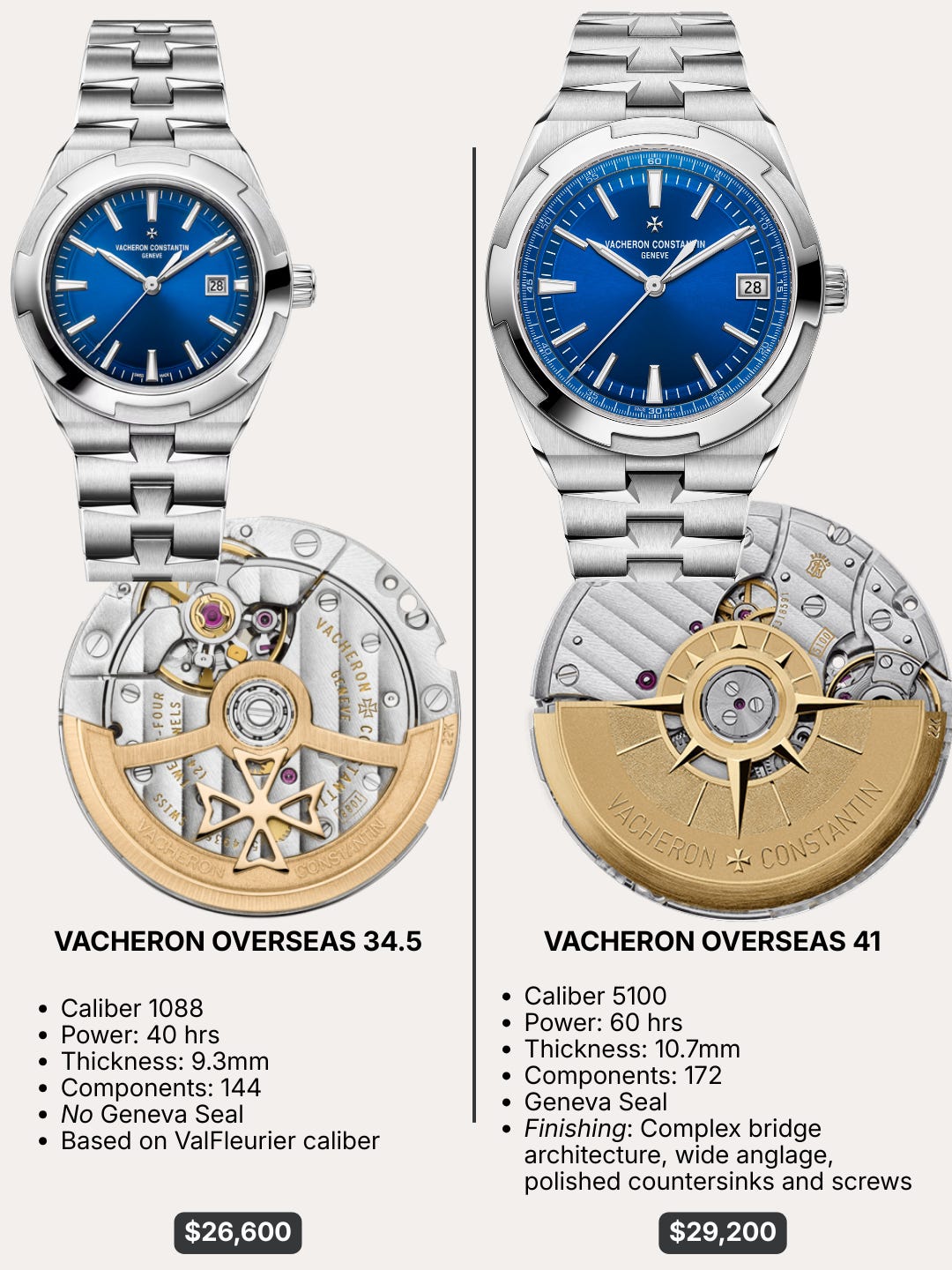
41mm ($29,200) vs. 34.5mm ($26,600; 91% of full-size price): As discussed, the Overseas 41 features the top-line cal. 5100, the only movement in our survey with the Geneva Seal—an external set of requirements largely related to finishing and available to watches made in Geneva. The cal. 1088 is serviceable, but it’s a clear step down from the cal. 5100.
IWC Ingenieur
A performance compromise
