


The “collectibility” of a watch isn’t exactly linear. It’s not as simple as watch + time = collectible.
Instead, there’s an Uncanny Valley for watches after they’re discontinued. A period when they’re not new anymore, but not old enough to be vintage or collectible. They’re just used or pre-owned, doomed to wallow away in obscurity on Luxury Bazaar or TheRealReal.
Most commonly, the “uncanny valley” is the idea that as a human-like robot becomes more life-like, our reaction shifts from empathy to revulsion. As robots become more like us, but not quite close enough, they just get creepy. Something like this:
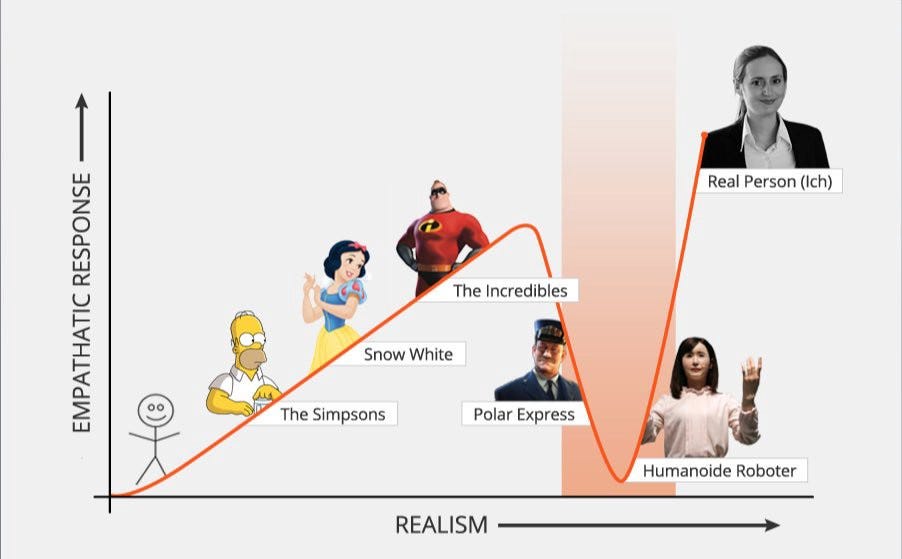
It’s not quite the same, but watch collecting has its own Uncanny Valley.
The typical lifecycle of a watch is something like this:
Watch is released, it steadily grows in popularity as awarness spreads. Sometimes this reaches a fever pitch, which we call “hype.”
Watch is discontinued, the hype dissipates, most of us move on to the next shiny whatever.
Watch falls into the Uncanny Valley. The previous generation starts to feel obsolete.
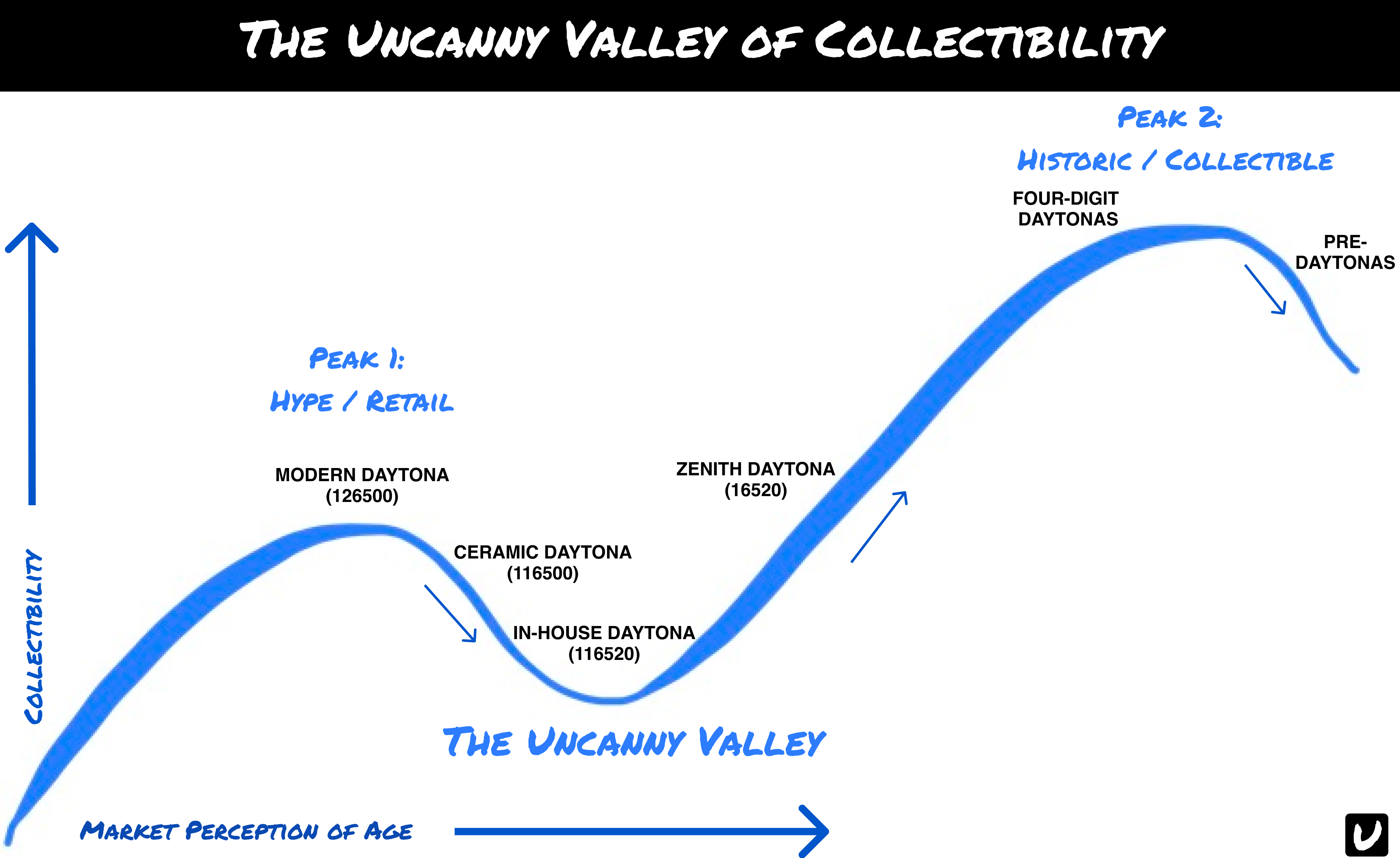
Take the ceramic Daytona. When Rolex introduced the updated Daytona in 2023 (ref. 126500), the subdials and lack of outer bezel ring on the previous version (ref. 116500) suddenly felt off or kinda creepy.
The older iteration starts to trade for less than the current one. It’s technically inferior to the new Daytona, but spiritually inferior to the vintage one. After all, who wants some used Daytona from 2018?
Watch is rediscovered. With the benefit of time, it’s understood as something different—like a 60s Daytona. They rise out of the Uncanny Valley and sit atop an even higher peak.
Here’s the entire Daytona lineage, mapped onto this lifecycle of collectibility:
The Uncanny Valley is so interesting because it’s where the opportunity lies.
When people ask, “What’s the next big thing?,” they’re often asking about the watches languishing in the valley.
Some rise out of it. They shed their “used” label and reemerge on the other side as vintage, collectible, classics. Over the past few years, we’ve seen it happen with some watches from the 80s and 90s, notably the Patek Philippe 3940, 3970, or early Brass-era Journe.
These used to be just old Pateks or Journes, stuck in the middle. But with the benefit of time, they’re seen as foundational to the modern era.
Just last week, a Patek Philippe 3940 Beyer First Series sold for $1m. Ten years ago, that was a $50k watch; even three years ago, it was $300k.
Then, the 3940 began its rapid rise out of the Uncanny Valley. It went from being a pre-owned Patek (gross!) to a Modern Classic That Defines the Philippe Stern Era, Perhaps the Last in a Lineage of Classic Perpetual Calendars. Oh, and Did You Know Philippe Stern Himself Wore a 3940?
Why do certain watches rise out of the Uncanny Valley, while others remain stuck?
With some watches, it’s inevitable—the Rolex Daytona or a complicated Patek Philippe is a pretty sure bet. Still, it can take a generation, sometimes more, for enthusiasts to figure out which watches from a previous era actually matter. It’s like a filter. All the out-of-production watches get poured into the top of the filter, but only some come out the other side.
It reminds me of music, where most of the value is in the back catalog. It’s not that music was better 20 or 40 years ago; it’s just that we only remember the good stuff and forget about the rest. I love listening to old Lil Wayne, but forget about all those crappy DatPiff mixtapes he dropped every other week in the 2000s.
Zooming out beyond Lil Wayne or the Daytona, here’s how I think about the Uncanny Valley of Collectibility:
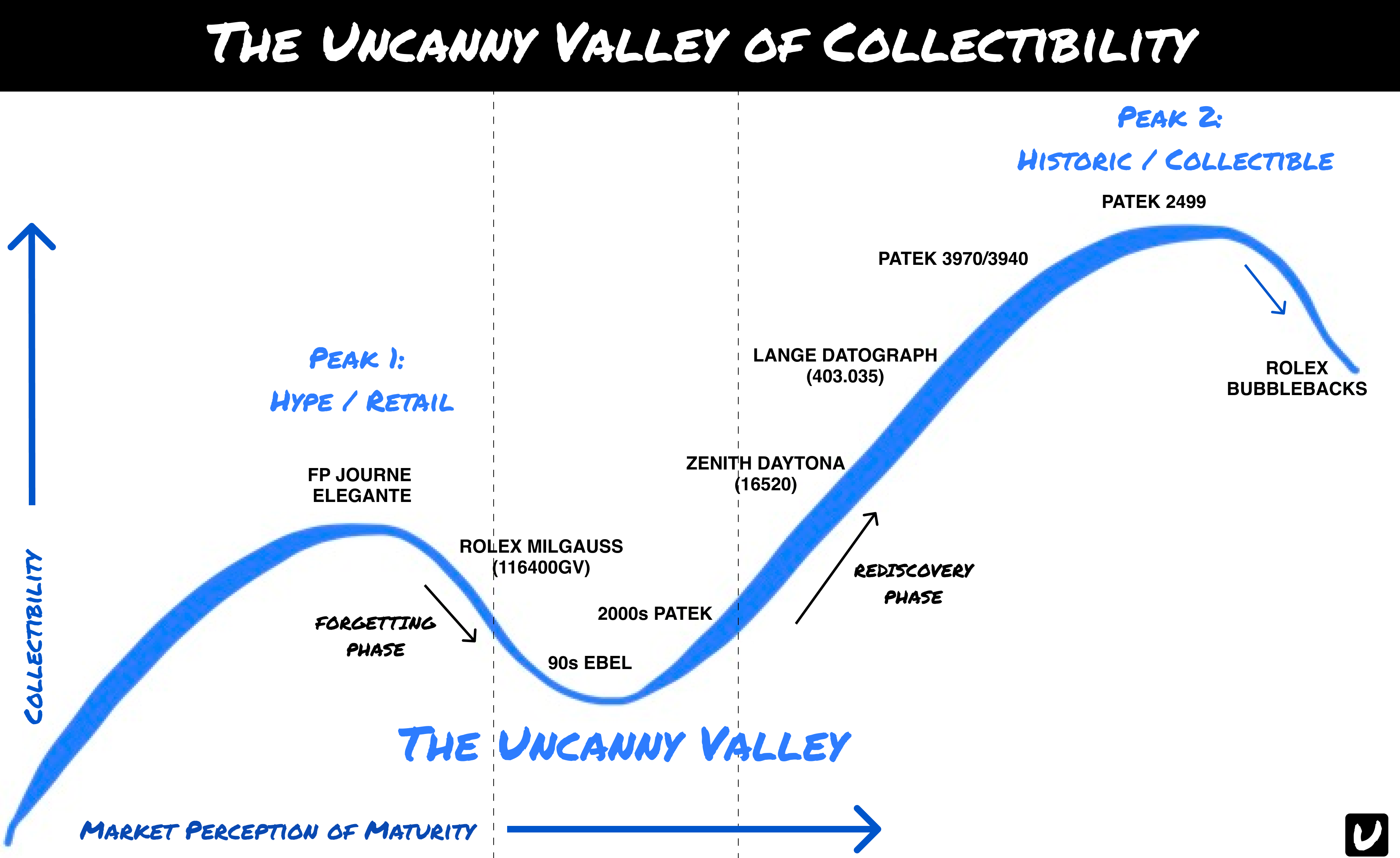
Besides those fancy Patek Philippes, other watches are in the rediscovery phase: ultra-thin QPs from Vacheron and Audemars Piguet; the original Breguet Tourbillon (ref. 3350). Indies are a different category, but early Roth or Dubuis, alongside Journe.
We’ve also seen watches bubble up but fail to reach escape velocity: Ebel, Franck Muller, Blancpain.
Why do some of these watches rise out of the valley while others remain stuck?
I think about a few factors:
[Below: five factors for thinking about how watches can escape the Uncanny Valley, along with a few that might be next to rise out of it.]
