


I spent last weekend in Houston, where I’m happy to confirm the two-tone Rolex-as-status-symbol is still very much a thing.
In today’s newsletter: Diving into the origins of the world timer at Louis Cottier’s Carouge workshop, why I’m pro pusher, and the modern taxonomy of travel watches. Plus, a shortlist of vintage world timers for the rest of us, what a $4.8m price drop says about how collecting tastes change, and how Tissot "hacked" the Cottier mechanism to build the first mass-produced navigator. We end with a game of “Spot the Difference.” Before we get to world timers—
Cartier, Explained: I filmed a 45-minute video with Teddy Baldassarre’s team all about Cartier. You have to hand over your email to watch it, but hopefully it’s a solid intro to the brand if you’re new or newish to Cartier. The shooting and production from Teddy’s team are impressive—I won’t speak to the on-screen “talent.”
Miami Beach Antique Show—panel and free tickets: I’ll be in Miami at the Miami Beach Antique Show this weekend, where I’m also moderating a panel with Tania Edwards (Collectability), Morgan Cardet (Matt Bain), and Mike Nouveau on Saturday at 3pm. Come say hey if you’re around. I also have a code for free tickets that I’ll leave in the comments of this post (not an ad, it’s just a fun show!).

Unpolished is the newsletter for watch collectors, and a top-20 Fashion & Beauty Substack. Join 1,000+ subscribers for free, or get all the good stuff for $8/month
Let’s talk about the world timer.
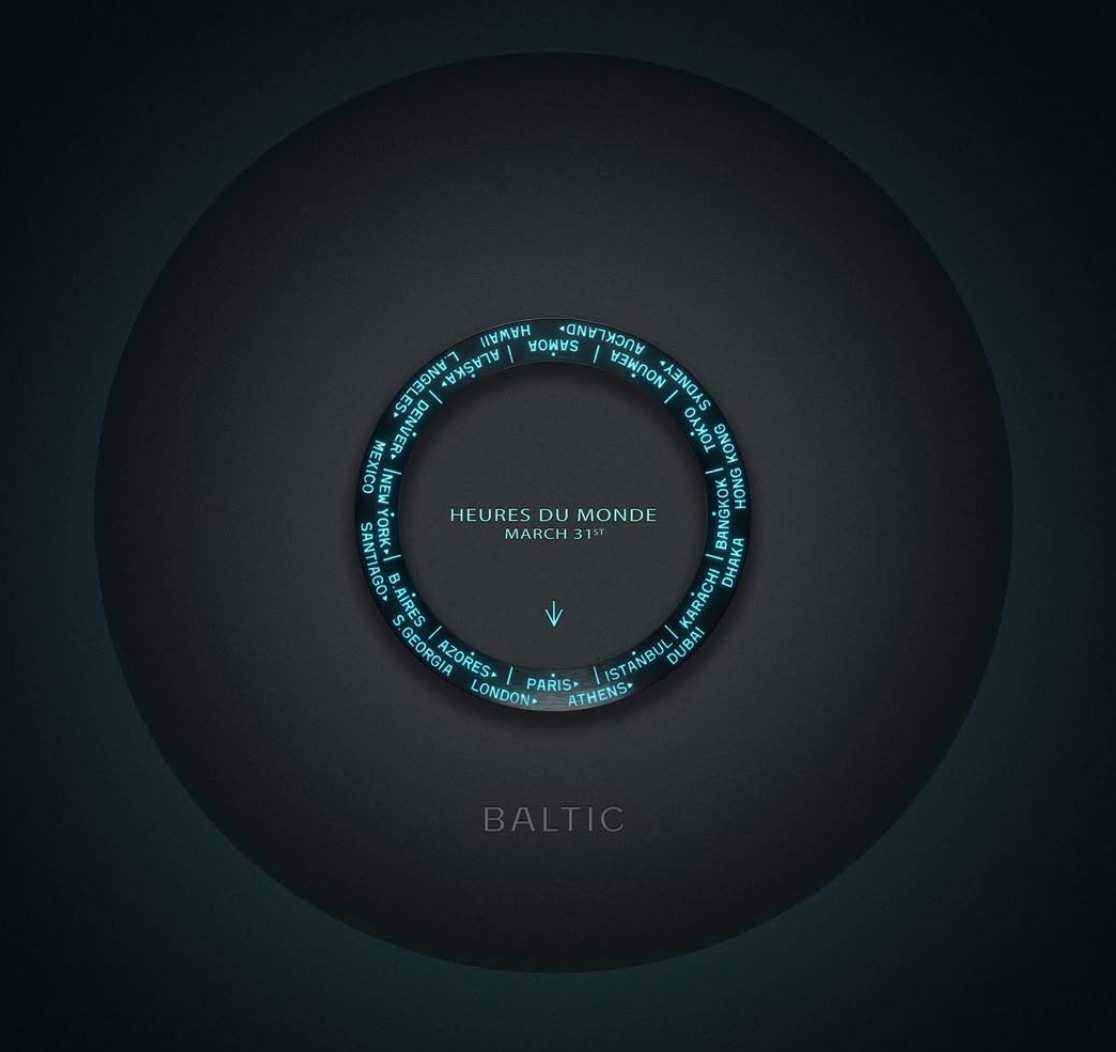
A couple of big-time vintage world timers are coming to auction this spring. For the rest of us, Baltic is teasing a new world timer-style release on March 31. As I’m finishing this letter, independent watchmaker Andreas Strehler just announced his new Säntis World Time.
We often focus on Patek Philippe perpetual calendars and chronographs as the pinnacle of collecting, but some of its most drool-worthy creations (rarest, most beautiful, super expensive) are world timers.
In 1931, Geneva watchmaker Louis Cottier invented a simple but brilliant world-time mechanism that uses a rotating 24-hour ring to track the world’s time zones at a glance. Simply align your city to 12 o’clock and set your local time. The hands turn clockwise, while the 24-hour ring rotates counter-clockwise once per day, geared to track time zones across the world.
Even today, this rotating 24-hour ring is called a Cottier-style mechanism.
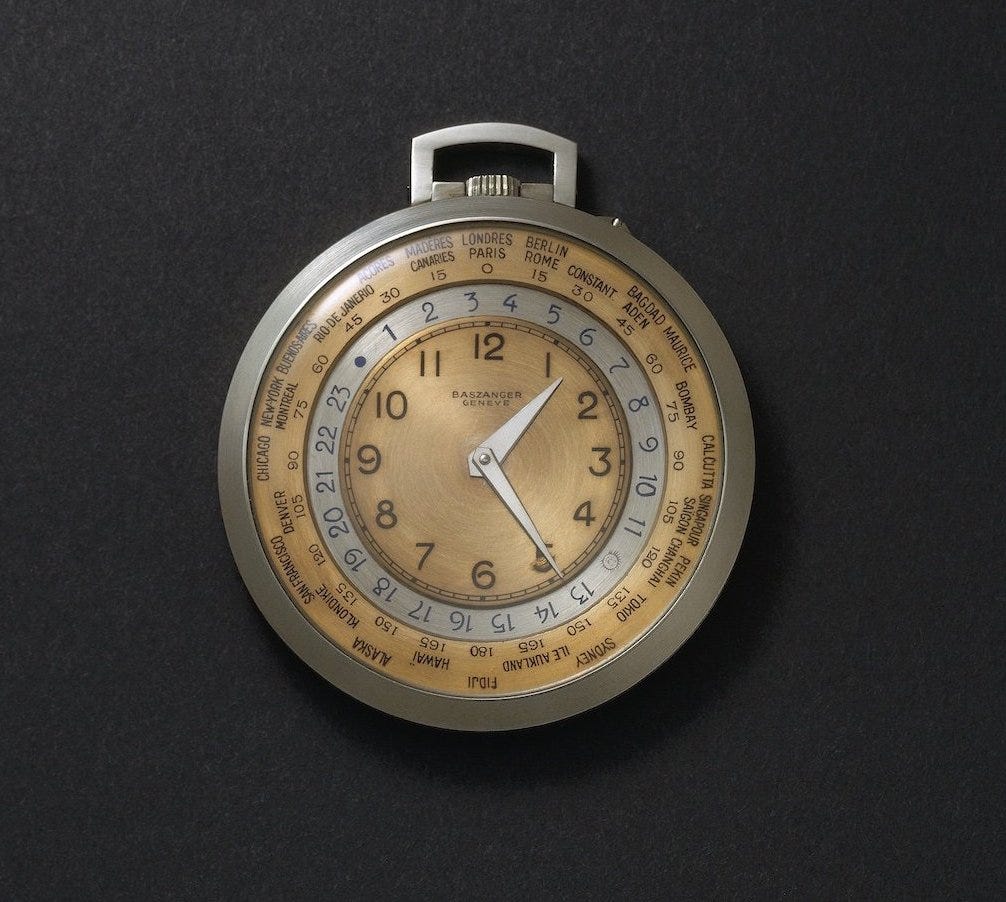
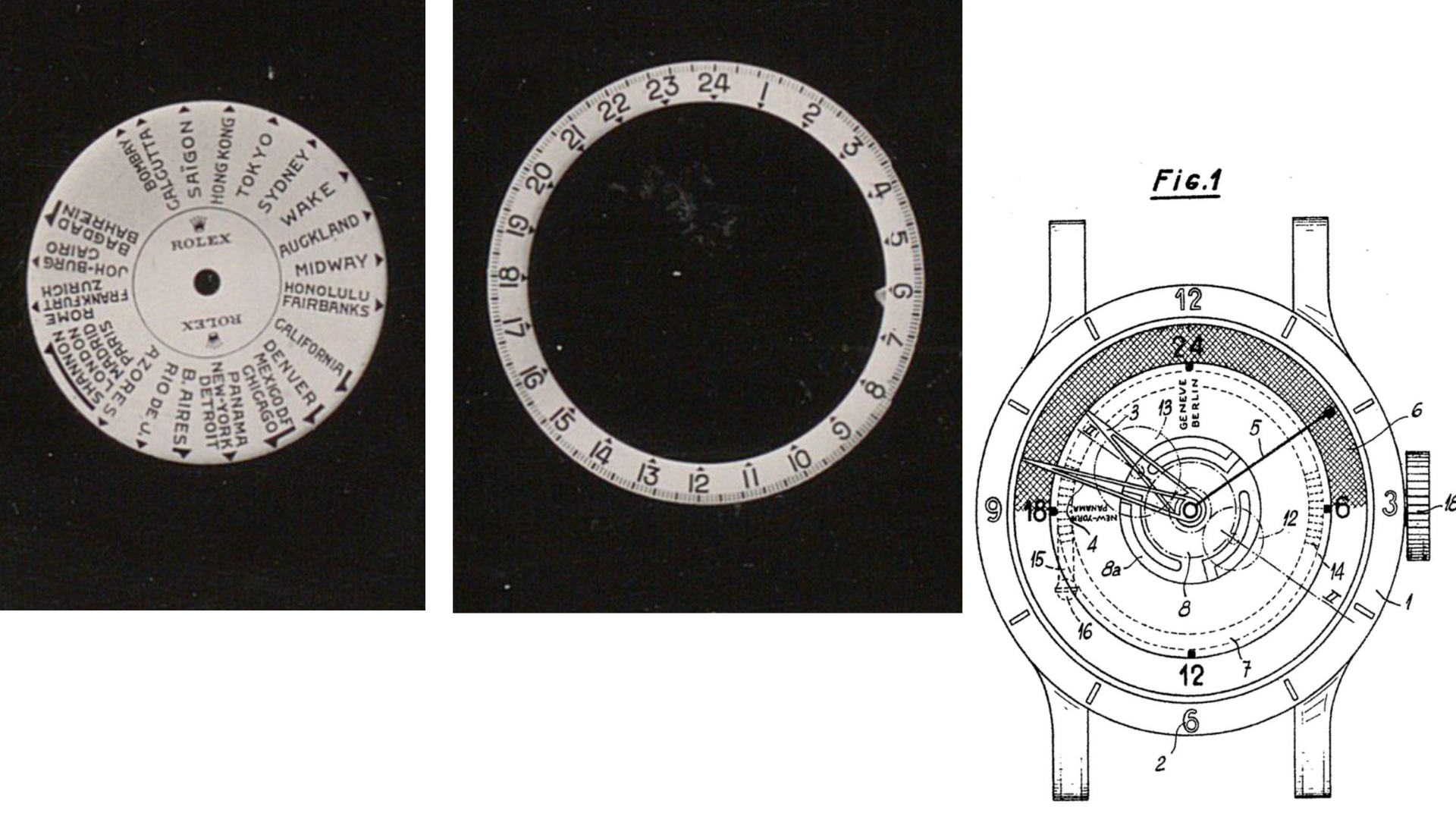
Cottier owned his patent and made world timers for Vacheron, Agassiz, and others, but his mechanism became most associated with Patek Philippe.1 From 1937 until his death in 1966, he delivered about 380 movements, mostly world timers, to Patek. He was also one of the few watchmakers whom Rolex founder Hans Wilsdorf trusted with his personal collection.
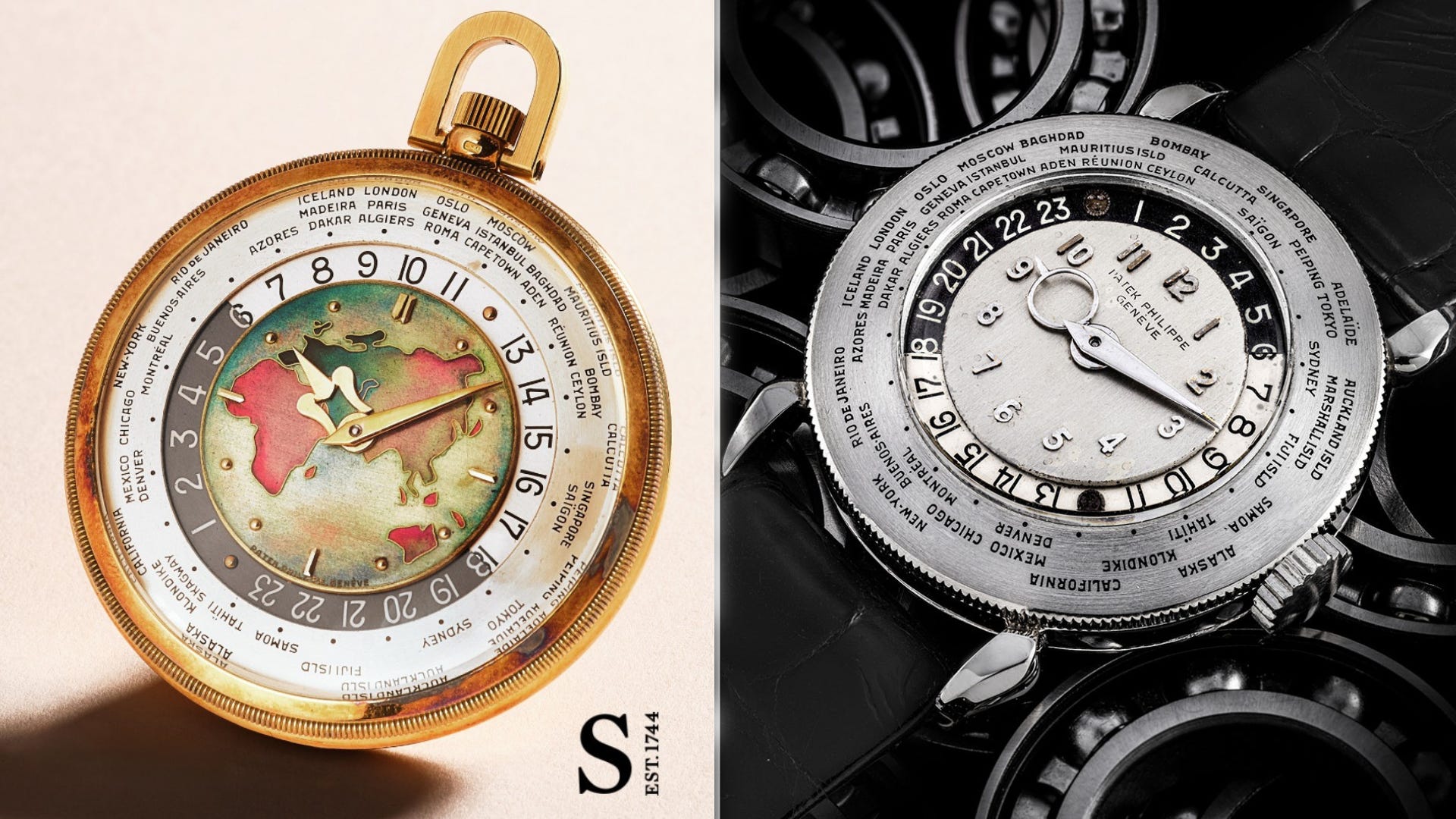
Cottier’s modular mechanism was delicate, so all these watches were hand-assembled at his Carouge workshop. He also made the hands, which explains their beautiful variety. His world timer production for Patek Philippe breaks down like this, some of the lowest production watches the brand ever made:
Ref. 605 pocket watch: ~90
Ref. 1415 wristwatch: ~115
Ref. 2523 and 2523/1 wristwatch: ~40
After Cottier died, Patek didn’t make another world timer until 2000, when it introduced the ref. 5110, improving on the Cottier mechanism by adding a pusher at 10 o’clock to quickly set the time, 24-hour, and city rings.
Anyone got the time in the Azores?
Not all “world timers” are the same.
I’ll admit: I find many multi-time zone watches kinda contrived. It’s not necessarily the act of wearing a GMT-Master II while you take a business-class flight from ORD to Sacramento to spend a couple of nights at the Fairfield Inn—of course, wear your watch for its intended purpose. But when I spot someone at the airport taking their watch off to set the time, it can feel like putting on an affectation, i.e.:

This is obviously a me problem. Lucky for me, in the late 50s, Cottier developed another dual-time mechanism for Patek Philippe: adding two pushers on the case to advance or retreat the hour hand instantly. It was introduced in the Patek Philippe ref. 2597 Heuere Sautante (jumping hour, or Cross Country in the U.S.). Importantly, this meant: (1) you didn’t have to disturb the seconds hand when hopping to a new time zone; (2) some guy who writes a newsletter wouldn’t take a creepy photo of you at the airport. Cottier modified only about 100 movements for Patek Philippe with his jumping hour module. Either a coincidence or borne of commercial expediency, it more or less replaced the world timer in the catalog.
I’m pro pusher: The best multi-time zone watches don’t need to be taken off your wrist to be set. Click a few buttons, and you’re done, without having to make a whole show out of it.
I know everyone wants crown-operated everything nowadays, but I love a good pusher. Who’s got time to take their watch off and fiddle with a crown? It’s why the Nomos Club Sport Worldtimer, Patek 5110 (and 2597), even the innovative Breguet Hora Mundi (if it didn’t have a face only a mother could love), are my favorite kind of travel watch.
Touchscreens have cruelly taken most of our beautiful, tactile buttons without asking. Our fidgety hands are left with nothing to push, and mechanical watches are the last objects that offer that real, tactile clack (if, for you, that satisfaction comes from the click of rotating a crown—great!)
Cottier’s original mechanism is a world timer in the truest sense, mechanically tracking time zones with its rotating 24-hour disc. But starting in the 50s, other watchmakers began making their own GMT or multi-time zone watches.
Rolex never made a world-time wristwatch, instead introducing the GMT-Master in 1954. The GMT-Master, Patek’s Heuere Sautante, and the dozens of similar watches seem to recognize that, as nice as it is to know the time in the Azores, most of us really only want to know the time in two or three locations. Or at least, that’s all our eyes can manage.
Since about 2018, tons of more affordable GMTs and travelers’ watches have hit the market, thanks in part to new movements from Miyota, Sellita, and ETA. There are a few main flavors:
Independent 24-Hour Hand (“Caller” GMT): An additional 24-hour hand that can be set from the crown allows you to track a second time zone.
Independent 12-Hour Hand (“Flyer” GMT): While there’s an additional 24-hour hand, the local hour hand is set with the crown. Convenient for flyers.
The Dual Time That Looks Like a World Timer (the “Geographic”): These watches have a world-time ring, but it’s used as a reference to set the time. Think of the Nomos Club Sport or Lange Worldtimer. Unlike a true Cottier timer, the world-time ring isn’t geared to move on its own—the wearer rotates it via a pusher or crown to set a reference time. It’s somewhere between a dual-time and a worldtime—the Jaeger-LeCoultre Geographic might’ve been the first to use this setup in the 90s (?), so I think of it as the geographic style.
There are other variations on this theme. Farer and others have made clever tweaks to a caller GMT movement to display 24 time zones; others add a rotating world time bezel to a caller GMT as a reference (Baltic’s approach, from the looks of it).
Just as there’s no wrong way to travel, there’s no wrong way to “world time,” whether or not you can actually tell the time across the world at a glance.
The Original Jet-Set Class
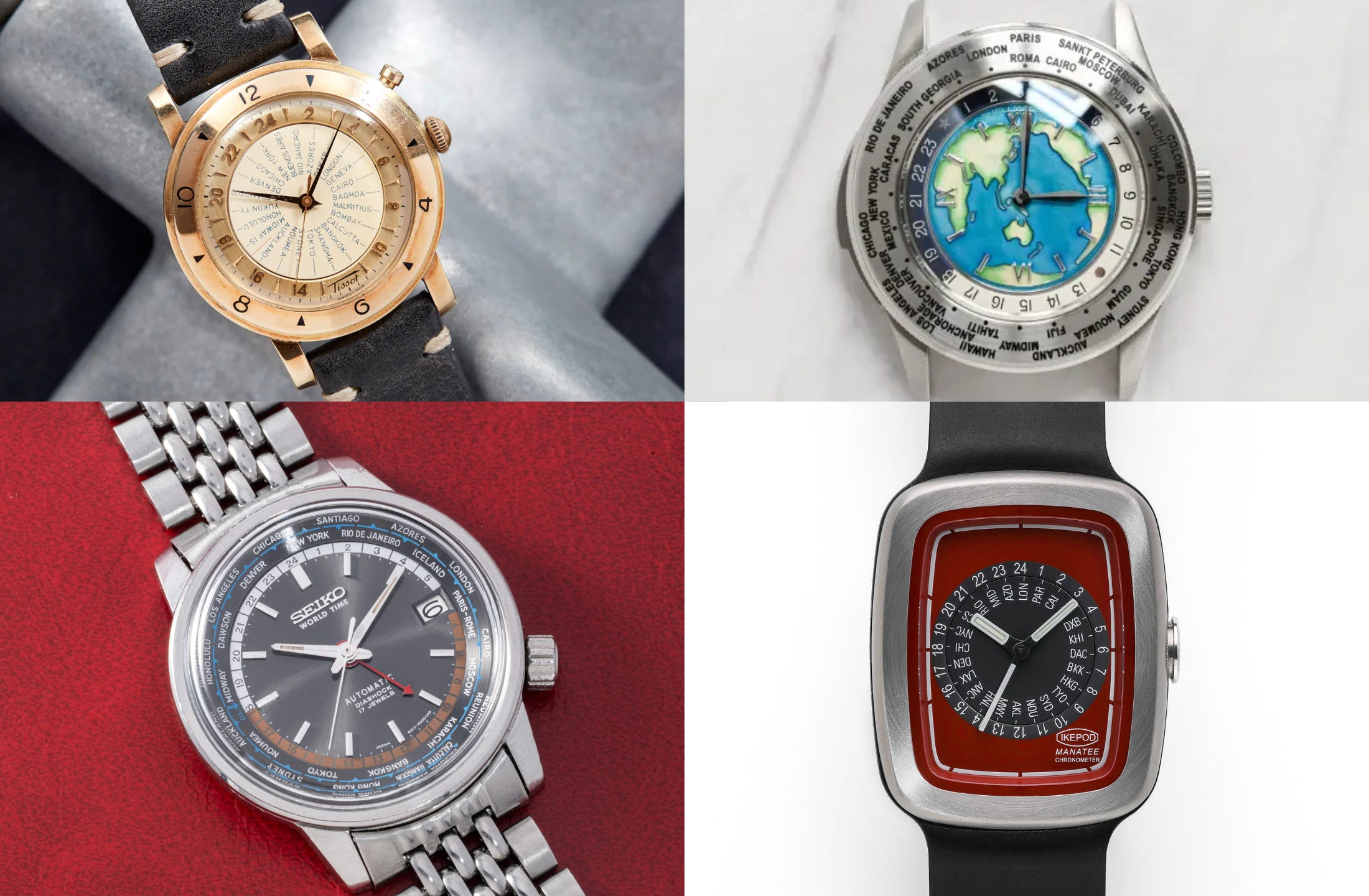
It’s not all Patek Philippe when it comes to vintage world timers. Here are a few favorite older takes on the complication:
Tissot Navigator. The 1953 pioneer, invented by legendary watchmaker Oscar Walden—it brought the Cottier world-time layout to the "everyman" while maintaining a mid-century jet-age aesthetic. More on the Navigator below.
Andersen Geneve World Timers. Feels like the indie watch world’s spiritual successor to Patek Philippe. Svend Andersen fell in love with the complication while at Patek, and once he broke out on his own, he made his first world timer, the Communication, in 1990. The Christopher Columbus from 1992 is a personal favorite—with one just selling for $20k at Phillips, I hope these aren’t passing me by.
