


I was in Michigan last week and came home to a pile of packages that would suggest a low-level problem with frivolous spending. But buried in the heap of one man’s trash was a thin book set I’ve been hunting for a while: Rolex Jubilee Vade Mecum (Latin for “go with me”). Before that—

The Roundup
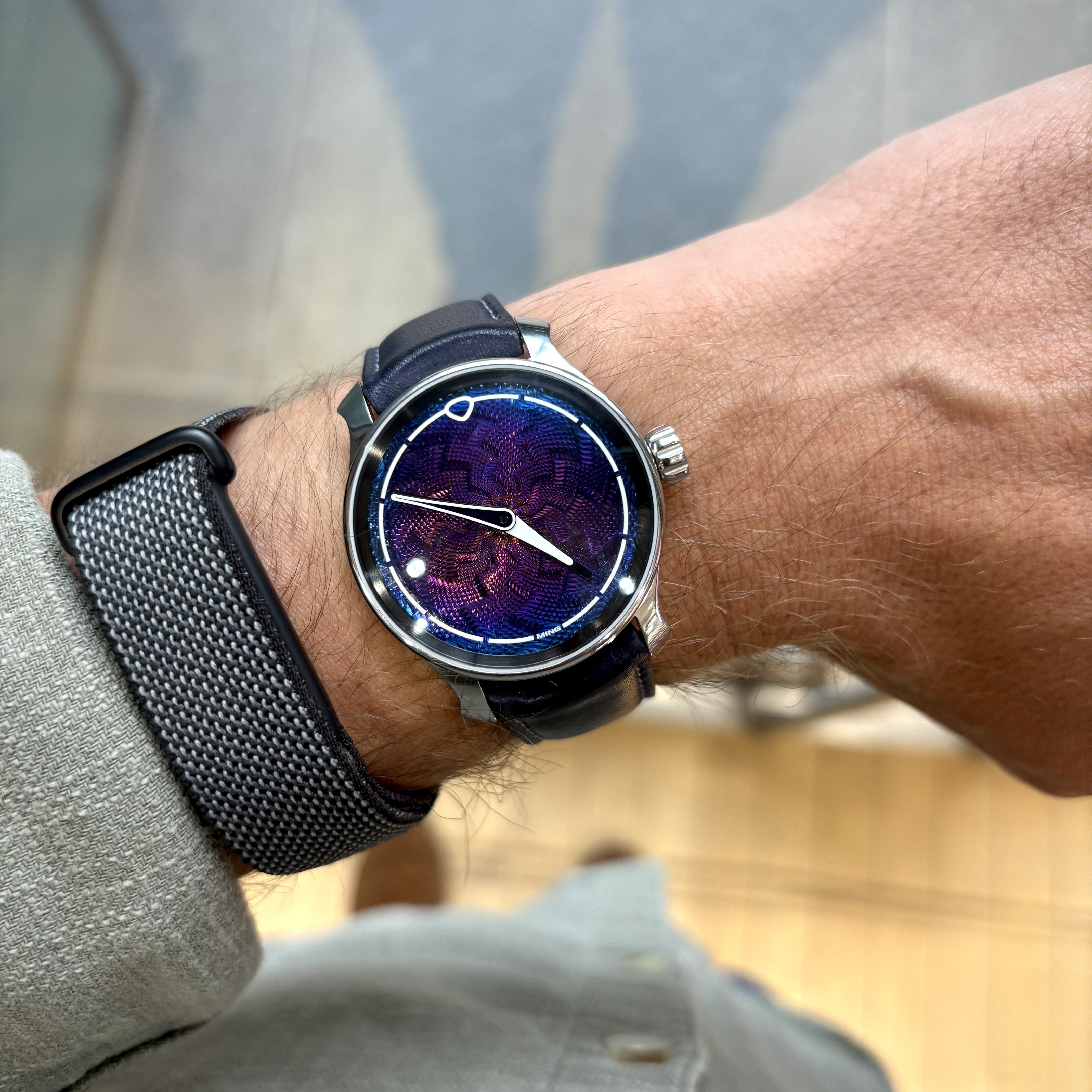
⚡️ The new Ming x J.N. Shapiro. I had the chance to see the new Ming x J.N. Shapiro Lightning, which features a titanium guilloche dial that’s turned by Josh Shapiro and then heat-treated by Ming Thien. It’s a smart way to bring Josh’s old-school guilloche work into Ming’s modern world. In press images, the dial looks super vibrant, and it can be. But as you can see above, it’s also subtle at certain angles and in certain light. Something I wouldn’t mind wearing one bit. Other watchmakers have toyed with turning titanium blue under high heat, but not like this. It’s a clever mix of old and new processes, of Shapiro’s handwork and Ming’s science experiments.
Sometimes, watchmakers are so precious about “craft,” but the Lightning shows Shapiro and Ming just want to make cool sh*t. The Lightning is currently sold through the next couple years of production—it’s limited by production, but not a limited edition. Ming says that probably means ~10 dials a month. CHF 6,250—More on Ming.
⚙️ The newest Claude model renders a fully functional mechanical movement. Pretty cool.
🎧 Bonus Podcast: This week, I published a “bonus” episode with Trevor Wynn, host of Paré Paré Podcast. Trevor was in Chicago during Memorial Day weekend, so we sat down for a short chat at Huckberry after filming a YouTube video. We talk about Trevor’s brief foray into acting, leaving your passion behind, some of our favorite 1990s watches from Rolex, IWC, TAG Heuer, and more, and other updates to Trevor’s collection.
Listen below or find the feed on Spotify / Apple / RSS:

Subscribers also get (1) 10% off in the Unpolished Store, (2) $50 off a service at Watchcheck, and (3) access to all comments and Q&As.
Rolex, in the Founder’s Own Words | Ref. 05
The Ref is a weekly story about a sometimes-forgotten watch or moment in history. Sunday is the perfect time to step away from the feed for a few blissfully naive minutes to remember the watches that were. Ref. 05 takes a look at Rolex, in the words of its founder. Previous editions:


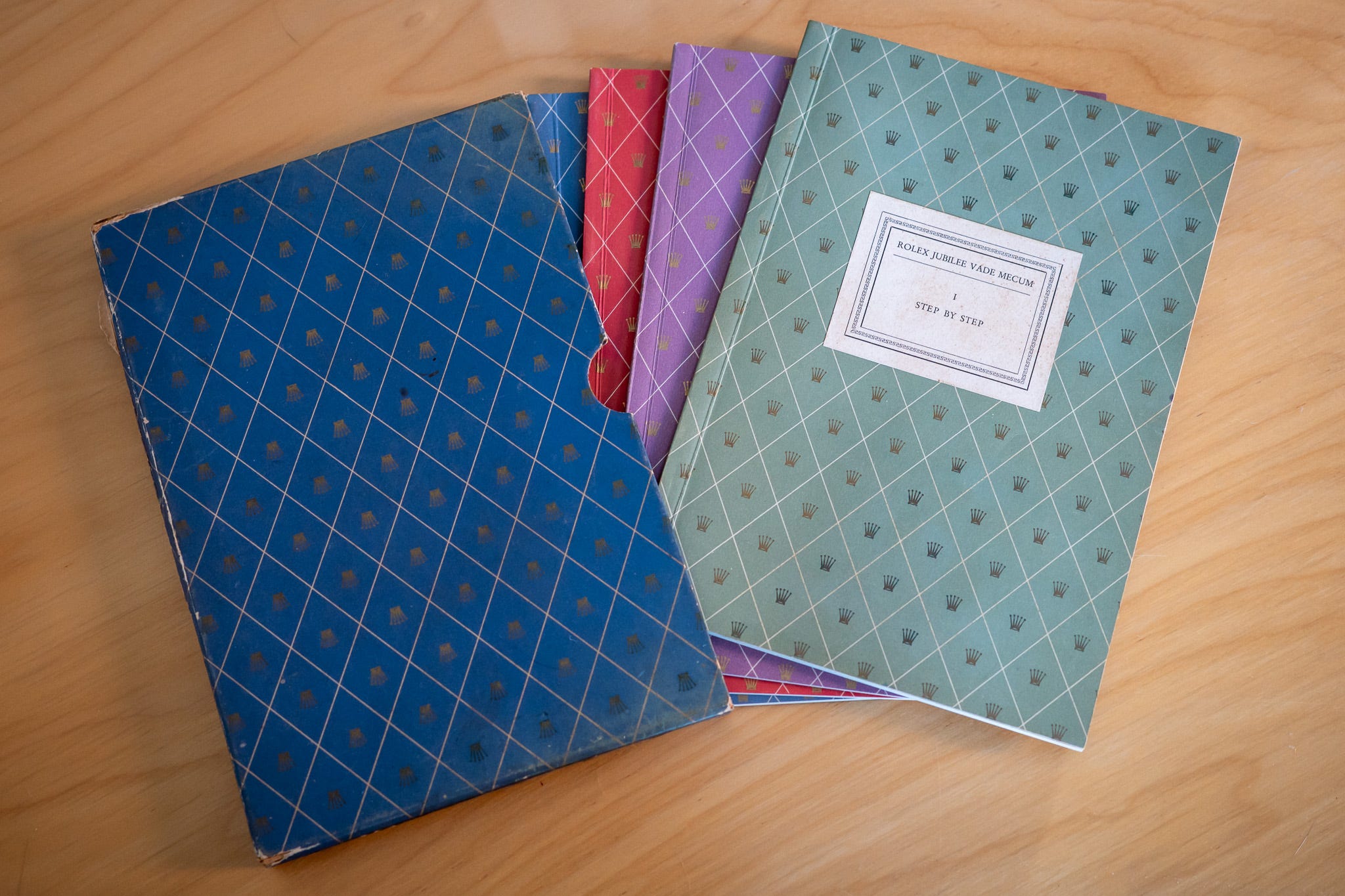
Rolex Jubilee Vade Mecum is a limited-edition set published in 1946 to mark Rolex’s 40th anniversary. Only 1,000 numbered copies were printed, and I’ve seen them in English, Spanish, French, and German. It contains four volumes in a slipcase:
Book I: Step by Step, written by Rolex founder Hans Wilsdorf, includes a brief biography, his philosophy, and company history.
Book II: The Evolution of the Wrist-Watch Chronometer, covers Rolex’s early efforts in watchmaking and precision.
Book III: How the Waterproof Watch Came Into Being, explains the creation and mechanics of the waterproof Oyster case.
Book IV: The Story of the Self-Winding Watch, details the development of Rolex’s automatic Perpetual movements.
Rolex published the set, and Wilsdorf was the consummate marketer, so no doubt there’s some legacy building. For example, Wilsdorf insinuates that Mercedes Gleitze was wearing a Rolex Oyster around her neck on her first swim across the English Channel in 1927, when it’s commonly acknowledged she wore it on her later “Vindication Swim.”
The set is also far from a detailed account of all things Rolex. It’s only 100 pages total, there are no details about the watches, and few dates or figures. Book I is written by Wilsdorf, but in general terms. The other three volumes are largely company lore that seems aimed at retailers, though ads from the time also pitched it to customers.
That said, Wilsdorf was famously elusive and private, and Vade Mecum is the only book he ever wrote, so it offers a peek into his mind.
Founding myths—true or not—define a company’s culture and values, and persist long after the founders are gone.1 They also guide priorities as a company grows. Vade Mecum feels like one of the primary texts for building the myth of Rolex.
Here are 7 things I learned about Rolex and Wilsdorf from Vade Mecum:
1/ Wilsdorf Already Had His ‘Three Factors’
Let’s begin at the end. Wilsdorf signs off with the following:
“On summing up the reasons underlying the universal prestige Rolex enjoys—apart from the chronometry of our movements—it must be attributed to three factors:
(1) To the Oyster known everywhere as the permanently waterproof wristwatch, for the making of which no plastic materials are used,
(2) To our increasingly popular automatic ‘Perpetual,’
(3) Lastly, our constant care to bring out new and pleasing models, sober and harmonious in design and in true Geneva style.”
This is even echoed in the set’s structure. Book I is about Wilsdorf, by Wilsdorf. After that, each volume focuses on Rolex’s three brand pillars: (1) chronometry (accuracy), (2) waterproof (Oyster), and (3) self-winding (Perpetual). Also note it was in that order, and Wilsdorf makes it sound like Rolex’s automatic movements are becoming more popular, but their success isn’t yet guaranteed.
It’s the exact same messaging we see in this year’s campaigns around the 100th anniversary of the Oyster case.
Wilsdorf emphasizes his prescience in seeing the potential of the wristwatch. Whether it’s that innovative vision, or simply beating us over the head with this messaging for 100 years—or most likely, a combination of both—this commitment to the bit is what makes Rolex so impressive.
2/ I Finally Learned Where ‘Oyster’ Comes from
In Book I, Wilsdorf begins:
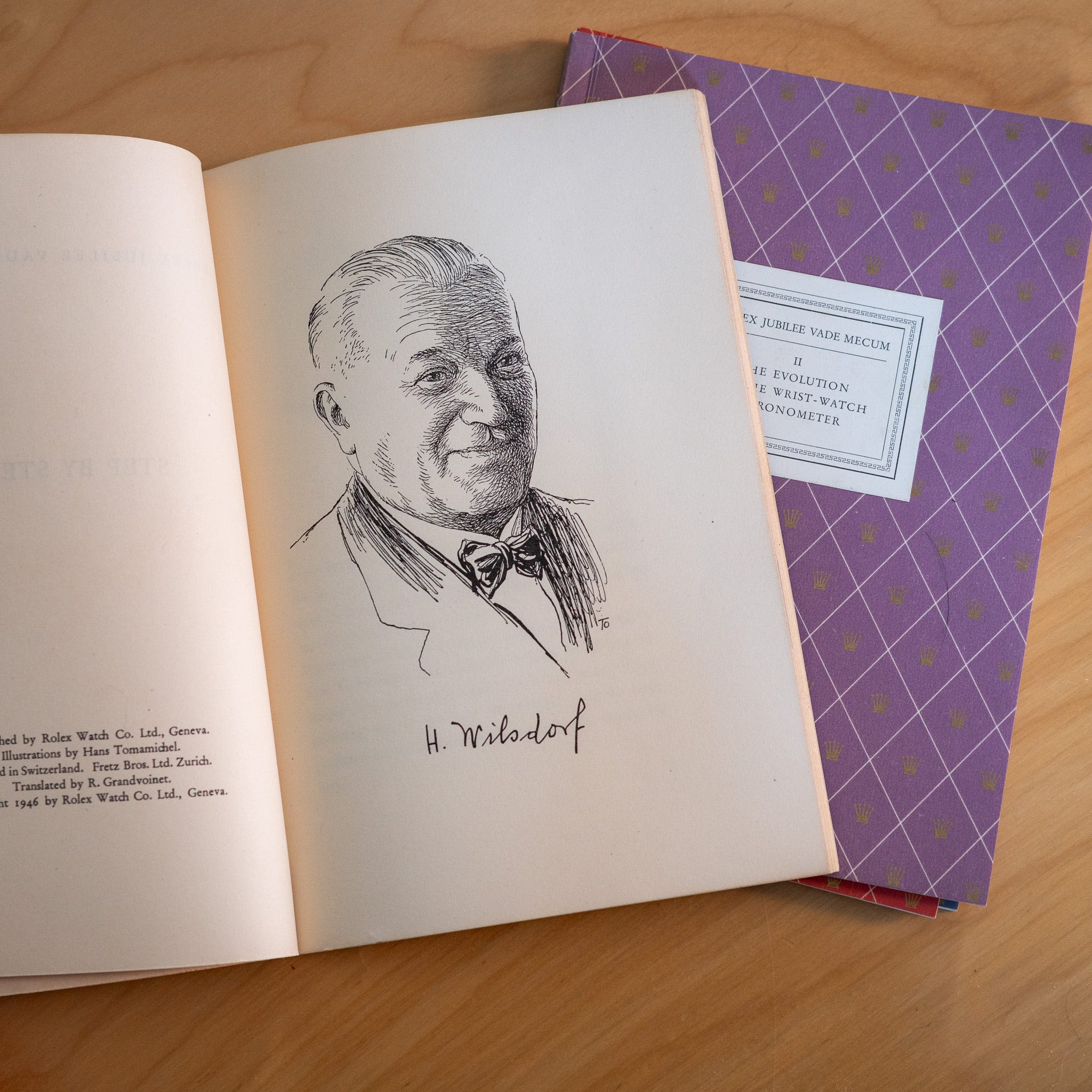
“I was born on March 22, 1881, of Protestant parents, the second son of a family of three. My mother’s early death was soon followed by that of my father, and, at the age of 12, I was an orphan.”
Wilsdorf was born in Bavaria, a historically Catholic region. His father had a successful hardware business, but his uncles liquidated it after his parents died. Young Hans was then put in a boarding school of “excellent repute.”
Wilsdorf says he liked math and languages, which drove him to travel. He began his career in Geneva as an apprentice at a pearl exporter.
Surely, this background in the pearl business is where he’d later find inspiration for the Oyster name of his waterproof cases.
In 1900, Wilsdorf got his first job in watches in La Chaux-de-Fonds at a watch exporter.
3/ Wilsdorf Thought Wristwatches Were Fashion
By 1905, at the age of 24, Wilsdorf had moved to London, where he started his own watch company, Wilsdorf & Davis. Alfred Davis was the money guy; Wilsdorf had the ideas. He writes:
“The first specialty we adopted was the travelling watch, called the portfolio watch, cased in the finest quality leathers….However, even at the time, my chief concern was the wristlet watch to which I devoted all my youthful energy and optimism.”
He writes that in 1905, the wristlet watch (or wristwatch) wasn’t popular, mostly an object of derision, and “contrary to the conception of masculinity.”
But Wilsdorf says he saw the potential of it to “bring about a certain revolution in the industry”:
“By its very nature, it called for more frequent renewal. More exposed to damage than a pocket watch, it was not of a type to become a ‘family heirloom.’ It was destined to become a modish accessory, an object submitted to the vagaries of fashion, calling for change and variety.”
Today, we wax poetic about the enduring nature of mechanical watches, and there’s some truth to it. But in the beginning, Wilsdorf saw them as something very different, at least as compared to pocket watches.
This also helped me understand why, especially in the early years, Rolex introduced hundreds of sizes, styles, and models. Wilsdorf saw them as fashion objects.
4/ The Importance of Aegler
Quickly, Wilsdorf strikes up his most important partnership:
“After founding my firm in 1905, I went to Bienne and placed with Hermann Aegler the largest order ever booked for wristlet watches at that time. The order amounted to several hundred thousand Swiss francs.”
Wilsdorf & Davis was an importer of Swiss wristwatches, which it then sold to retailers across Britain and other markets in the British Empire. Wilsdorf says they became particularly popular in Australia and New Zealand.
He emphasizes the importance of this partnership with its movement manufacturer Aegler, which eventually became Rolex Bienne. In 1919, Wilsdorf set up Rolex Geneva. He did this so Aegler could focus completely on manufacturing, while Rolex Geneva could design and launch watches “according to the traditional style of the ‘City of Watchmaking.’”
This division remained important to Rolex. It didn’t officially acquire Aegler until 2004; before that, it was officially a separate entity, even though it’d been producing movements exclusively for Rolex long before that.
5/ The First Rolex Ad Campaign Cost $900k (in 2026 Dollars)
As Wilsdorf & Davis grew, he wanted a name to put on dials. He was very proud of “Rolex,” a word pronounced the same in every European language and easy to memorize. But it didn’t pick up immediately.
Wilsdorf writes that:
“Despite the qualities of this trade name [Rolex], it took 20 years of hard work to make the idea acceptable in England. At first, I ventured to inscribe it on one watch in every six.”
