Welcome back to the newsletter for watch collectors. A few notes:
Canvas Straps are now available in 20mm and, for the first time, 22mm. Shop the Unpolished Store here—all paid subscribers get 10% off. Pick one up at the launch price of $65 for the next week.
Upgrade to Founding Membership here to get the 2025 Rewind Magazine. For annual subscribers: An email from Monday also has another easy way to upgrade.
Unpolished hit #20 on Substack’s Fashion & Beauty leaderboard, which I believe roughly tracks paid subscriptions. There are just two male writers in front of me—Jake Woolf, I’m coming for you.
I was on Derek Mon’s YouTube and talked about a few watches here.
Today’s letter is brought to you by Pushers.io—more below.
🎧 Listen to this week’s issue here, or find it on Spotify / Apple:
![You Are Your Watch's Biggest Problem [Audio]](https://substackcdn.com/image/fetch/$s_!kXoq!,w_140,h_140,c_fill,f_webp,q_auto:good,fl_progressive:steep,g_auto/https%3A%2F%2Fsubstack-video.s3.amazonaws.com%2Fvideo_upload%2Fpost%2F189399229%2F632d572c-cc5b-4cc6-8ffb-f3a8b109fba2%2Ftranscoded-1772224170.png)

The Protection of Precision
Watches are a funny thing because you have to suspend disbelief to take them seriously, and the extent to which you decide to suspend disbelief determines what you like or don’t.
What I mean: “Nobody needs these,” is our oft-repeated cliché, a bit of feigned self-deprecation that reminds us more accurate timekeepers are in our pockets or on our microwaves.
AND YET, we suspend disbelief, taking seriously the mechanical watch’s continued pursuit of accuracy.
Perhaps it’s because if watches completely toss aside the timekeeping, we’re left with nothing but wrist jewelry—and most of us can’t admit we’re just obsessing over pretty little metal bracelets.


I was in a sprinter van with Wei Koh a few months ago, being shuttled out to some Geneva suburb where the watch manufacturing actually happens, when he asked the group of assembled media members:
“What’s the most accurate watch you own?”
I think Wei might’ve recently acquired a Grand Seiko UFA, prompting the line of inquiry.
I tossed the question over a bit. Technically, my answer is something like the Casiotron 50th Anniversary, which uses radio signals to sync with atomic clocks every night—though perhaps this isn’t keeping in the spirit of Wei’s question.
Beyond that, I mostly have a roster of older watches that proudly proclaim things like “Superlative Chronometer,” even if they’re well past a chronometric mid-life crisis. They keep pretty decent time, though I’d check the Casiotron if I had to be somewhere at zero six hundred hours sharp.
All this to say: Accuracy has never been particularly important to me.
I’ve never been able to totally suspend my disbelief and access the portion of watch enthusiasm that speaks about accuracy in split seconds and tracks it with timegraphers.
I’m closer to the we do not know its service history, but the watch is running well end of the spectrum.
COSC, the Center for Swiss Something or Other
A few weeks ago, COSC, the Center for Swiss Chronometer Something or Other (the acronym works in French, I’m told), introduced its new Excellence standard. From the Mothership:
“Movements then return to the manufacturer to be cased and subjected to an additional five days of testing. This will include robotic simulation of daily wrist wear for 24 hours, followed by testing where the average daily rate must fall between -2/+4 seconds per day.” [emphasis mine]
These cased-up watches are also tested for anti-magnetism and power reserve. It’s more stringent than the existing COSC certification, which tests only movements and only to an accuracy of -4/+6 seconds.
It’s a response to METAS, used by Omega and Tudor, as well as the litany of brand specs like Rolex’s Superlative Chronometer or the Grand Seiko Standard.
BROUGHT TO YOU BY PUSHERS.IO
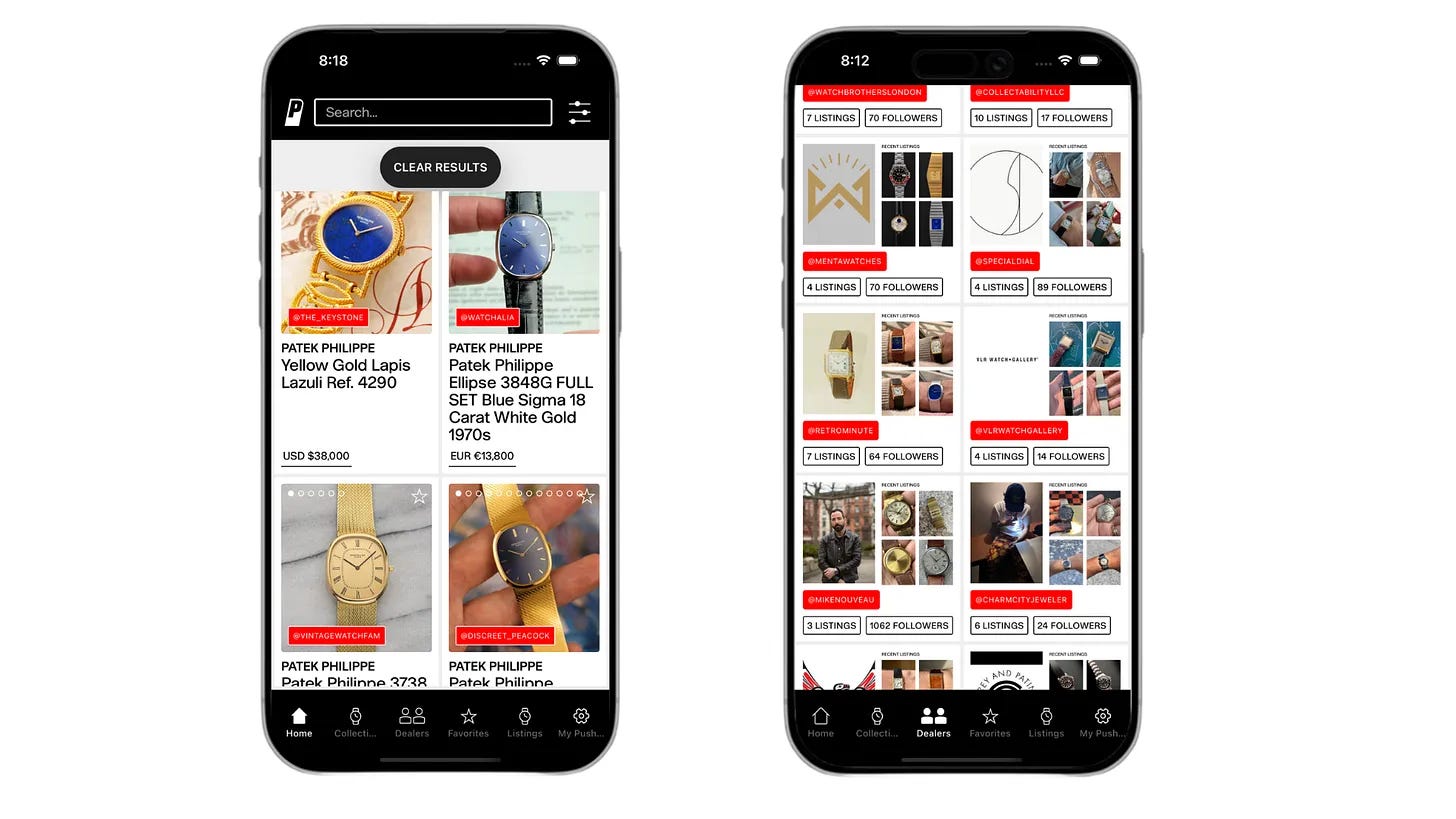
Reach a community of 10k+ vintage collectors. Pushers.io is the app built for collectors. It gives dealers a direct connection to enthusiasts, instead of getting in the way of a deal. All dealers are verified (3 vouches minimum), so you know you’re in good company. All for a flat monthly fee. Interested dealers: reach out to hello@pushers.io with references.
Rolex and the Robots
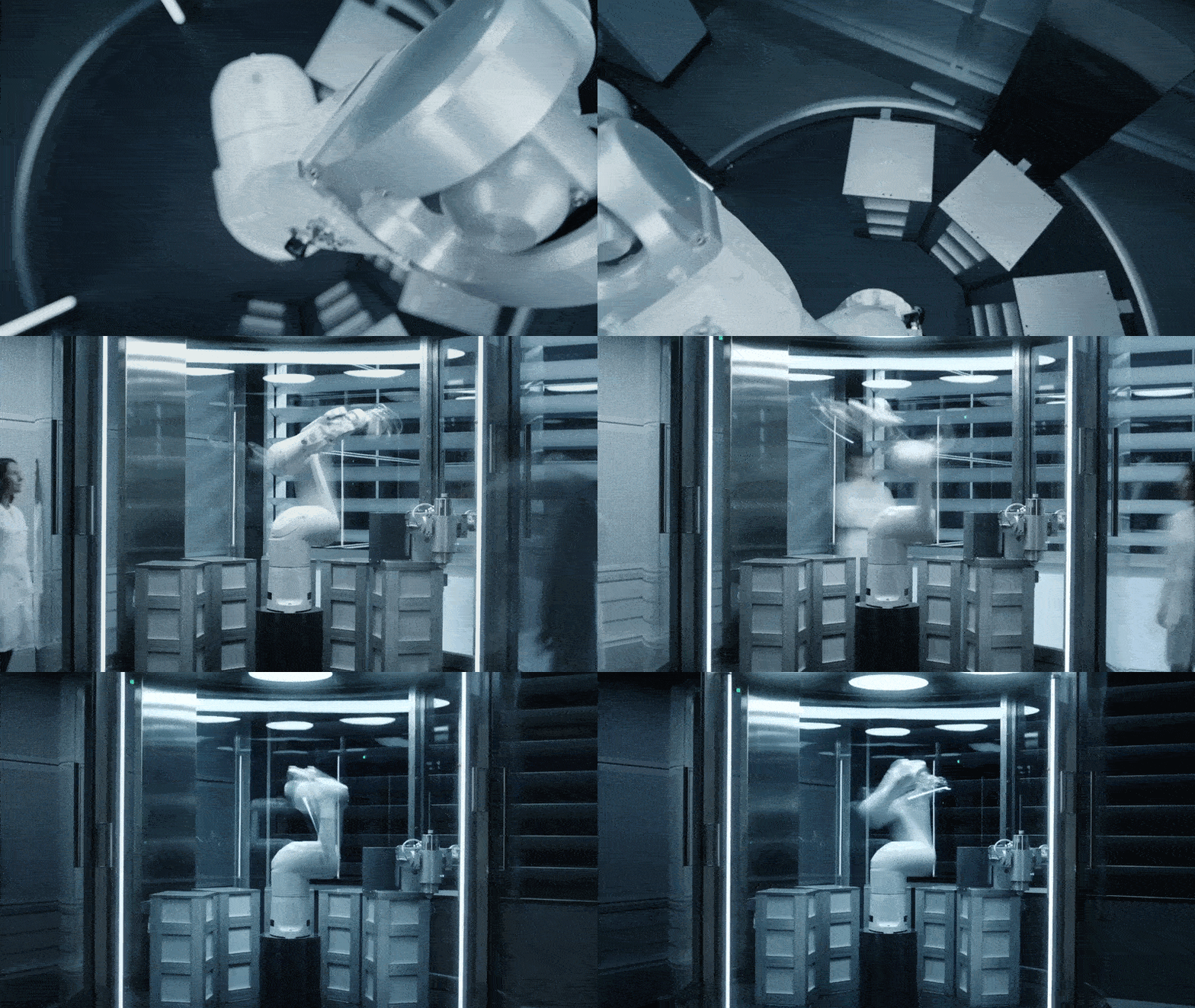
Rolex’s Superlative Chronometer testing uses a similar approach, saying it has robots simulate real-life wear. But Rolex doesn’t stop with robots.
Recently, Coronet got actual quotes, attributed to an actual person at Rolex, about its approach to chronometry. Rare!
“It’s not precision, but the protection of precision,” a Rolex rep told Coronet. It published an interview with Felix Grasser, a chronometry specialist in Rolex R&D, who said it’s “found that the way a watch is worn is the leading cause of accuracy issues. Rolex watch wearers lead very different lifestyles. Some are highly active, while others are more sedentary.”
It’s not always the most active people who have accuracy issues. To better understand these very human differences, Grasser said Rolex does something that there have been rumors about for years, but I don’t think had ever been confirmed:
“We are constantly conducting test campaigns involving hundreds of volunteers who are asked to wear modified or unmodified watches, sometimes with sensors. These studies, which are spread out over several months, or even years, enable us to look at the long-term behavior of the watches.”
That’s hundreds (or more!) of volunteers wearing test Rolex watches around town.
Wearers vs. Winders


All this reminded me of a recent conversation I had with Nathan Bobinchak, Oak & Oscar’s in-house watchmaker. After servicing lots of Rolex watches, he noticed wear patterns generally fit into two categories, which he referred to as Winders and Wearers:
Wearers: Owners who wear their watch every day.
Kill their rotor axles, reversers, along with the escape wheel and third wheel (never stop moving)
Winders: Owners who wear their watch intermittently, requiring it to be manually wound when picked up again.
Kill their setting wheels and pinions (the crown is the failure point)
It’s an endearing reminder: While you might be able to group us owners into categories, we aren’t robots.
Beyond Rolex, I found a few brands that tout human testing, but usually in reference to their ambassadors: think Rafa Nadal wearing an RM during the French Open or Breitling and its cringey squads. But that’s more marketing than substance.1
It reminds me of the old cybersecurity adage—despite all the technology, firewalls, and phishing tests, the human is the most common point of failure.
Sometimes, brands get so caught up in celebrities and certifications that they forget it’s mostly normal people doing mostly normal things with their watches.2 And as Rolex’s Grasser says, we humans are the leading cause of accuracy issues.
And we should take pride in that. No AI or robot arm can simulate the entirely mundane task of walking the dog, folding the laundry, or eating a taco.
Okay, I think we’ve suspended disbelief long enough for today.
The Roundup
Inside the new ‘Rolex University,’ how it differs from the old Rolex University, and the trade-offs we make; a different take on the Quartz/Currency Crisis; a special First Series Patek Philippe 3940.