


Before we get to field watches and the Hamilton Khaki Field 250: Listen to the latest collector conversation with John Cote, who’s been collecting watches since the 1990s and recently ended a term on the NAWCC board. He’s got a different approach to acquisition, buying mid-century chronographs in pairs—matching the steel tool watch to its dressy counterpart. We talk about his approach to hunting, boomer chronographs, and how he’s seen watch collecting change over 30+ years:
Subscribe to the podcast to get future episodes in your feed: Spotify / Apple / RSS:

In the Field
The “field watch” is my favorite kind of watch. It’s not a complication like a chronograph. Unlike dive watches, there’s no generally accepted ISO definition. It’s based on the old military-spec watches for forces in the field, foot soldiers far greater in number than divers or pilots—matte dial, hacking seconds, Arabic numerals.
The field watch is, frankly, kinda boring.
There’s often an inverse relationship between price and execution. Timex manages a better field watch than Patek Philippe. The most expensive field watches ever sold at auction are far cheaper than record-breaking divers or chronographs. A handful of Rolexes with mountaineering provenance have reached six figures—or a rare white “albino” Explorer—but that’s about it.
I recently talked about a few of my favorite field watches from Rolex, Hamilton, and IWC on the YouTube channel—

But when I think field watches, I think Hamilton. On July 4, I wrote about the rise and fall of the American watch industry. While the Swiss industry began to dominate in the early 20th century, Hamilton still produced more than 1 million timepieces for the American military during World War II, from wristwatches to marine chronometers. After the War, it continued to make simple mil-spec watches for the many troops fighting the many conflicts of the new global superpower.
But the Swiss franc enjoyed a low exchange rate post-WWII until 1973, making its watch exports very competitive.
Hamilton shut down its Lancaster, Pa. manufacturer in 1969, then Swatch Group (SSIH) acquired the brand in 1974. The Swiss conglomerate introduced the Khaki Field collection for civilians in the 1980s—33mm watches inspired by those mid-century military-issued watches.
🎁 Unpolished Members get: (1) Welcome Care Package; (2) 10% off the Unpolished Store; (3) $50 off Watchcheck, + 2 newsletters/week, comments, and Q&As. Find info on all your benefits HERE.
MEMBERS ARE READING:


BROUGHT TO YOU BY THE ESCAPEMENT
A new event for collectors, By collectors

The Escapement is the first collector-focused event built for enthusiasts of all types. It’s not a trade show. Come to see live stage talks from independent watchmakers like Rexhep Rexhepi and Romain Gauthier. Plus, get hands-on with watches from Greubel Forsey, Simon Brette, and some of today’s most important makers. All in an arena and format that’s never been done before.
It’s not all watches: Saturday night will feature a comedy headliner, while Sunday will have a closing concert. Friday is VIP day, all day, with an opening-night Gala. Saturday and Sunday are General Admission. Join us: November 20-22, Etihad Arena, Abu Dhabi (UAE):
What Hamilton kept
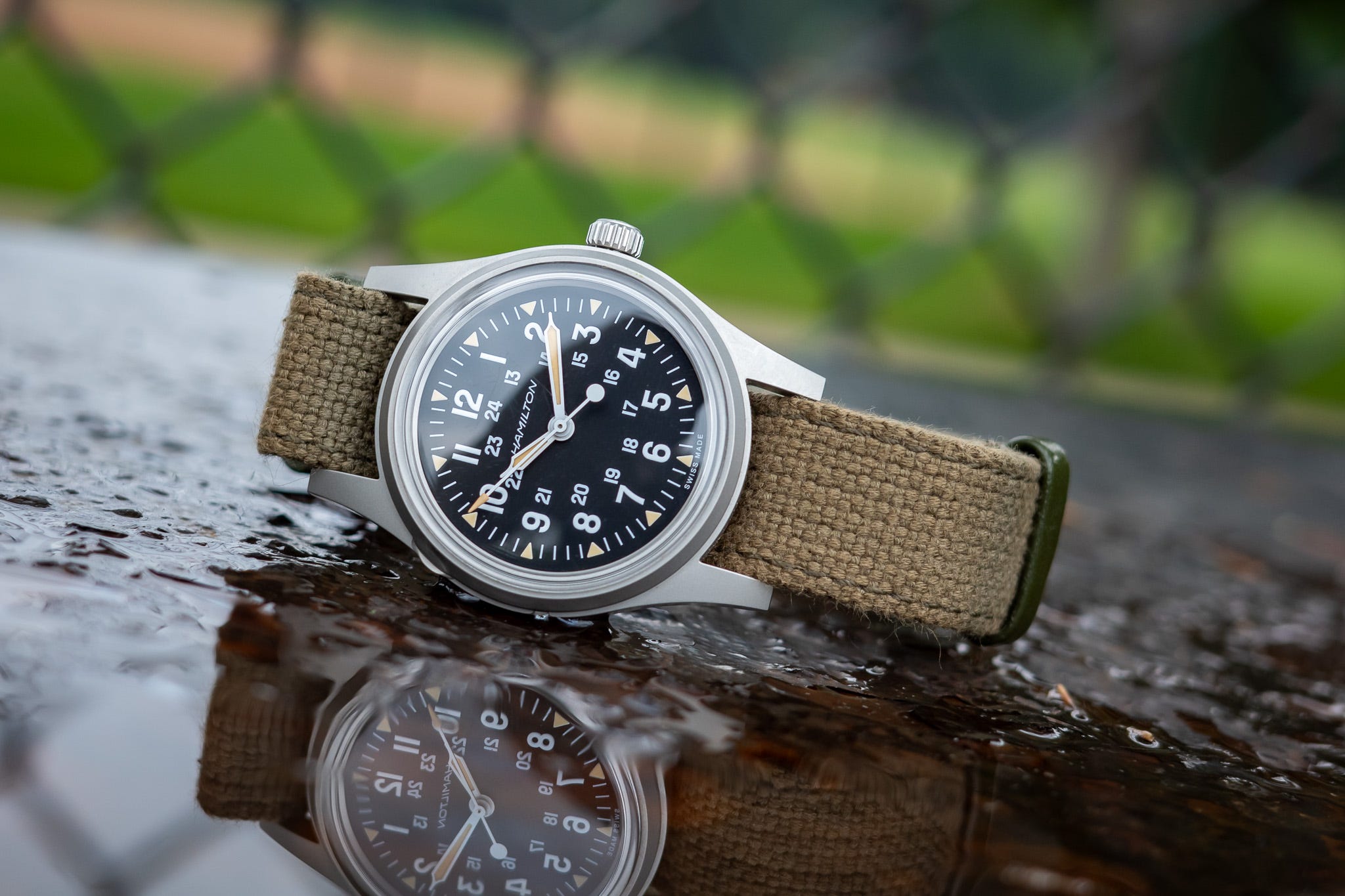
It’s odd that Hamilton’s never really produced a 36mm Khaki Field, which I’d argue is the Perfect Size for a field watch. The standard Khaki Field Mechanical measures 38mm, but has a lug-to-lug that spans the length of a dachshund.
On the rare occasion Hamilton has made a 36mm Khaki Field, I’ve scooped it up, and that Engineered Garments limited edition is my favorite modern Khaki Field.
That is, until this year’s Hamilton Khaki Field Mechanical 250, a special edition to mark the U.S.’s 250th anniversary. The 250 comes in two flavors:
A limited edition of 1,776 that comes with an extra leather NATO strap and watch roll; and
A non-limited edition that doesn’t come with those extras but is otherwise the same. It’ll be produced just for 2026.
Both are $725, and you can still buy the non-limited version at retailers or online.
The 250 is based on the Hamilton FAPD 5101, which was produced for one glorious month, September 1970—the same month Ford introduced the Pinto—and issued to navigators in the U.S. Air Force.


The FAPD 5101 was basically a souped-up version of Hamilton’s existing military-issued watches (built to spec MIL-W-46374). It’s a larger 36mm parkerized case that’s dull and corrosion-resistant; fixed lugs; an acrylic domed crystal; hacking movement adjusted to better accuracy than those other mil-specs—these were for high-flying navigators, after all, not your average infantryman.
Specs: Hamilton faithfully recreated all these features in the 250: 36mm (46mm lug-to-lug), 10.2mm thick, 100m water resistance (an improvement over the standard 50m), 18mm lugs, delivered on a soft cotton-canvas NATO strap with leather keepers. Hamilton’s 80-hour caliber H50 is inside, and there’s even a dust cover in a nod to the original.
The matte case mimics parkerization, the faux-aged lume works, and the syringe hands have a more dramatic taper than the standard Khaki Field.
The biggest difference compared to the original FAPD is the Hamilton wordmark at 12 o’clock, of course not on the old military watches. Hamilton uses a period-appropriate italic font that’s more squared-off than its modern logo. A solid choice, but man I would’ve loved to see Hamilton have the cojones to eschew a logo altogether or put it down at 6 o’clock.
No doubt about it, this is a watch for enthusiasts. Hamilton takes just a couple of liberties from the original:
Lug width: The 250 is 18mm, while the original FAPD was 16mm. It’s a fine choice—the 18mm width already feels slightly narrow with the long lugs.
Seconds hand: The other thing that stands out is the large lollipop counter-balance on the seconds hand. It’s bigger than the original, and the only component that really feels like Hamilton took from the standard 38mm Khaki and slapped into the 250.
On the Wrist
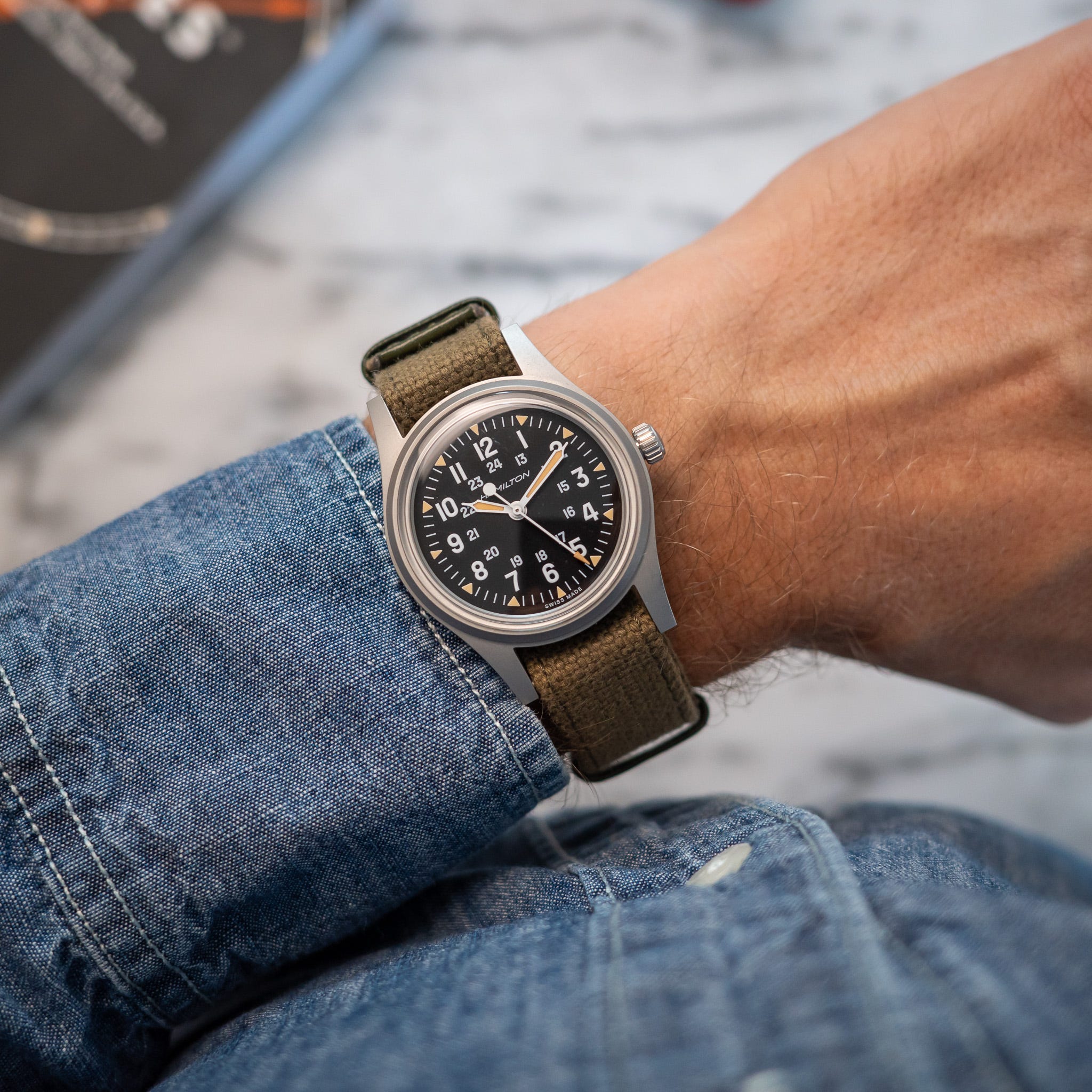
I borrowed a friend’s Khaki Field 250 for the better part of a month, and found myself reaching for it all the time. It’s the perfect summer watch. I swam, ran, biked, and generally galavanted around with it.
There’s no screw-down crown, which any Redditor would scream at you is the Khaki Field’s original sin, but I find manually-wound movements and screw-down crowns fundamentally at odds with all that screwing/ unscrewing.
The boxed, domed, acrylic (plastic) crystal is perfect for the 250. The biggest flaw of modern Khakis is the flat sapphire crystal, which makes a vintage-inspired tool feel unmistakably modern. In some of my photos, you can even see the scuffs that accumulate on the crystal, easily buffed out with toothpaste or Polywatch. A domed crystal also adds something to the overall shape that I think makes most watches better. It feels more organic, sloping naturally instead of ending abruptly.
The cotton strap is softer and more comfy than any NATO—this is why I sell a cotton canvas in the Unpolished Store, and if Hamilton sold this material as a two-piece strap, I’d have some competition—and doesn’t tilt too far into military cosplay for me in the way NATOs do. It’s not as long, so there’s no tail to tuck into the keeper. I found the limited-edition leather NATO unwearable, obscuring the lovely, compact dimensions of the 250.
The fixed bars are a practical mark against the 250, but that’s also the point. Hamilton was right to include them, and plenty of custom makers can make straps for fixed bars.
Will I buy it? $725 for the platonic ideal of a field watch isn’t a big ask in 2026. That said, I already have, by my count, 6 field watches, one of which is another Hamilton, so I need another one like the Dodgers needed Tarik Skubal.
Nothing to add
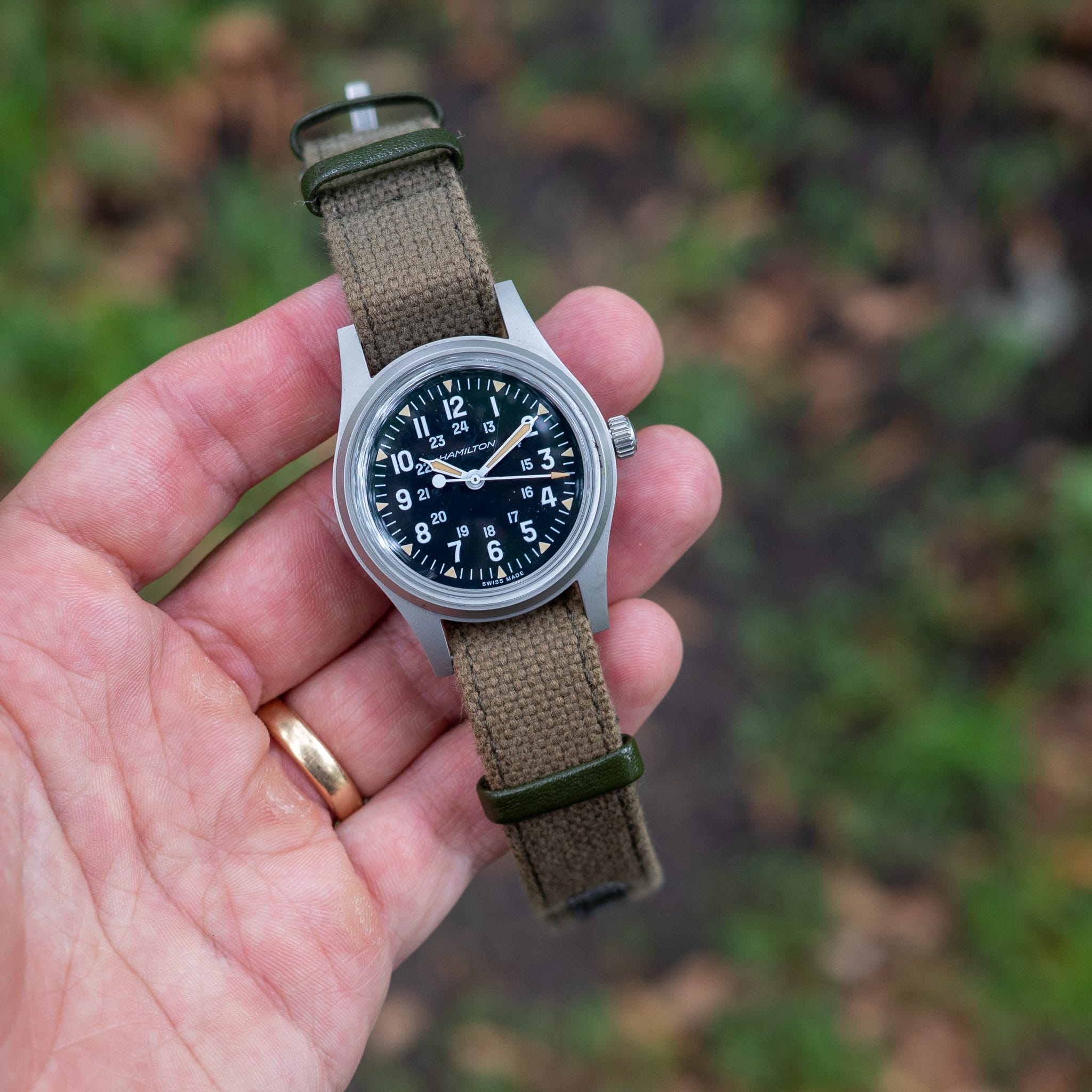
Most Swiss watches today trade on luxury and heritage. We call some of them “tool watches,” but that’s mostly a reference to a long-gone history of actually using them to do something.
The field watch is different. You can dress up a diver or chronograph in gold or diamonds and it still kinda works. But dress up a field watch too much, and it becomes something else, too fancy to really be for the field.
That’s why the Khaki Field 250 works. Hamilton didn’t add anything—it went back to September 1970 and took away what worked back then.
Let me know if you enjoyed this review, and which watches you’d like to see next. Thanks to my friend Dan for letting me borrow his 250 for the better part of a month.
Get in touch:
tony[at]unpolishedwatches.com
My favorite, tap the heart or leave a comment ❤️
Could a domed sapphire crystal
Have worked? It could then have had the shape of the original with greater scratch resistance. I used to have a Panerai with a dome shaped sapphire crystal. Would that be too fancy for the field watch aesthetic?
Love the review, Tony! Looking at your wrist shot, and thinking back to whenever I tried on similarly shaped 36mm field watches, I’d always find myself wishing they were just a few millimetres smaller. I think it has to do with how much of a field watch’s design is basically just dial - there’s no bezel or subdials to break up the space. So for those of us with smaller wrists, I feel like field watches with long lugs like this fit even better when they are around 33–34mm.
I actually recently wrote up a summary of my own search for one, which ended with an IWC Midsize Pilot from the 2000s.