


After the New York sales put an exclamation point on the spring auction season, it feels like time for a Market Update, but I’m struggling to find a register that strikes a middle ground between:
Breathlessly cheerleading mega results for Journe, Voutilainen, vintage Calatravas, Rolex Bubblebacks, etc.
Throwing a wet blanket on the whole charade, droning on that the “market’s too hot,” like an economist who’s predicted 9 of the last 5 recessions.
What paid subscribers are reading:


After all, auctions often have very little to do with the watches. Watches are mostly stripped of history, context, or anything else—placed on a tray with only an estimate, and, eventually, a price that supposedly defines their value. We look on as a few far-flung billionaires chase a quartet of Voutilainens to $1.9m, $1.8m, $1.2m, or $1.1m, reaching for words like rarity or condition to call it Culture, pretending that spending is taste.
GQ’s Cam Wolf wrote that 70 watches have already sold for $1 million this year, almost equaling the 80 from all of 2025.
Scroll the catalog like a feed
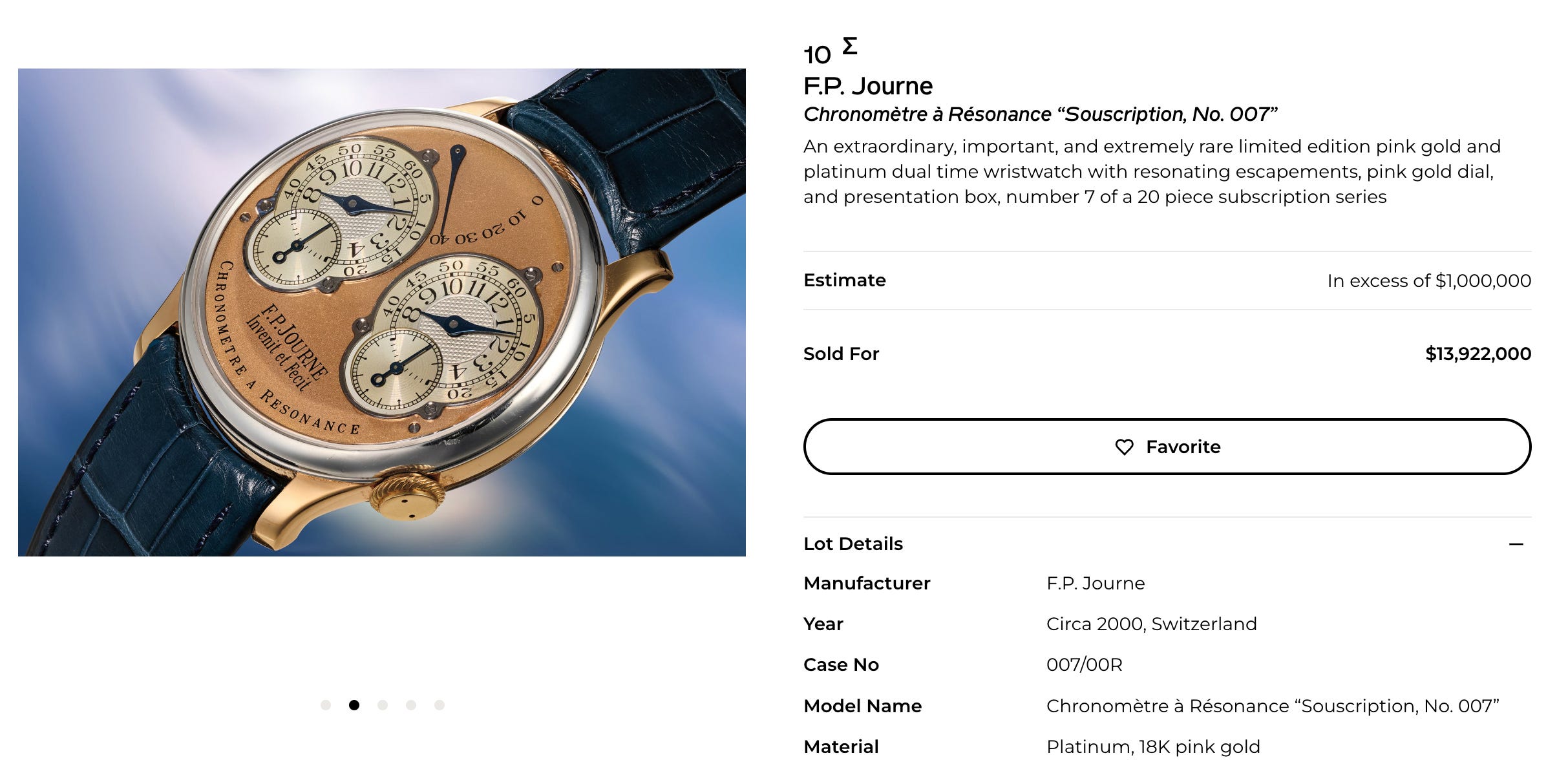
There seems to be no common thread running through what performs well right now, except that scrolling through an auction catalog feels more and more like scrolling on Instagram. If it pops on the feed, it pops on the rostrum. A rare Journe (or not rare), a Patek Philippe Calatrava with Breguet numerals or sector dial. Bubblebacks, apparently.
As for Voutilainen, he’s probably made ~1,200 watches, a fraction of Journe’s ~20,000.1 But rarity also passes for importance. It’s much easier to explain that a Voutilainen is a piece unique than it is to wax poetic about Kari’s dual-wheel direct impulse escapement, or, at least, it’s easier to fit into an auction headline or Instagram caption.
On one hand: This rarity means every time a Voutilainen comes up, it’s a chance to get a rare trophy from a modern master.
On the other: I can’t shake the feeling that this also means a small cabal could ensure every Voutilainen becomes record-breaking or headline-grabbing.
We call this the “watch market,” but it’s not a market. The number of collectors buying trophy watches at $1m+ must be vanishingly small. WatchPro and Eric Wind pointed out that the number of registered bidders at Phillips Geneva was slightly smaller this May (1,815) compared to last November (1,886), and certainly down from 2021 (2,311).
The current indie boom was built, in part, by big players like Phillips and 1916 Company. They admirably championed indies when no one cared, they told their stories in lot descriptions, and bought up inventory. Surely, not even they knew the ceiling, or 1916 wouldn’t have sold so many of their Journes back when an entire Journe-dedicated sale of 40 watches achieved the value (~$15m) that a single Souscription Résonance almost hit last weekend.
Seeing red
Perhaps the most confounding results of the weekend, to me:
