


Before today’s Real Review: We just published the latest YouTube video on field watches, which you can watch here—and please subscribe to the channel! This post may be too long for email, so click the headline to view it in your browser.
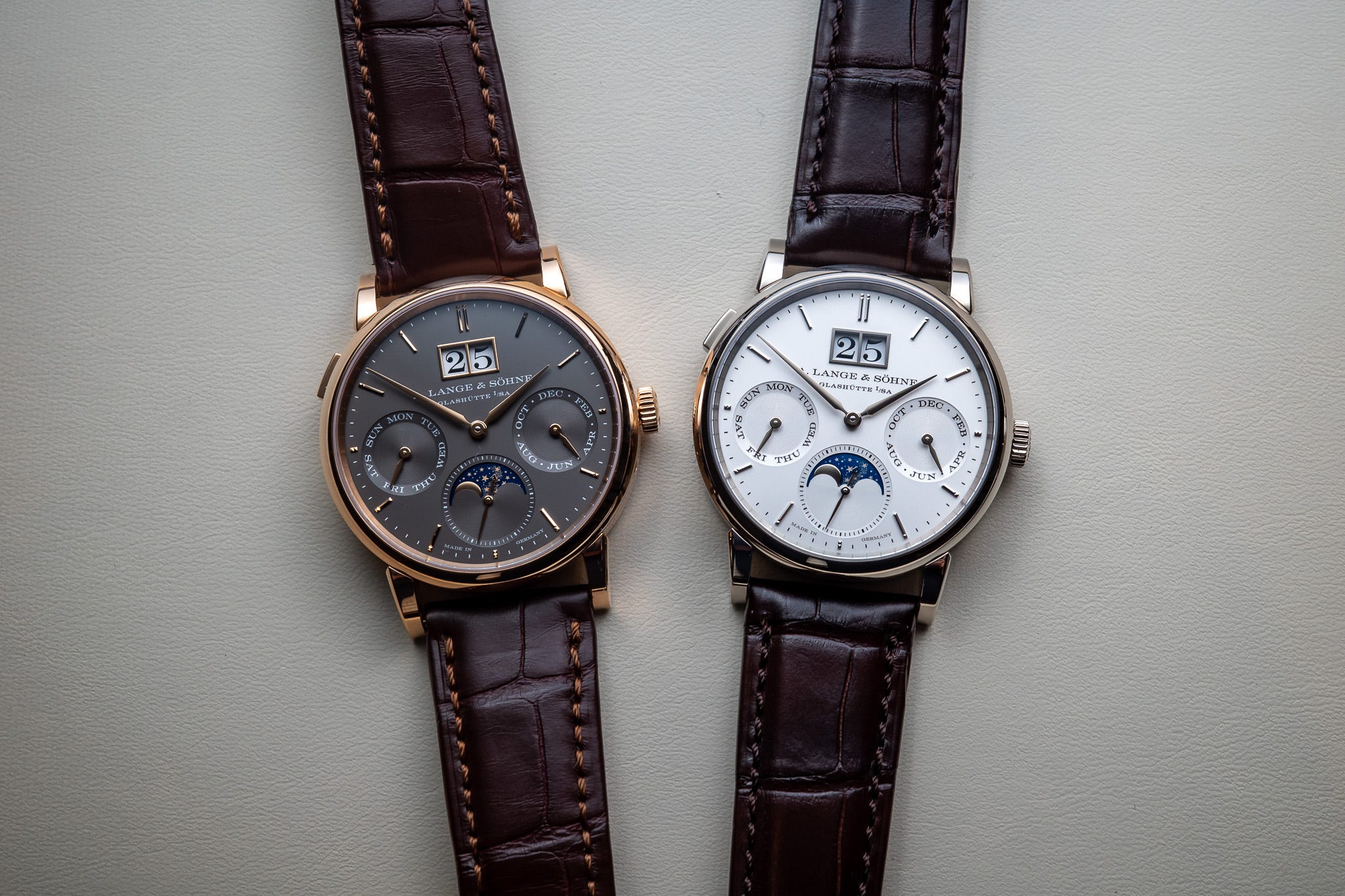
For the second year running, A. Lange & Söhne has surprised with a well-proportioned release. The new Saxonia Annual Calendar measures 36 x 9.8mm, offered in 18kt white or pink gold. It’s not a limited edition and costs $63k.
The Saxonia Annual Calendar isn’t perfect and makes some compromises to achieve its wearable size, but it’s one of my favorite releases of 2026. After we take a look at the new pair, we’ll compare to a few competitors, new and vintage, but the Lange does more than enough to stand out.
Subscribers also get (1) 10% off in the Unpolished Store, (2) $50 off a service at Watchcheck, and (3) access to all comments and Q&As.
What Is the Saxonia Annual Calendar?


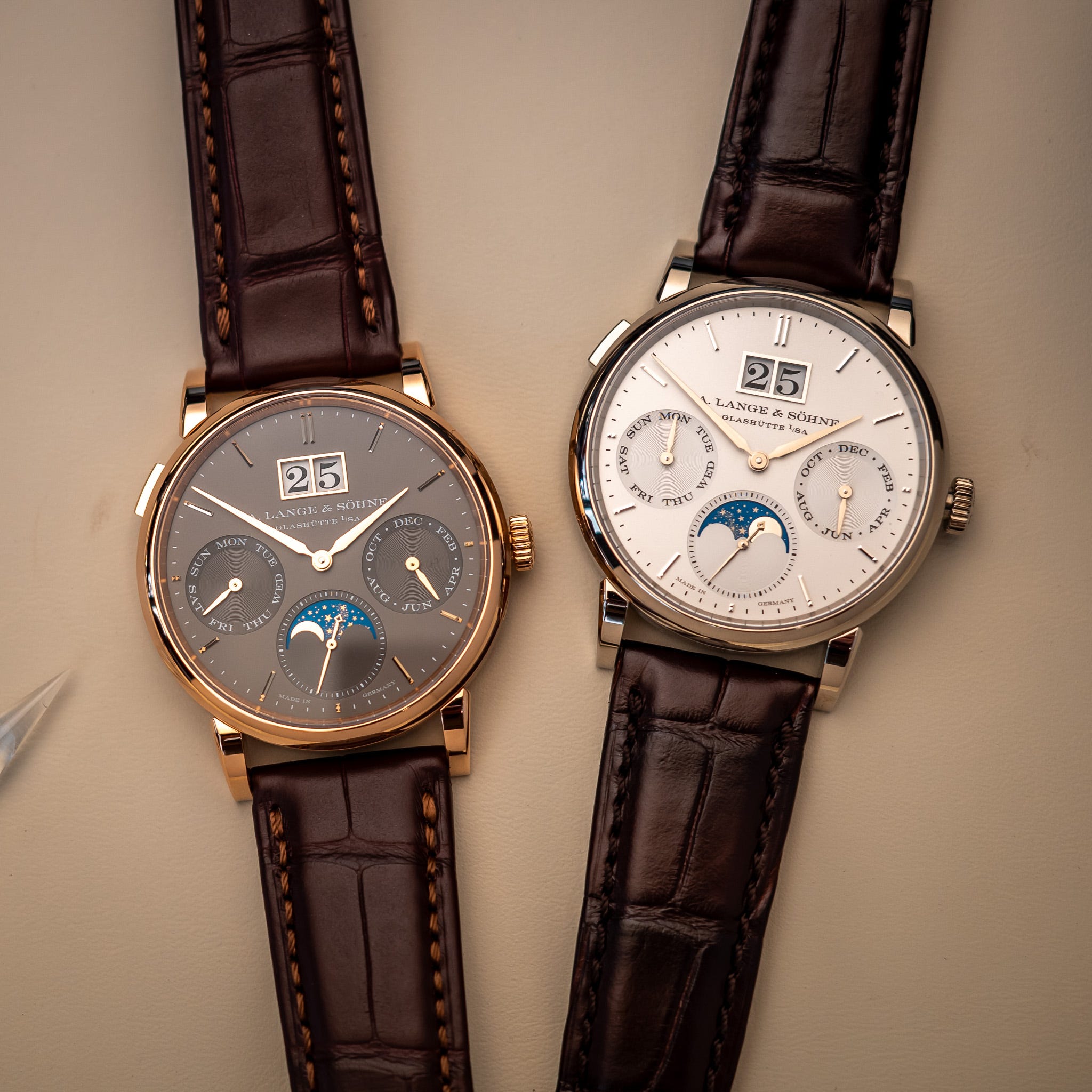
The gold Saxonia Annual Calendar (~43mm lug-to-lug) is paired with either an argenté or grey dial, both made from 925 silver.
An annual calendar needs one manual adjustment every year at the end of February. Invented by Patek Philippe in 1996 as a “useful complication” priced between its Calatravas and high-priced complications like a perpetual, it debuted in the ref. 5035.1
Lange introduced the first-gen Saxonia Annual Calendar in 2010, measuring 38.5mm and featuring its Sax-0-Mat micro-rotor movement. A bit of a slept-on watch nowadays, especially the slick grey U.S. boutique edition.
As for the updated Saxonia Annual Calendar, let’s start on the outside and work our way in:
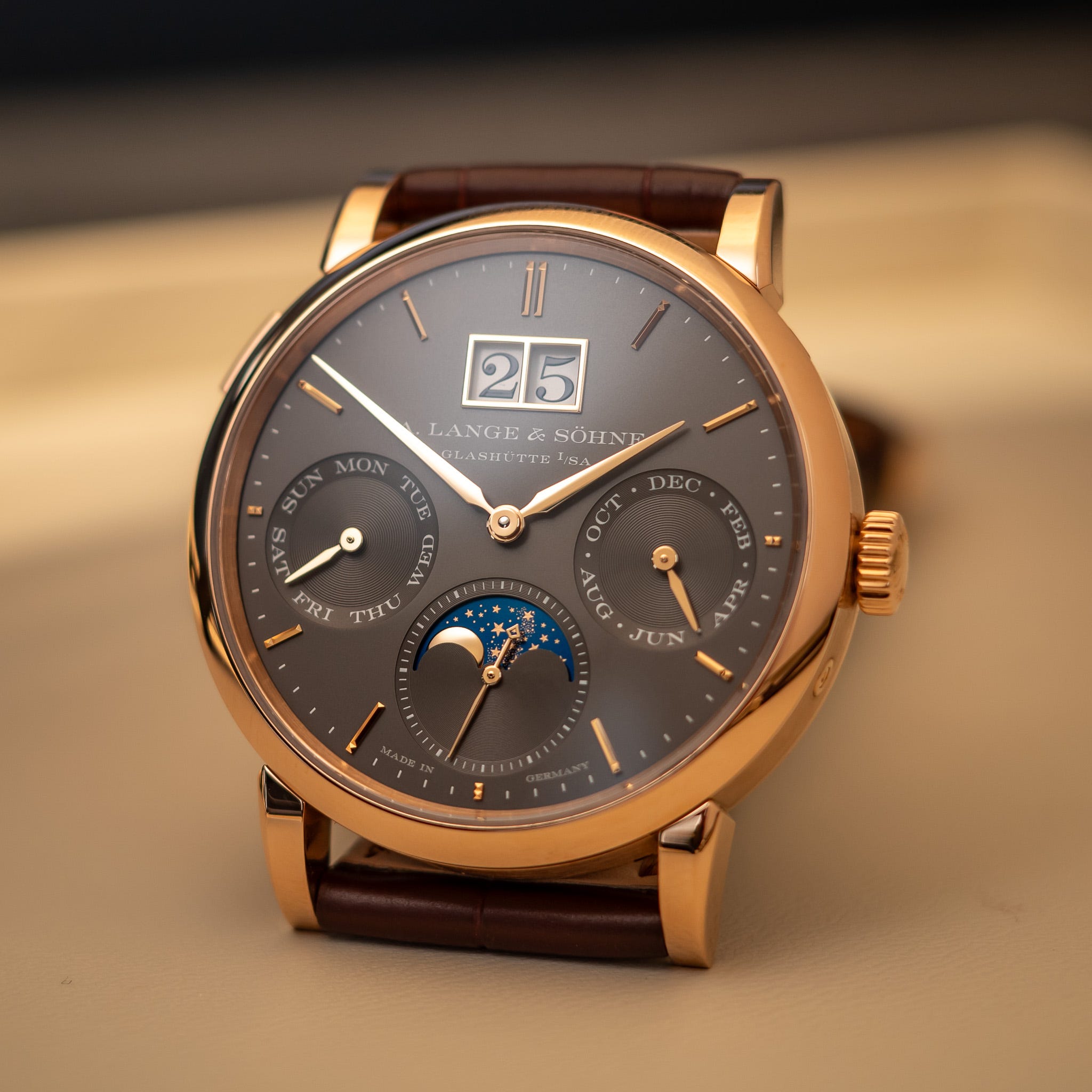
Dial: The Saxonia Annual Calendar looks kinda flat in press images, but it’s not: The three subdials for month, running seconds, and day, are slightly recessed, and circular graining contrasts against the main surface. In keeping with the Saxonia collection, decoration is sparse: big date, applied gold hour markers, gold hands. The applied markers have an additional faceted pyramid on the tip, a thoughtful detail and nod to the previous annual calendar. The vibrant moonphase disc provides the only color needed.
Case: The case uses Lange’s familiar construction: Three parts, with a polished bezel, brushed midcase, and Lange’s distinctive notched lugs.
The bezel is noticeably slimmer than many other models, giving the compact calendar as much dial real estate as possible. The case adds a pusher at 10 o’clock, which advances the calendar with a click—an update that makes the annual calendar easier to use. The additional calendar correctors sit flush in the midcase.
The grey and rose gold is the winner, a combo we’ve seen before from Lange, but one that almost always hits. The white gold, with its matching silver dial, white gold hands and markers, is either boring or tastefully subdued, depending on who’s looking.
I prefer yellow gold watches, but the rose- and white-gold Annual Calendar pair and many, many other releases seem to indicate “the market” disagrees with me; proof, as if we needed more, that the market is not always right.
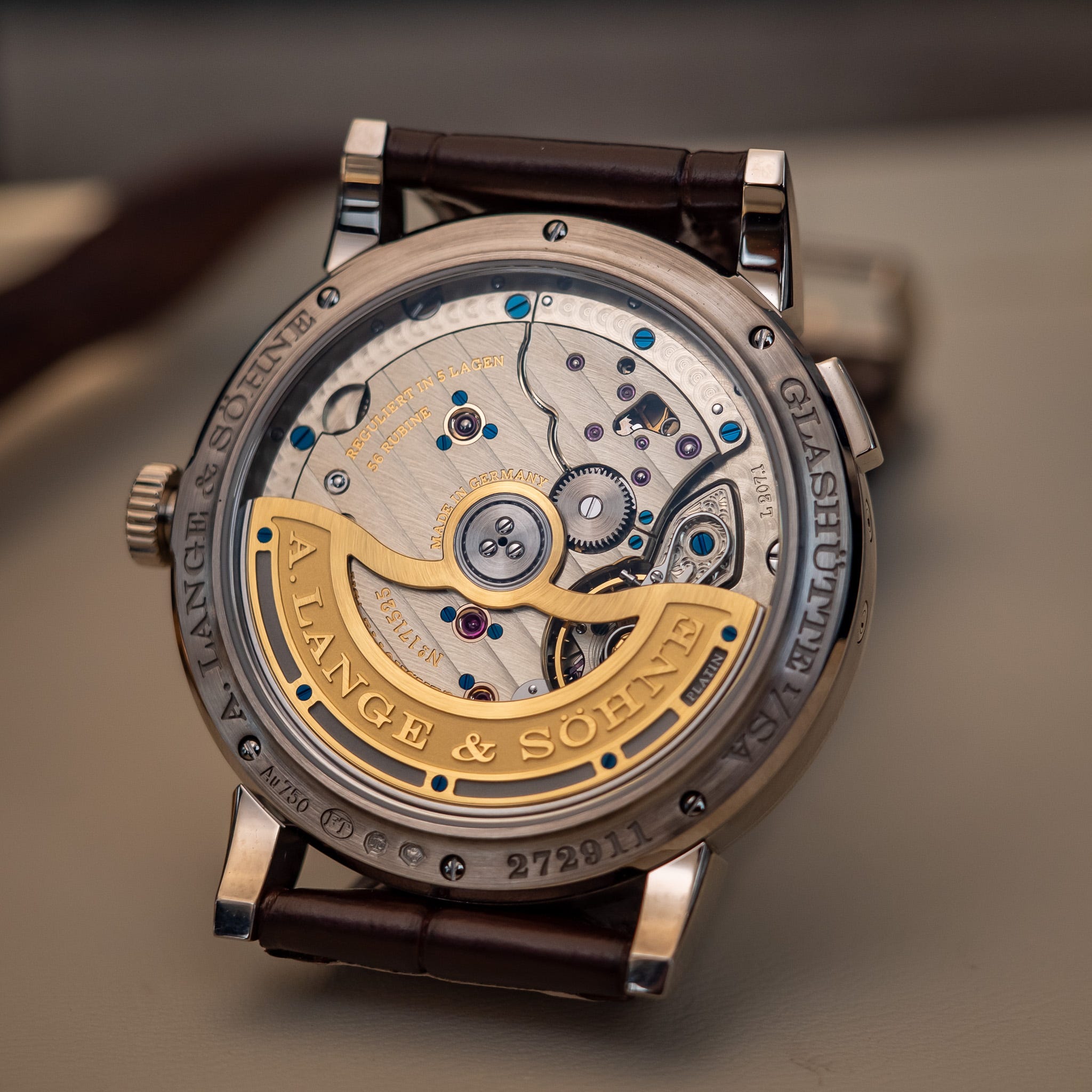
Movement: Inside is the new automatic caliber L207.1, with 60-hour power reserve. It uses the same foundation as the automatic movement seen in the Saxonia Automatic and Outsize Date (L086.1), which has been around since 2011.
There are the hallmarks of a Lange movement: German silver plates, anglage, black polish, hand-engraved balance cock, an in-house hairspring. Unlike the standard L086.1, there are even some gold chatons!2
It has a full winding rotor, in contrast to the previous Annual Calendar. Let’s look at a couple key differences between the old and new movement.
What the new annual calendar doesn’t have: The previous Annual Calendar used the Sax-0-Mat, Lange’s excellent micro-rotor, and had a couple of features the updated version doesn’t:
Zero reset: Long a calling card of Lange, its patented zero reset snaps the seconds hand to zero when the crown is pulled out, allowing for accurate time setting.
Gold rotor: The micro-rotor in the previous Saxonia Annual Cal is solid gold, while the full rotor in the new calendar is gold-plated.
I’ve seen these mentioned as shortcomings, but I think both are basically fine:
There’s discussion about Lange’s decision to use a gold-plated rotor dating back to 2011, when it introduced its new automatic movement. Back then, Lange said the choice wasn’t about cost savings, but about technical considerations: Gold is soft, and especially when that thin (and winding rapidly), prone to stretching. So, it uses ARCAP for its full rotors, an alloy similar to German silver (e.g., it’s also used on the Odysseus’ Datomatic).
The zero-reset takes up space, and the new caliber is 30 x 5.7mm. So what, you’re Lange, figure it out! you might say. I guess this is fair, but other technical improvements to the Annual Calendar make the zero-reset less necessary: The power reserve is up to 60 hours (compared to 46 on the previous Annual), and that new pusher at 10 o’clock makes it easier to advance the calendar without interrupting the business of timekeeping.
My biggest critique of the movement is aesthetic:
[Also below: A collector’s tip on the Langematik, the calendar competition, and on wrist impressions of the Saxonia Annual Calendar.]
The wide outer track for the rotor makes the movement appear smaller, leaving less room for Lange’s best-in-class finishing to shine. That said, Lange’s automatic caliber still stacks up favorably to competitors like the Patek caliber 240.
A Brief History of the Langematik (and Why You Should Care)
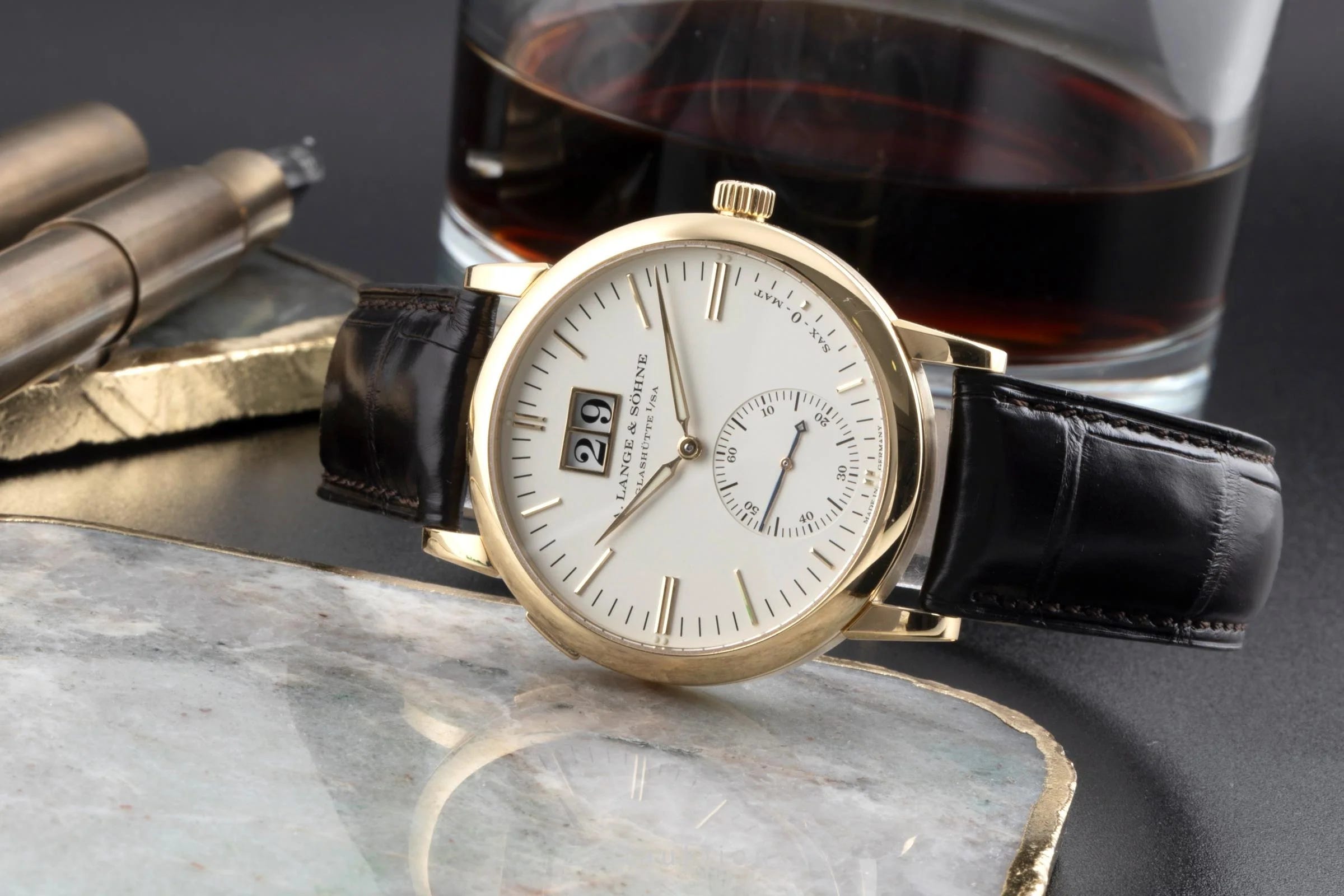
Lange introduced the Langematik, featuring the base Sax-0-Mat movement, in 1997, retiring it in 2011 for the full-rotor automatic. Today, it persists only in the Langematik Perpetual. Langepedia has said of the Sax-0-Mat:
“To this day, it remains the finest self-winding movement Lange has ever created. Given its craftsmanship, aesthetics, technical ingenuity, and historical mark on the brand, it will be quite hard to surpass.”
Some will mourn the Sax-0-Mat’s final departure from the Annual Calendar, but the smaller version’s size and other improvements ultimately make it difficult to compare the two.
Collector’s tip: Meanwhile, if you’re looking for an early Lange that isn’t being hyped up by Instagram dealers, look at the original Langematiks. This was Lange’s original sporty effort, the Sax-0-Mat is excellent, and the 37mm size is just right.
On the Wrist
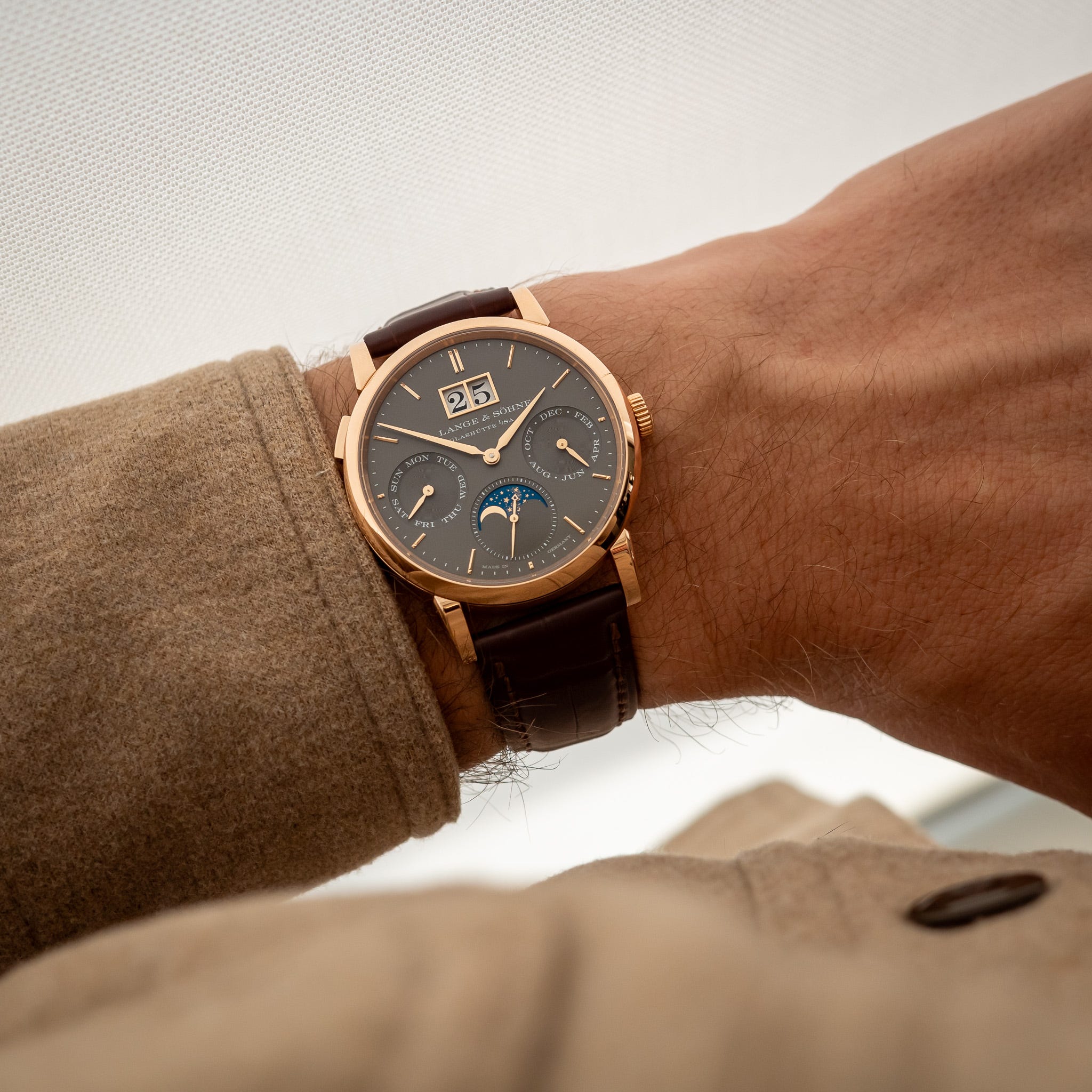
The updated Annual Calendar comes on a padded alligator strap. It feels too dressed up for a watch in 2026, but I work from home, so what do I know, except that it’d probably (definitely!) look better on a Matte Calfskin Strap from the Unpolished Store (stone grey for white gold, chestnut for rose, I’d say).
The Saxonia Annual Calendar is wearable but substantial on the wrist. The lugs are also slimmed down, giving it less visual weight. Slightly thicker than an ultra-thin 90s perpetual calendar or Lange’s old time-only 36mm watches, but I want a little oomph from my Lange.
There’s just enough heft to give it that I want the owner to feel like they’re closing the door of a Mercedes, as Günther Blümlein famously put it—but it’s more SL than G-Wagon.
The Calendar Competition
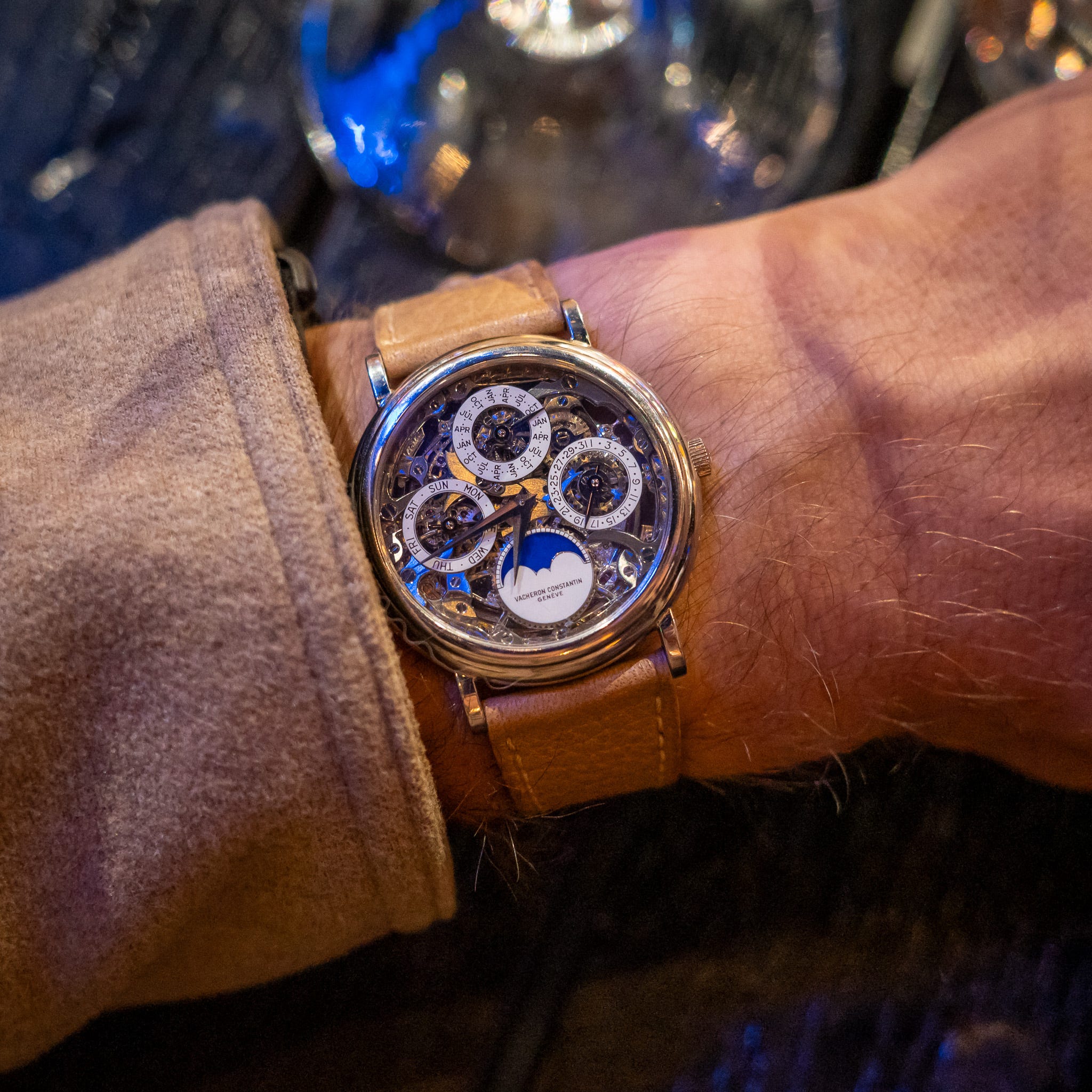
I struggle to think of any true, direct competition for the Saxonia Annual Calendar—a good sign for any new release. The previous Annual Calendar measures 38.5mm, more like a traditional Lange. That said, you can also find them for like $30k.
For a 36mm calendar, natural comps are the ultra-thin perpetual calendars from the 1990s: the Patek Philippe 3940 and its round competitors from AP and Vacheron (I don’t really consider the 5035 and other Patek annual cals as competitors). You could get a later 3940J for around the same price, but (1) the Lange’s case construction is much better and (2) Lange’s movement offers superior performance and finishing.
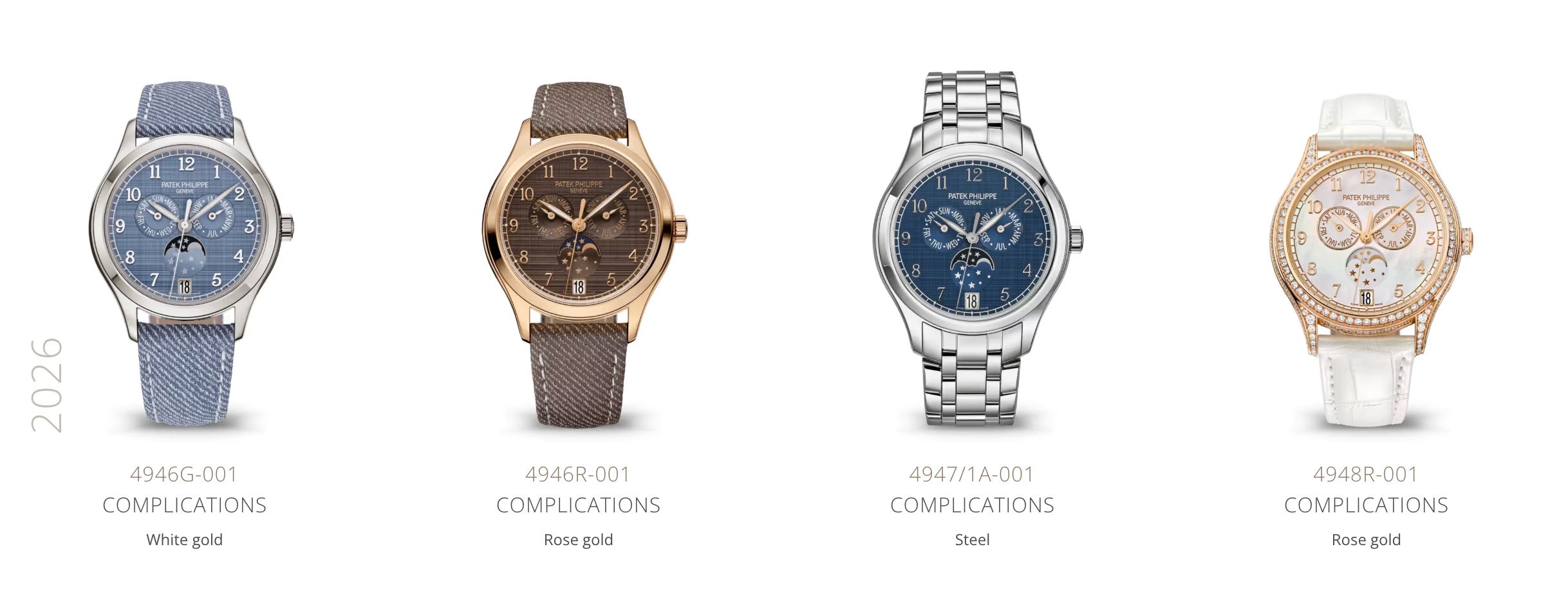
There are also the modern annual calendars from Patek Philippe: the ref. 5396R is the best comp, but it measures 38.5 x 11.2mm and costs about $4k more. Meanwhile, Patek Philippe itself doesn’t seem to take seriously the rest of its annual calendar offerings, so I won’t either:
Concluding on a Good Annual Calendar
The Saxonia Annual Calendar, along with last year’s 1815 34mm, shows that Lange takes watchmaking for smaller sizes seriously in a way that many other watchmakers don’t.


Here I am comparing a new watch (and a less complicated one at that) to a 3940, one of the most in-demand vintage watches around.
But six weeks removed from the beige halls and fluorescent lights of its Watches and Wonders release, and after spending some more time with it, the Saxonia Annual Calendar holds up:
Compared to vintage watches: Modern quality, movement finishing, and performance in a compact size the watches of a generation ago can’t match;
Compared to new competitors: A form factor that most modern complicated watches don’t even try to execute.
A. Lange & Söhne is at its best as a new-old watchmaker, taking the ideas of historic Glashütte watchmaking and bringing them to modern watches. The Saxonia Annual Calendar is proof.
More about the Saxonia Annual Calendar on Lange’s website. I’ve heard that it’s starting to be delivered, so also check out your local boutique. Lange’s new boutique just opened in Chicago, which is where I was able to see it.
MORE ON LANGE


Even though the annual calendar is less complex, this doesn’t exactly mean fewer components. The Annual Cal’s caliber L207.1 has 491 parts, compared to the Langematik Perpetual’s 478. (Interestingly, Patek Philippe’s perpetual cal. 240Q requires just 275 parts, while the base cal. 240 has 152 parts.)
Btw, it’s commonly repeated that Lange gives you the same finishing at its entry level as it does in a grand comp. The use of gold chatons in the annual calendar, and not in the base automatic caliber, illustrates when this isn’t exactly true.
when i first heard the criticism of the use of arcap for the rotors, i thought it was as idiotic as the claim that rolex moved to an open caseback on the platinum daytona to achieve “cost savings”. these are incredibly expensive watches that don’t need more margin at retail, their buyers will not be dissuaded if the price went up 2% on account of a bit more gold. these are deliberate design choices, whether you like it or not.
and i am going to be very bold and disagree with langepedia, the most beautiful series production automatic that lange have made is the l021 used in the l1 daymatic and qp. and it’s not even close.
This is great 30k watch