


Gallet introduced the Flying Officer in 1939, a chronograph with a world-time indicator, rotating bezel, and waterproof case—all novel for the time.
The cities on the world timer might seem unusual—small towns like Djask and Dakar alongside familiar metropolises like New York or London.
In those early days of intercontinental flight, you couldn’t just fly directly from one far-flung destination to another. Pilots had to hopscotch through sometimes obscure outposts, making multiple refueling stops to get across the world. For example, KLM, Air France, and Britain’s Imperial Airways all had routes connecting Europe to Asia running through Djask, a small port town on the Gulf of Oman.
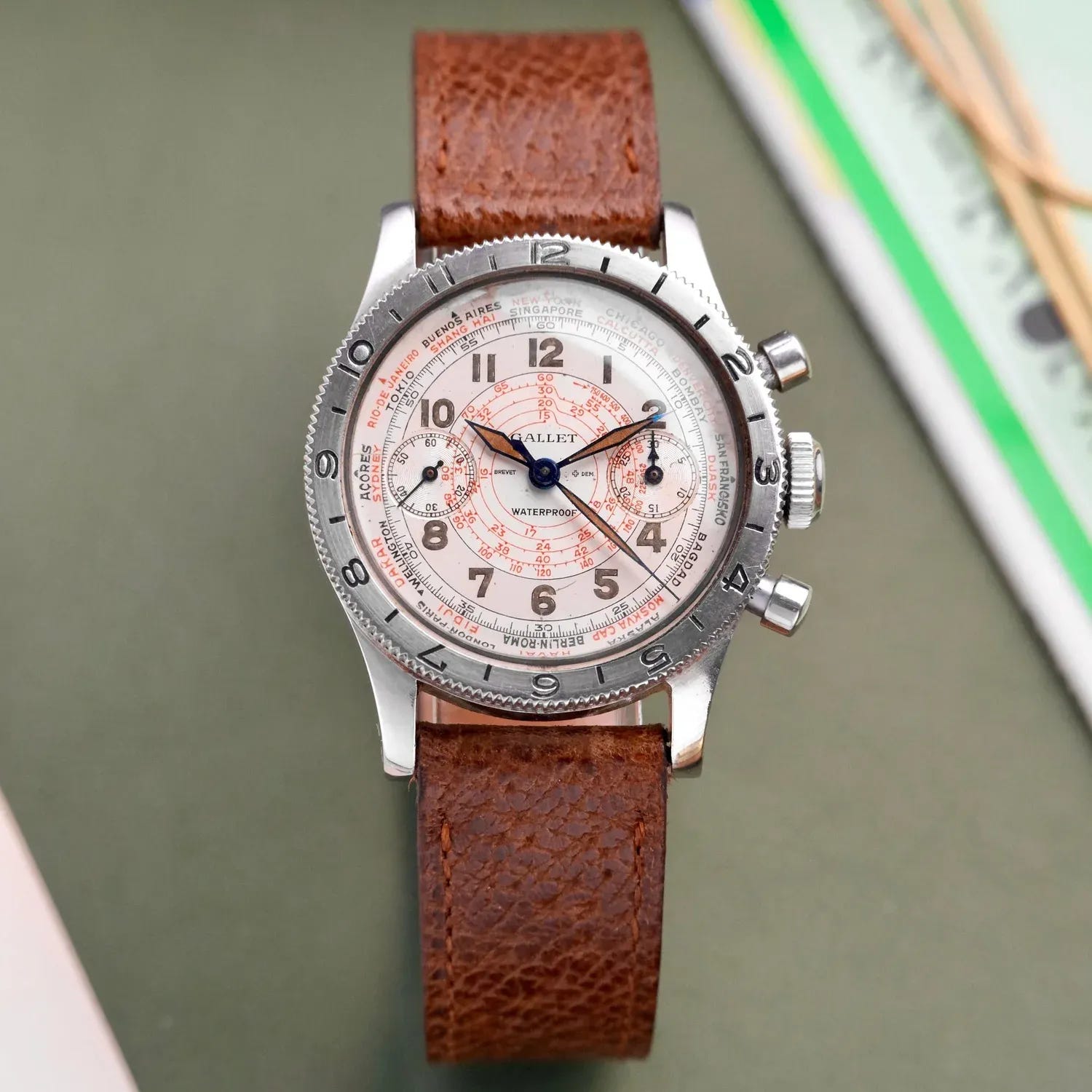
This is the origin of the Gallet Flying Officer, with its indicators dictated by specific, real-world practicality.
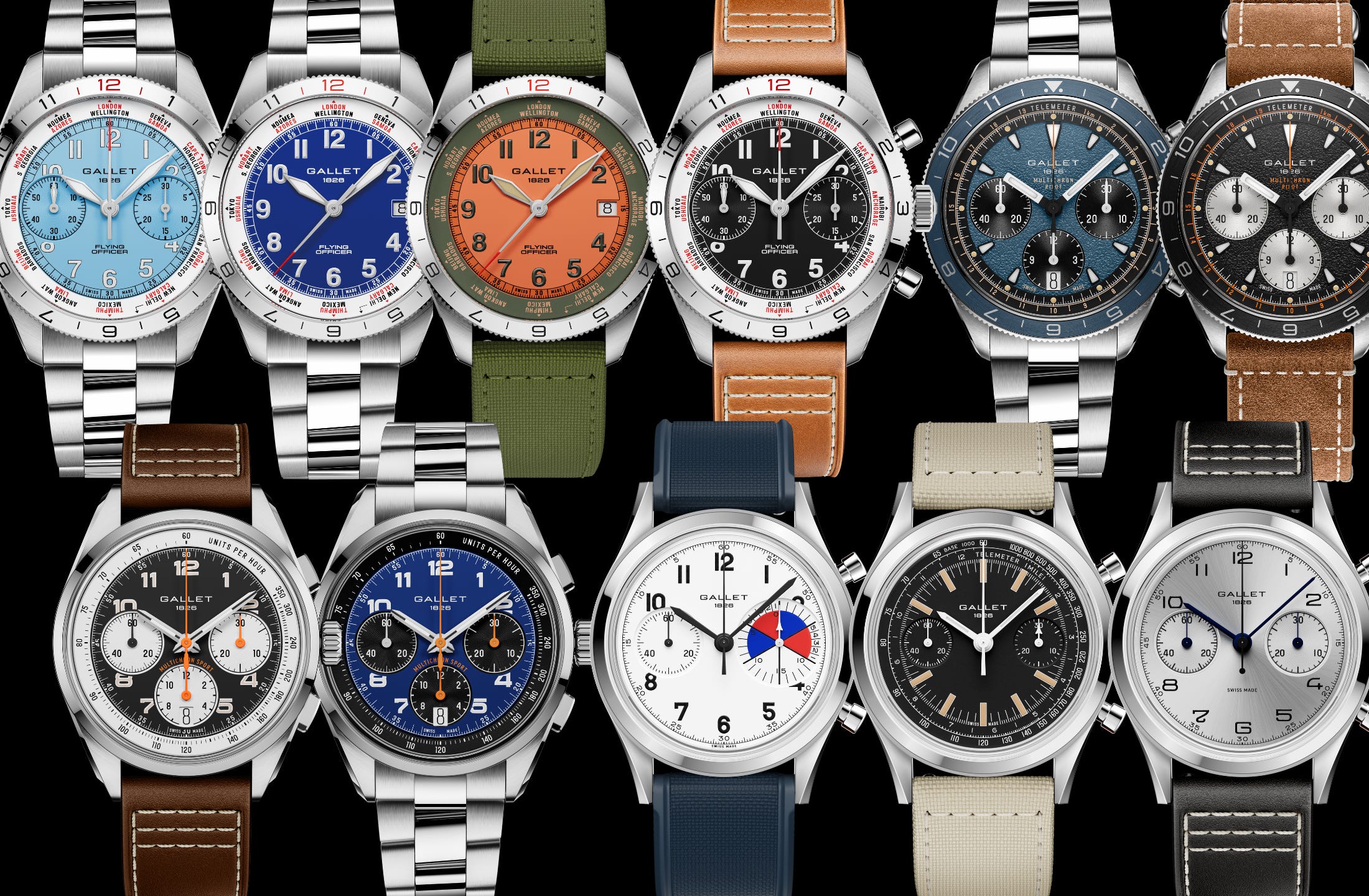
Today, Gallet officially relaunches under Breitling’s House of Brands, after its acquisition by Breitling and Partners Group was first reported in February 2025. It’s introducing four collections, but calls the Flying Officer the “blueprint” for its relaunch.
The new Flying Officer has been upsized to 40mm (15mm thick), and Gallet says:
“The rotating bezel has been entirely reconsidered around 24 contemporary destinations, pairing major international gateways with more remote points of exploration to reflect how travel has evolved.”
That original specificity is long gone—instead, the world timer has become a moodboard for “wanderlust.”
👉 Unpolished doesn’t run brand ads. Members get: (1) Welcome Care Package; (2) 10% off the Unpolished Store; (3) $50 off Watchcheck, + comments and Q&As. Find all your benefits HERE.
Wanderlust

Gallet’s relaunch is all about wanderlust. From its press release:
“Wanderlust is more than the urge to travel. It’s the instinct to break free from the ordinary, leave the noise behind, and chase what lies beyond.”
Gallet is positioned as a sibling brand of Breitling, with the four new collections to be sold via “select Breitling boutiques now featuring dedicated safari-inspired Gallet corners, inviting visitors into the brand’s world of escape, exploration, and adventure.”
The German wanderlust is a strong desire or impulse to travel. 160 million posts on Instagram have the hashtag #wanderlust, many of those from the late Obama years when millennials like me were Eat-Pray-Loving our way across Spain or Thailand or Colombia or whatever “affordable” destination an entry-level gig at Accenture could bankroll.1
It’s a strange place for Gallet to end up, since its actual history is anything but vague.

Founded in La Chaux-de-Fonds in 1826, Gallet & Co. became known for its chronographs with very specific use cases: the Navigator for navigating; Yachting for yachters; Decimal for engineers and scientists; Filmeter for Hollywood; Medigraph for doctors; even basketball and football timers.
The Wright Brothers used a stopwatch known as The Sun, manufactured by Gallet, to time their first flights at Kitty Hawk in 1903. “The Sun” was a New York importer’s trademark, and the design was a horse timer Gallet had been selling since the 1890s.
Gallet’s distribution was focused in the United States, likely thanks to the efforts of Leon Gallet and Jules Racine. As wristwatches began to replace pocket watches in the 1930s, Gallet took advantage.
In 1938, it introduced the MultiChron Clamshell (my favorite Gallet), which used a primitive waterproof case design with four screws in the caseback to seal it against moisture. A year later came the Flying Officer. Earlier world timers from fancy brands like Patek Philippe used Louis Cottier’s intricate system. By contrast, the Flying Officer was practical and affordable, a tool for actual use by pilots and navigators.
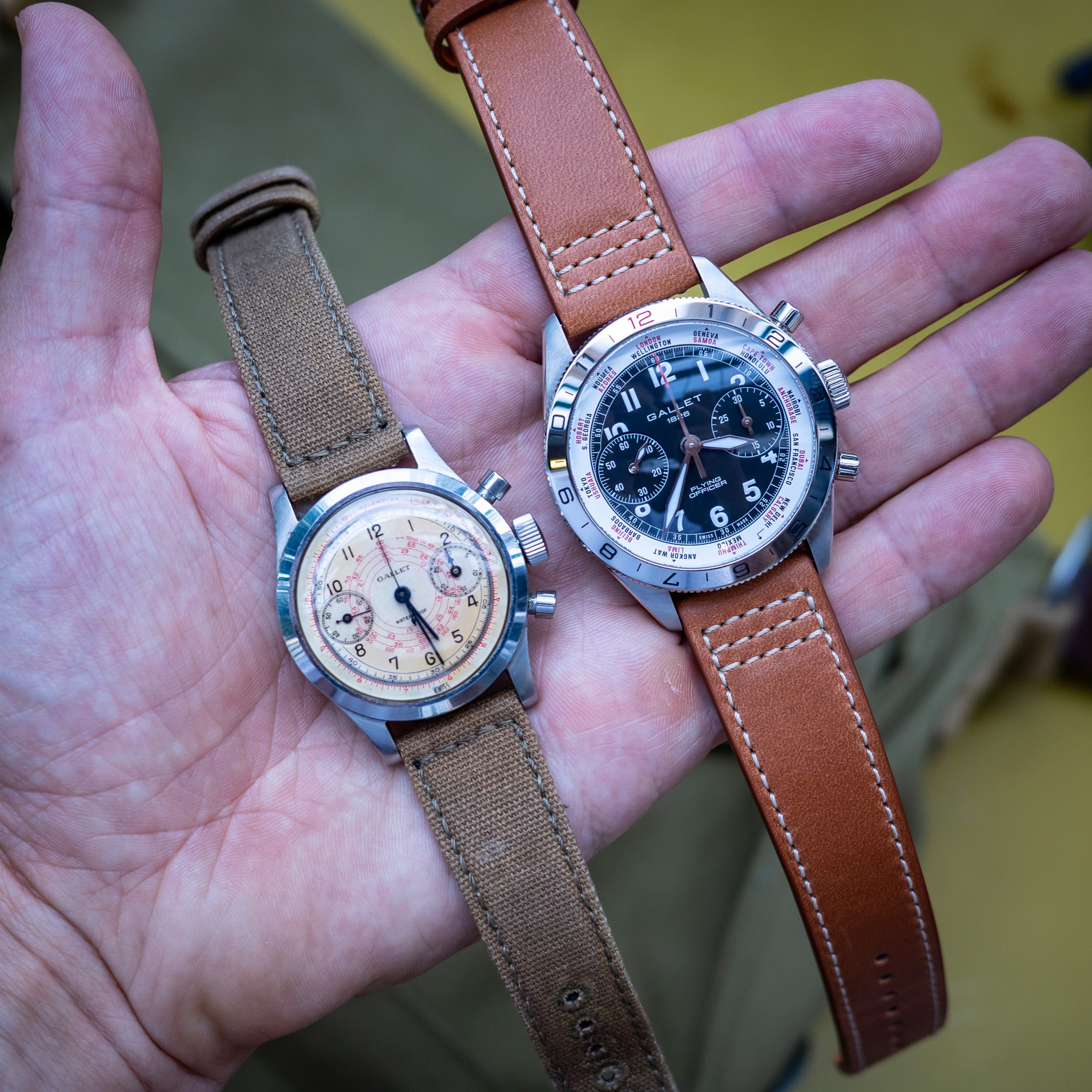
An early Flying Officer was given to Harry S. Truman, who later became President of the United States and dropped two atomic bombs.
Meanwhile, Gallet entered its golden age with the rest of the Swiss industry, producing an endless variety of chronographs for the world’s growing middle class that enjoyed driving, yachting, flying, and other leisurely endeavors.
Gallet eventually became a victim of the Quartz and Currency Crisis, with the brand falling out of the Gallet family by 1994, going into private ownership and remaining largely dormant until its 2025 acquisition by private equity firm Partners Group and Breitling.
Today, Gallet enthusiasm is small compared to even Universal Genève, with a center of gravity in the U.S. given the historical link.
The new Gallet watches are “Manufactured by Breitling,” benefiting from Breitling’s “after-sales service and global distribution.”
This does not include Breitling movements, except for the 200th anniversary Gallet Classics (more below). Instead, Gallet relies on Sellita: the core chronographs are based on the Sellita SW510, while the Flying Officer Automatic is based on the SW200.
This may be a point of contention for some, but it’s historically honest. Vintage Gallet chronographs used outsourced calibers from Landeron, Venus, Valjoux, and, famously, Excelsior Park. Here’s the pricing:
Flying Officer Automatic: $2,900 (strap) / $3,100 (bracelet)
Flying Officer Chronograph, Multichron Pilot & Sport: $4,400 (strap) / $4,600 (bracelet)
Gallet Classics (Yachting, 45, Silverlight): $6,700 USD (strap only)
It’s a competitive segment, and growth is slow. The chronograph prices put Gallet at the top band of Sellita users—smaller brands like Baltic, Hanhart, Christopher Ward, and Furlan Marri offer cheaper SW510 alternatives. Gallet comes in slightly below Norqain, which may be the best comp. Meanwhile, Longines offers a range of COSC-certified chronographs below $4,000.
For another couple grand, you can graduate to a Tudor Black Bay Chrono, which uses a Breitling-descended caliber, while “Breitling-made” Gallet runs a Sellita.
The problem: Gallet is a niche brand, but has chosen the broadest possible marketing and design codes, which means it’s taking on every competitor in the most crowded segment of the market.
Perhaps Gallet can become a true competitor to Longines, or more accessible than Tudor and its steady march upmarket. But it’s not there with this launch collection.
Let’s get specific

All those old Gallet chronographs answered a very specific question for doctors, pilots, engineers, or just rich lawyers with a boat.
But wanderlust isn’t a specific question—it’s a feeling, and feelings don’t lend themselves to precise answers. Let’s start by looking at the core collections:
(1) The Flying Officer
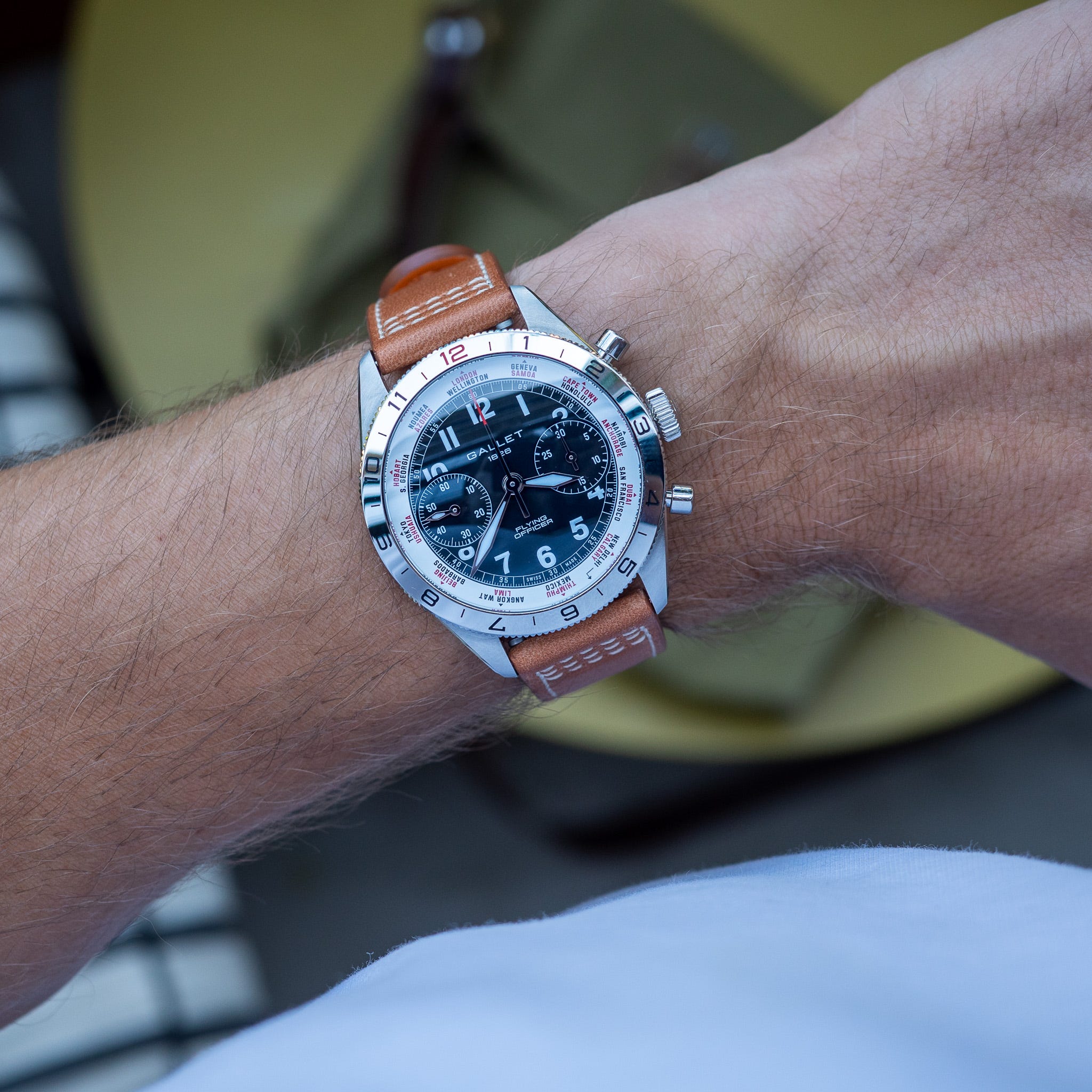
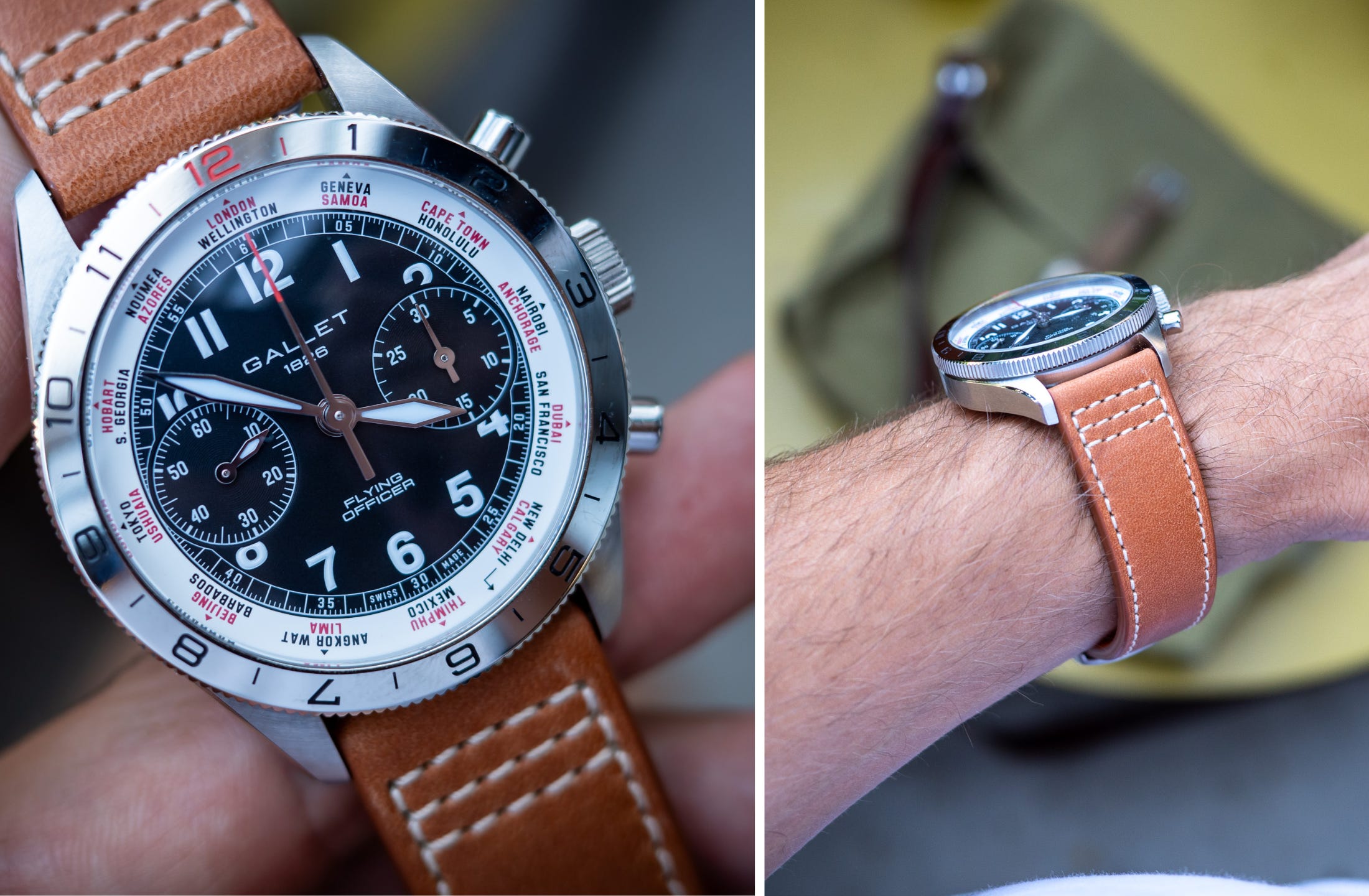
I’ve seen the Flying Officer in person. It’s a chunky: 40x15mm (47.5mm lug-to-lug), though I suppose not overly imposing for someone with larger wrists.
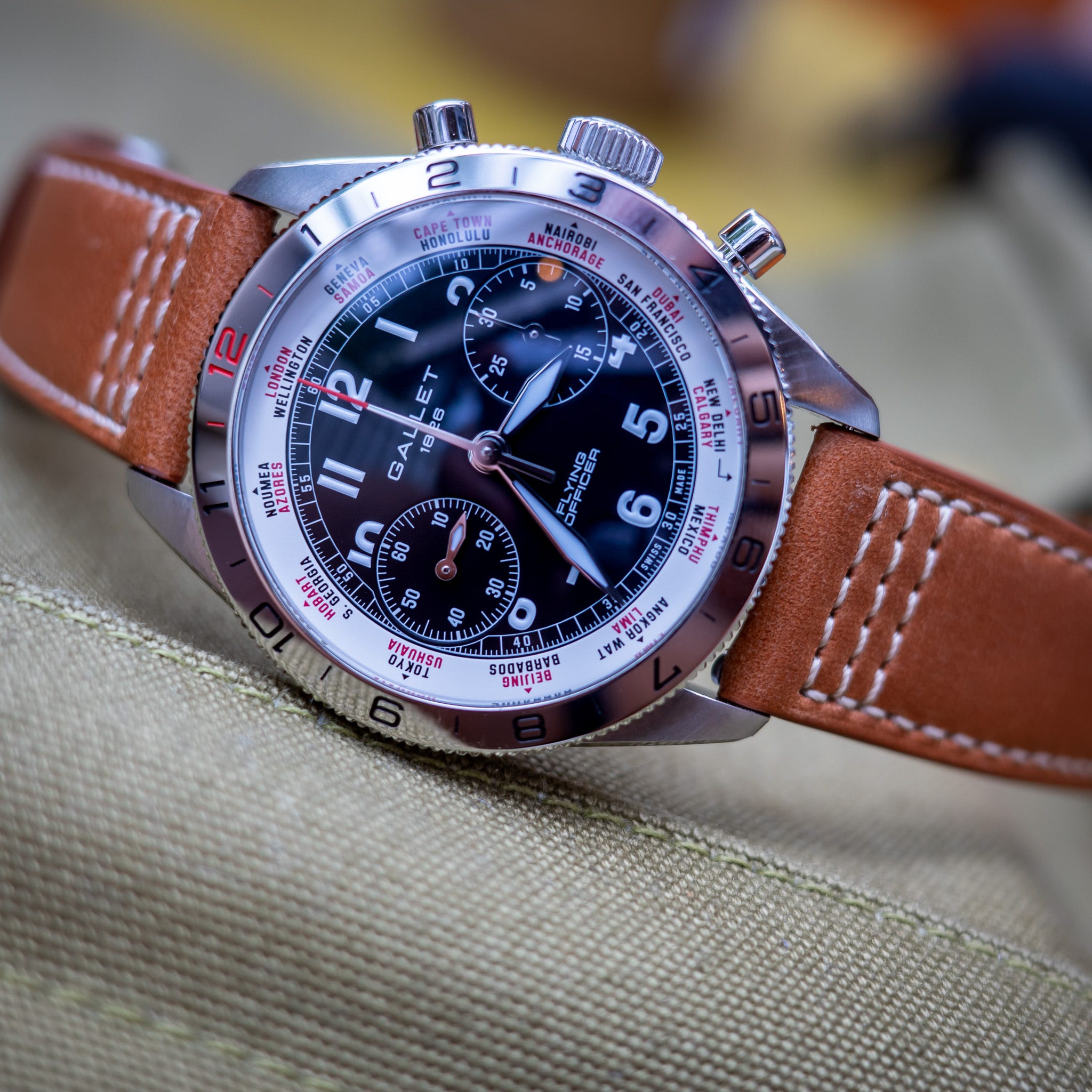
It’s offered with a black or trendy Tiffany-adjacent blue dial with that “reconsidered” world timer around the periphery. The simple design takes after second-gen vintage Flying Officers from the 60s, with no tachymeter or telemeter scales.
The bezel is highly polished, making it much shinier than the old Flying Officers. A pilot friend of mine wore a Flying Officer sample in the weeks leading up to this release, so I asked for his impressions. He told me:
“From a practical perspective, it’s too shiny, it leans too far away from the tool watch aesthetic.”
However, he called it a sharp watch, saying he’s glad Breitling has brought a new pilot’s watch to the market. He’ll have a full video with his thoughts on his YouTube, PilotWatchGouge.2
The Flying Officer is big, brash, and thick—closer to a 2006 sensibility of what a luxury watch should be than 2026. Instagrammable destinations like Dubai, Nairobi, and even Angkor Wat dot the dial, moving from #wanderlust to the world timer.
The Flying Officer might not be for me, the limp-wristed enthusiast, or my pilot friend, but Breitling is betting that the fat middle of consumers might be intrigued enough to take a safari to the corner of their local Breitling boutique.
(2) Flying Officer Automatic
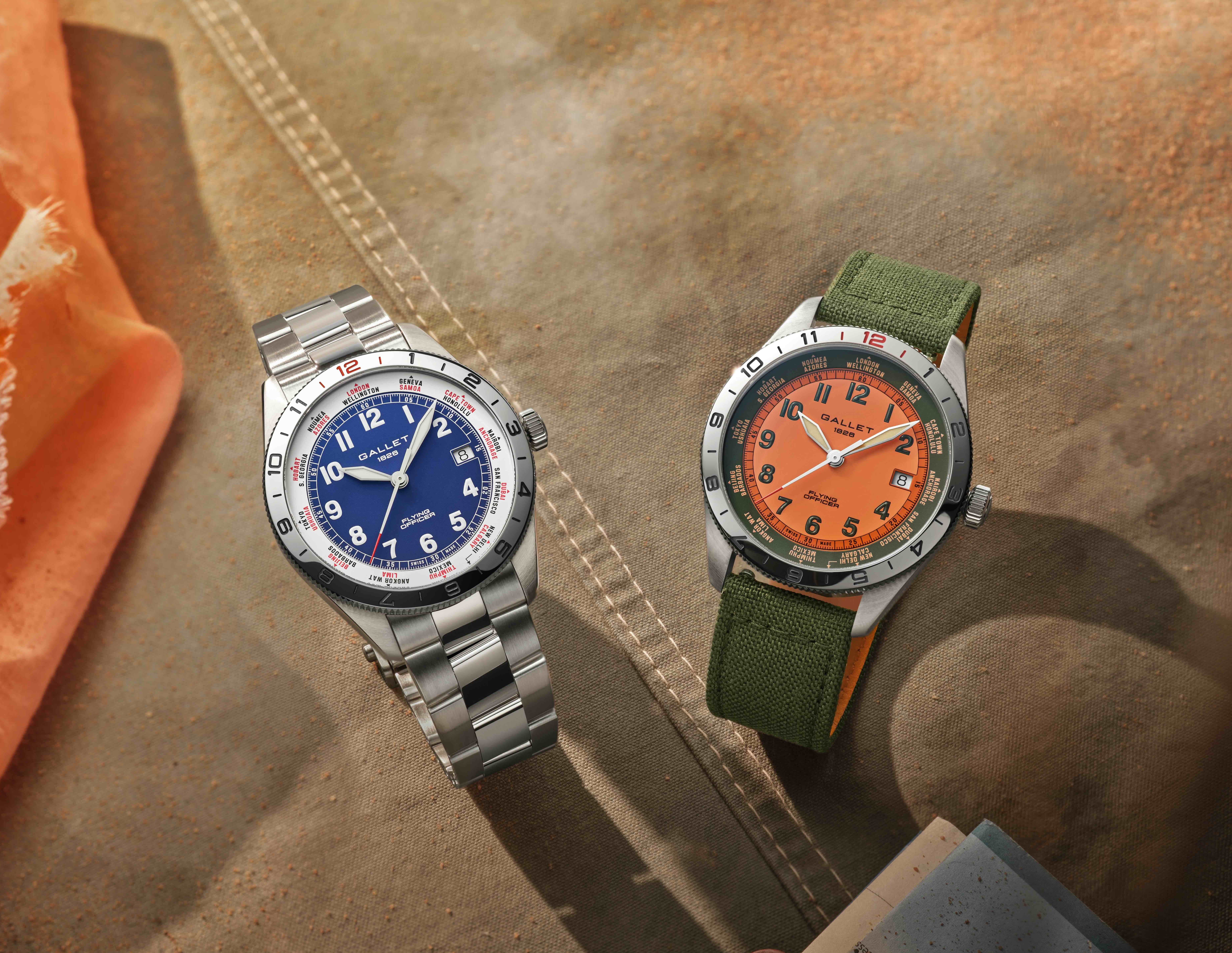
There’s also a time-and-date Flying Officer Automatic, which doesn’t have a direct ancestor. Historically, Gallet mostly made chronographs, so I get the need to reinterpret its back catalog into a modern three-hander. But simply removing the chronograph shows a relative lack of imagination.
Gallet says the orange dial is “inspired by the patina of an aged Flying Officer,” and serves as the color palette of the entire brand relaunch.
Patina, repackaged as a Pantone.
Below the paywall: the financial reality behind the relaunch, the new Classics I actually like, and what Gallet could’ve been.
(3) The Multichron Pilot 42. Gallet calls it “a go-anywhere, do-anything watch with a rugged, textured dial and the ability to track a second timezone.” GADA, that overused phrase born on Reddit and forums, elevated to press-release lingo. I expected all the watches to be super-sized, and the core collection is, even if the Multichron Pilot is a somewhat compact 42mm (11.3mm thick and 45.6mm lug-to-lug).
(4) The Multichron Sport 41 will wear bigger. A familiar three-register chronograph measuring 41x 13.9mm thick (49mm lug-to-lug), offered with a black or blue dial. It’s the only model without a historical analog. To me, it’s also the closest of the bunch to a Breitling, mixing elements that feel familiar from the Top Time or Classic AVI. Squint and it’s a Longines.
Across the Multichron, the design and color palette play it safe—relying on retro, unapologetically masculine tool-watch tropes like bright orange accents as a shortcut for establishing its credentials.
Gallet is being positioned as a sibling brand of Breitling, and it’d be hard to mistake it as anything but that.
Keep it Classic
Let’s get to the watches I like.
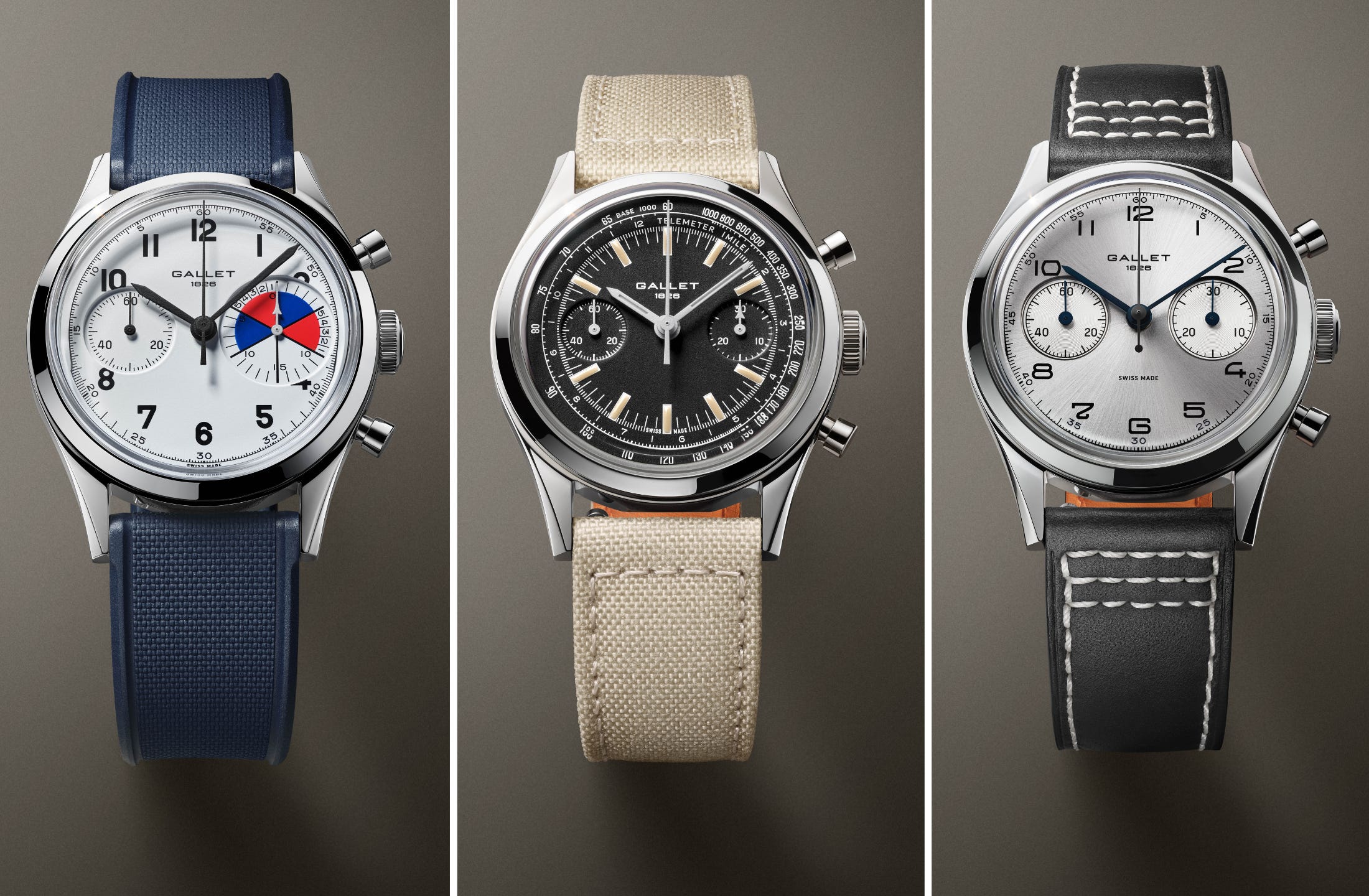
Alongside the core collection, there are three special-edition Gallet Classics. Unlike the others, they use Breitling’s hand-wound caliber B09. They’re also smaller: 38x12.5mm (46mm lug-to-lug). Even the GALLET wordmark at 12 o’clock has been shrunk down.
Price: $6,700
I’ve talked to a few enthusiasts who were consulted on these, and it shows. The dimensions slip under the Tudor Black Bay 39 Chrono, as does the price (strap only vs. bracelet, but still). The lugs have a slight bevel, inspired by old Gallet cases like this one.
The models are interesting and even unexpected:
The Yachting Big Eye is a reference to the vintage models of the same name, some of the best in Gallet’s entire back catalog.
The Tribute to Multichron 45 references a rare vintage Gallet powered by a Landeron movement.
Gallet says the Tribute to Silverlight is inspired by the vintage Navigator, though it lacks the additional navigator hand (basically a compass), which would’ve been a cool touch.
Sure, I would’ve loved to see these in 36mm, but we always knew that’d be asking for a lot from Breitling’s House of Brands.
While I like the execution of all three, that’s not to say I want Gallet to be entirely a heritage brand that reissues small(er) manually-wound dress chronographs for the finicky enthusiast set. That’s not a viable business, and isn’t what sells at Fifth Avenue or airport boutiques.
There’s also the business context. Earlier this year, Moody’s and S&P downgraded Breitling’s debt rating. The Financial Times reported that its private equity owners have cut Breitling’s valuation by as much as half of its 2023 peak, citing slowing growth and expensive boutique rollouts. Just this week, there were reports about Breitling’s $1b in debt that will need to be refinanced by 2028. Taken together, the headlines sound ominous, even if those ratings agencies say Breitling’s liquidity is adequate. It’s long been assumed Breitling will IPO in the next few years, and the Gallet and Universal Genève relaunches are part of an effort to present a diversified portfolio to the public market.
But zoom out, and Breitling has been a massive success story since Georges Kern became CEO in 2017, more than doubling its sales.
Gallet relies on a familiar blend of heritage meets adventure. The relaunch has some similarities with Bremont’s rebrand under CEO Davide Cerrato, also framed around the amorphous idea of adventure. So many of the brands in this segment—Bremont, Longines, Tudor, Norqain, and now Gallet—sell watches off that same sense of exploration.
Gallet is niche enough that I thought it could build around something else. Think about the way Nomos sells design or Sinn sells engineering. Gallet could’ve sold the specificity of its catalog—it made watches for doctors, engineers, cinematographers, navigators, and referees.
Asking the right questions
Those old Gallet chronographs were good because they were specific. The Flying Officer was a clever bit of 1930s engineering, hacked out of a rotating bezel. Eventually, the world caught up—the GMT hand, then quartz, then the phone in your pocket.
But specificity itself isn’t obsolete. Just last week, Ming introduced a world timer with an ingenious solution for tracking Daylight Saving Time, a real problem that didn’t have a mechanical answer. Somebody is still asking the kind of question Gallet used to ask.
Gallet spent its first 150 years making instruments for those who knew where they wanted to go, or what they wanted to measure. Now, it makes watches for wanderlust.
Let me know what you think about the Gallet relaunch in the comments!
Wanderlust is also a 2012 rom-com starring Jennifer Aniston and Paul Rudd (58% on Rotten Tomatoes).
And thanks to this pilot friend for letting me see his sample before the official relaunch!
As I type this I am wearing a Gallet Multichron Chronograph, purchased by my father at Racines in 1970. Valjoux movement lovingly serviced by Roland Murphy of RGM Watches. None of the new watches come close (Classics are the best, though), although I am happy to see that the brand has been resurrected. I also have a Brietling Premier B09 with pistachio dial and the same manual movement as the new Gallet Classics. I see potential, though I will not rush out to buy one yet.
Appreciate your honest review that doesn’t simply regurgitate the press release.