


Craft—what is it?? I asked Max Büsser, Sylvain Berneron, Rebecca Struthers, Josh Shapiro, and more.
📺 I’ve enjoyed the first few episodes of Wei Koh’s Man of the Hour, now in the U.S. on Discovery+. Binge it with a 7-day free trial. Also listen to Wei on the Unpolished Podcast last November.
👨🏫 What happened when Piaget bought Heuer. I’d thought of the years leading up to the formation of TAG Heuer in 1985 as The Lost Years. But this piece of historical journalism explores the early 80s when Piaget stepped in to acquire a struggling Heuer, with cameos from Seiko, Ebel, and Lemania along the way. Piaget didn’t exactly want Heuer—what they really wanted was ultra-thin watchmaking. Heuer was collateral damage.
👂 LVMH Rumors. There’s all kinds of talk about LVMH, Zenith, and TAG Heuer—sales, rumored CEO departures, sibling rivalry. I’ll save it for a postscript below today’s main event.
Find the entire Unpolished archive online, including last week’s existential issue:

I’ve read several great articles, often on Substack, over the past few weeks. If you want to work together, have a story you think Unpolished should cover, or wanna talk watches, shoot me an email: tony[at]unpolishedwatches.com.

Craft: More than marketing?
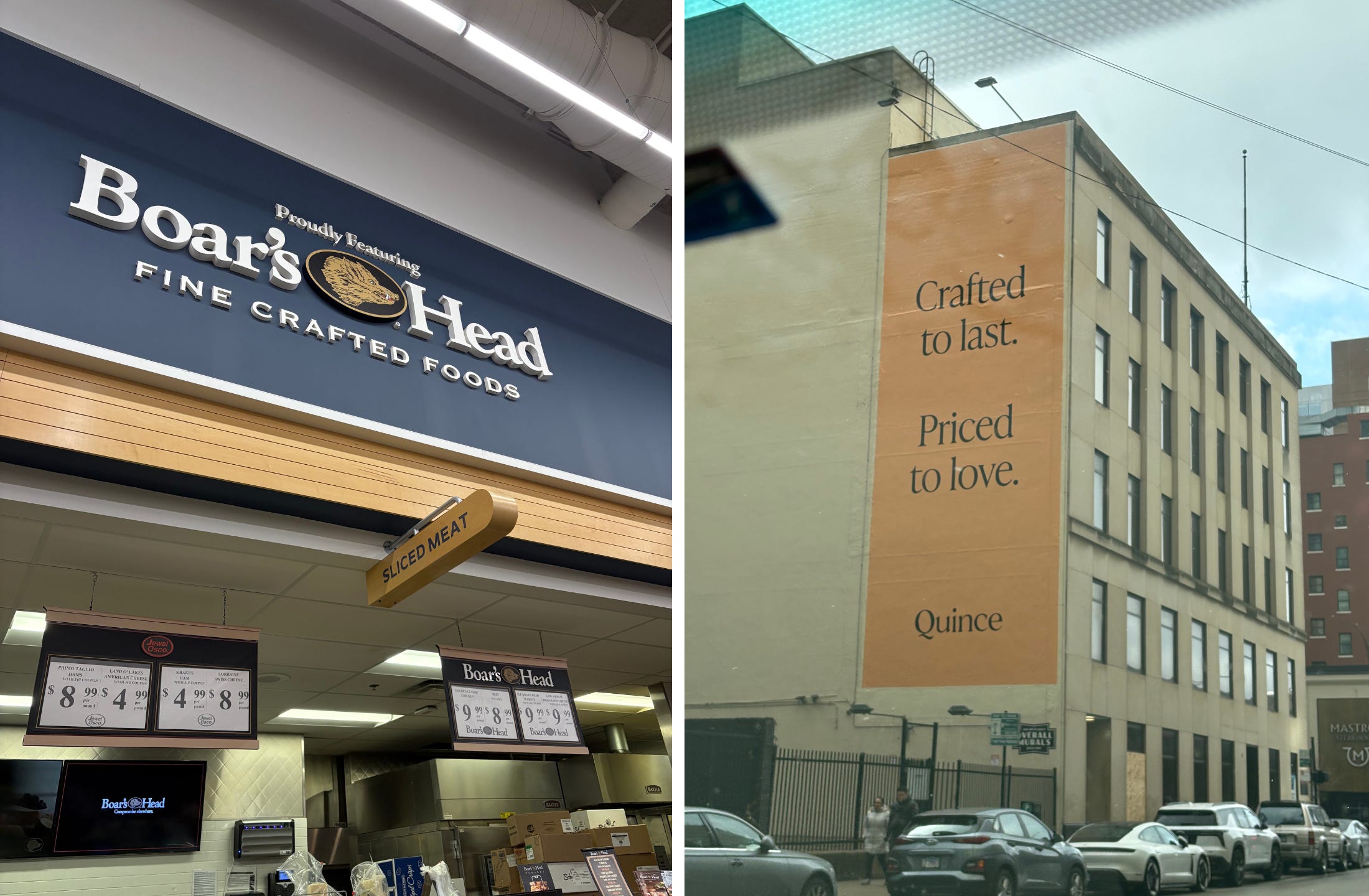
Craft. It’s everywhere. Just in the past week, I’ve seen luxury bags, fast fashion, and deli meat tout the craft imbued in their products. Cynically, it’s a way to justify rising prices. Talking about craft is a way to show your work, as your high school algebra teacher no doubt admonished you.
It’s gone from a word with real substance to yet another marketing term. Of course, craft makes sense in the context of watches. The processes, skills, and techniques required to make, assemble, and finish all those mechanical components make it something more than just another piece of wrist jewelry. (Though jewelers, too, have had their own crack at craft.)
“Brands are reducing their reliance on price-led growth and refocusing on creativity and craftsmanship to rebuild client trust,” Business of Fashion writes in its annual report.
This specific brand of human-centric jargon has taken over lately. Craft. Taste. Authenticity. While all hold an underlying truth, they’ve also become buzzwords for anyone trying to outrun an LLM. It’s a convenient narrative: the one thing Zuck or Altman can’t copy is our "soul." But as these words are polished into marketing slogans, it’s made me wonder: are we celebrating what makes us human, or just finding a more expensive way to package it?
So what does craft actually mean? Surely, it’s not some ultra-processed deli meat.
To help define “craft,” I reached out to 13 people I see practicing it in their work: Watchmakers, brand owners, and collectors—among them a Formula 1 lead, a software developer, and an Olympian. They’re all different, but share a love of watches.
An ancient impulse
Our fascination with craft can be traced back at least to ancient Greece. Hephaestus, the Greek god of craftsmen, gets shoutouts in Homeric hymns:
“He taught men glorious crafts throughout the world—men who before used to dwell in caves in the mountains like wild beasts. But now that they have learned crafts…they live a peaceful life in their own houses.”
My Catholic upbringing reminds me that, a few centuries later, Jesus was the son of a carpenter—the human urge to respect the bench runs deep.
In his book The Craftsman, sociologist Richard Sennett writes that “craftsmanship is the basic human impulse to do a job well for its own sake.” It’s a broader definition of craft, from the practical to the artistic—playing the piano, cooking a meal, laying bricks, shooting a free throw, or programming a computer can all be crafts when practiced in a way that engages all of our human faculties. He argues it’s key to living a fulfilling life.
It’s why I’m just as fascinated by that new Martin Scorsese documentary as I am by Steph Curry’s warmup routine. It’s being aware that someone is entirely lost in their work, and that shows something greater about their character. Craft isn’t confined to any single discipline, but something we recognize in watchmakers, athletes, or anyone who’s perfected the same motion through thousands of hours of practice. Anyone can do something well for its own sake.
In watches, “craft” is often applied narrowly, but real craft isn't hand-finishing for its own sake or scarcity dressed up as care. It’s the human judgment about what matters, and how that transforms a process into an expression of the person behind it.
From Olympic fencers to F1 leads: 13 perspectives on craft
Enough of me, here’s what everyone else said. Let me know how you define craft in the comments.
Jason Fried, watch collector, co-founder of Basecamp:
“I think most ascribe craft to technique applied or time spent, but I think it’s more fundamental than that. To me, craft is more about pride in the work, respecting oneself, and knowing what to pay attention to. You don’t perform a craft for someone else. It’s always for you. Others can enjoy your craft, but it’s your craft.”
Sylvain Berneron, founder, Berneron:
“Craftsmanship is to me the excellence of execution, achieved through intelligence, dexterity, and experience. For example: The precise cut of the surgeon; the right note for the musician; the intentional word of the writer; the balance of a dial for a designer; the feel of a case for the casemaker; the right reflexes of a guillocheur; the precision for a watchmaker.”
Rebecca Struthers, watchmaker, Struthers Watchmakers:
“We were, I think, among the early contemporary watchmakers to start routinely using craft as it was something we founded with as a core value in 2012. Back then, it wasn’t a buzzword and, beyond the recognised artistic crafts, it’s not something I recall being used regularly….
In this context, craft means the skill of making things by hand and, in that sense, beyond the artistic crafts that go into some dial making, movement decoration, and, occasionally, case making, there’s hardly any true craft left in mainstream watchmaking. We’ve started distancing ourself from the word as we did with ‘luxury’ and ‘bespoke’ which similarly became overused and diluted.
Our first in-house piece, Project 248, was a crafted watch which we made almost entirely ourselves, so it’s something we care about. That said, as one of the few workshops to achieve that commercially, we also appreciate it isn’t a viable business model.”
Max Büsser, founder, MB&F:
“Watchmaking has always been where engineering meets beauty and humanity. The humanity part is the artisanship, the human skills necessary to transform a piece of metal into a work of art. When I started in the high-end watch industry 35 years ago, all high-end pieces were finished by hand. Today, only a handful of small creators like us still bring that incredible human finishing touch to movements. It makes no economical sense, but that is what watchmaking will always mean to me.”
Curtis McDowald, Olympian fencer, collector, former GPHG jury member:
“For me, ‘craft’ isn’t an aesthetic or narrative. It’s years of discipline—fundamentals repeated until they become a standard you hold when and where no one’s looking. In watches, that shows up in restraint: proportions, finishing, tolerances, and details even in places the wearer will never see, that only reveal themselves with time and wear, not marketing.”
Josh Shapiro, watchmaker and founder, J.N. Shapiro Watches:
“Craft, craftsmanship, handmade, in-house, manufacture movement. All these terms are mostly just marketing terms and subjective to every brand. Here is our mission statement that the team and I made together, which I think answers what we value:
Manufacturing with our machines, in our workshop.
Sharing our knowledge, both professionally and publicly. Delivering work on par or exceeding the highest level of peers.
Pursuing new horological developments, and mastering those of old.
Emphasizing handmade (non-automated) methods wherever possible and practical.
Fostering a fun environment with versatility and diversity in workload.
