This week’s format is a little different.
Last year’s most popular podcast was How to Collect Neo-Vintage Watches, so we’ll have more “How to Collect” episodes this year. In addition to a podcast, I’ll provide a more comprehensive written Collector’s Guide for paid subscribers. Each episode will feature a dealer or expert going deep on their particular niche.
This week: The vintage Rolex Daytona with dealer Michael Morgan of Iconic Watch Company. Michael’s a dealer based in Orange County focusing on vintage Rolex.
I won’t claim this is a complete guide to the Daytona—I’m not sure that’s possible, in one hour or ten. But it’s a jumping-off point for buying one: Eras, key terms, what to look for, condition tips, the market in 2026, along with where to find value, our favorite Daytonas, and more.
🎧 Listen to the full episode here:

Subscribe to the podcast to get future episodes in your feed: Spotify / Apple / RSS.
Collecting is about recognizing patterns, and whether or not you’re interested in the Daytona, this episode will help you understand patterns in vintage Rolex and how to think about originality and period correctness. We cover all four-digit Daytona references, starting with the last Pre-Daytona 6238.
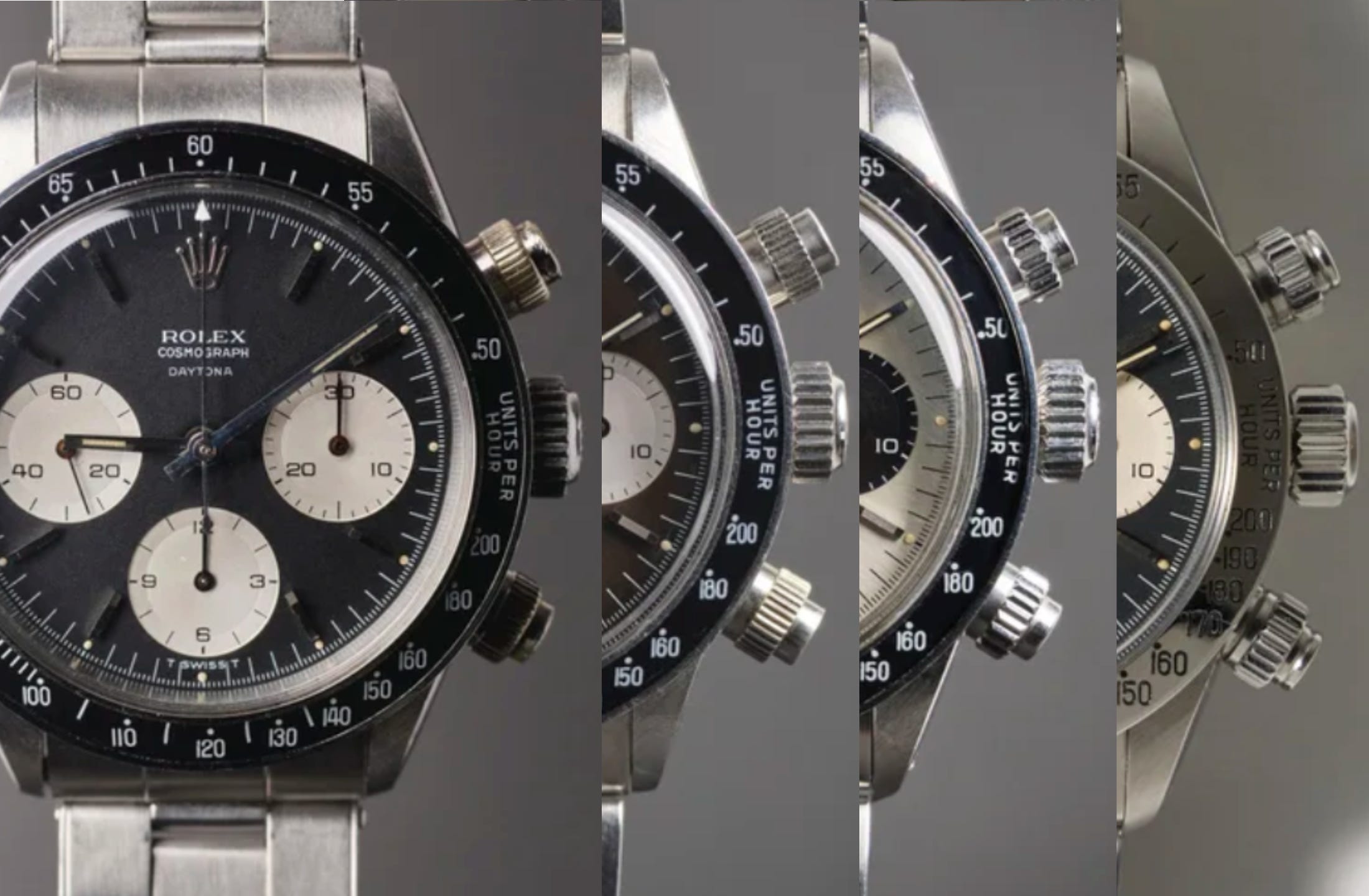
The vintage Daytona can be divided into three eras:
Pump pusher era: Refs. 6239 and 6241 (1963–69)
Transitional era: Refs. 6262 and 6264 (1970-71)
Screw-down era: Refs. 6263 and 6265 (1971-1988)
“Experimental” reference 6240 (1965-69)
The Daytona’s been covered again and again, so instead of repeating what you already know, I’ll try to fill gaps I see in what’s been published and talk about the market right now.
Why now? While everyone else is going crazy for neo-vintage Patek Philippe, smart collectors are zagging, baby!
We focus on standard dials, though the exotic Newman is mentioned a few times. In 1988, Rolex discontinued the manual-wind Daytona for the automatic Zenith Daytona.
Upgrade your subscription to receive a copy of the 2025 Rewind Magazine—a collection of the best writing, photography, and watches from Unpolished. Founding Members get:
The Magazine (read more about it here). If you’re already a Founding Member, here’s how to order your copy.
A free strap from the Store ($110 value)
$50 off any service from Watchcheck
2 newsletters/week, comments, Q&As, and the full archive:
Pre-Daytona: Ref. 6238
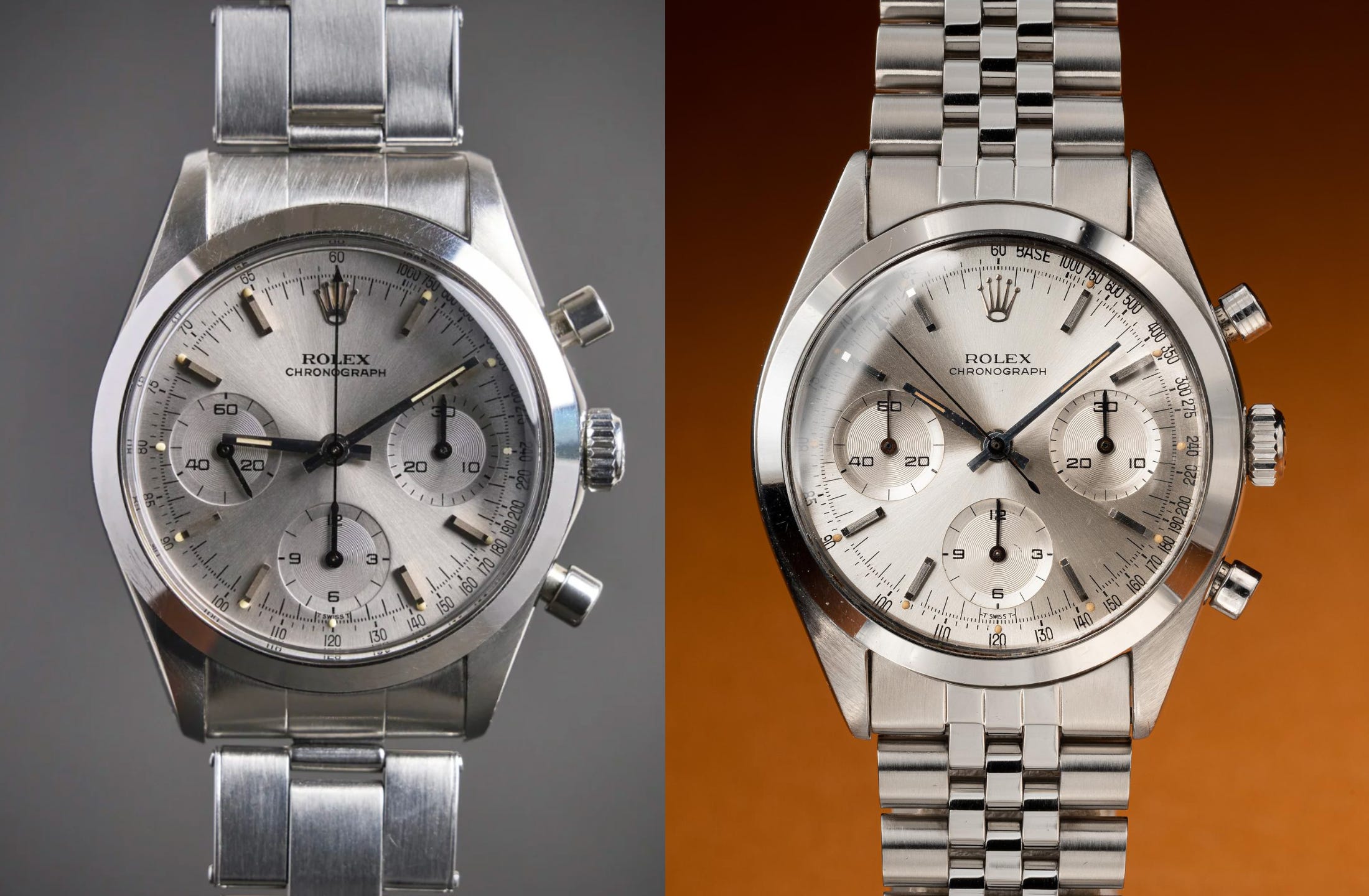
Rolex introduced the pre-Daytona ref. 6238 in 1962, producing it through 1968 (meaning it was offered alongside the first Daytonas). While there are earlier pre-Daytonas, the 6238 is the first that feels like a properly distilled mid-century design. No more of those messy scales used to measure the distance of artillery fire (or whatever). Clean, simple, and easy to read.
As you’ll pick up on in the podcast, Michael and I share an affinity for the 6238.
“I love the 6238 because it’s an example of straightforward design cues,” Michael says. “Once you get to the Daytona, especially with the black bezel, it gets busier—the 6238 is just the purest version.”
The 6238 has three monochromatic dial colors: Silver, grey (often mistaken for silver), and black.
“The grey might be even rarer than the black; I’ve seen very few nice grey examples,” Michael says. Meanwhile, I’d bet there are maybe 10 silver dials for every black one.
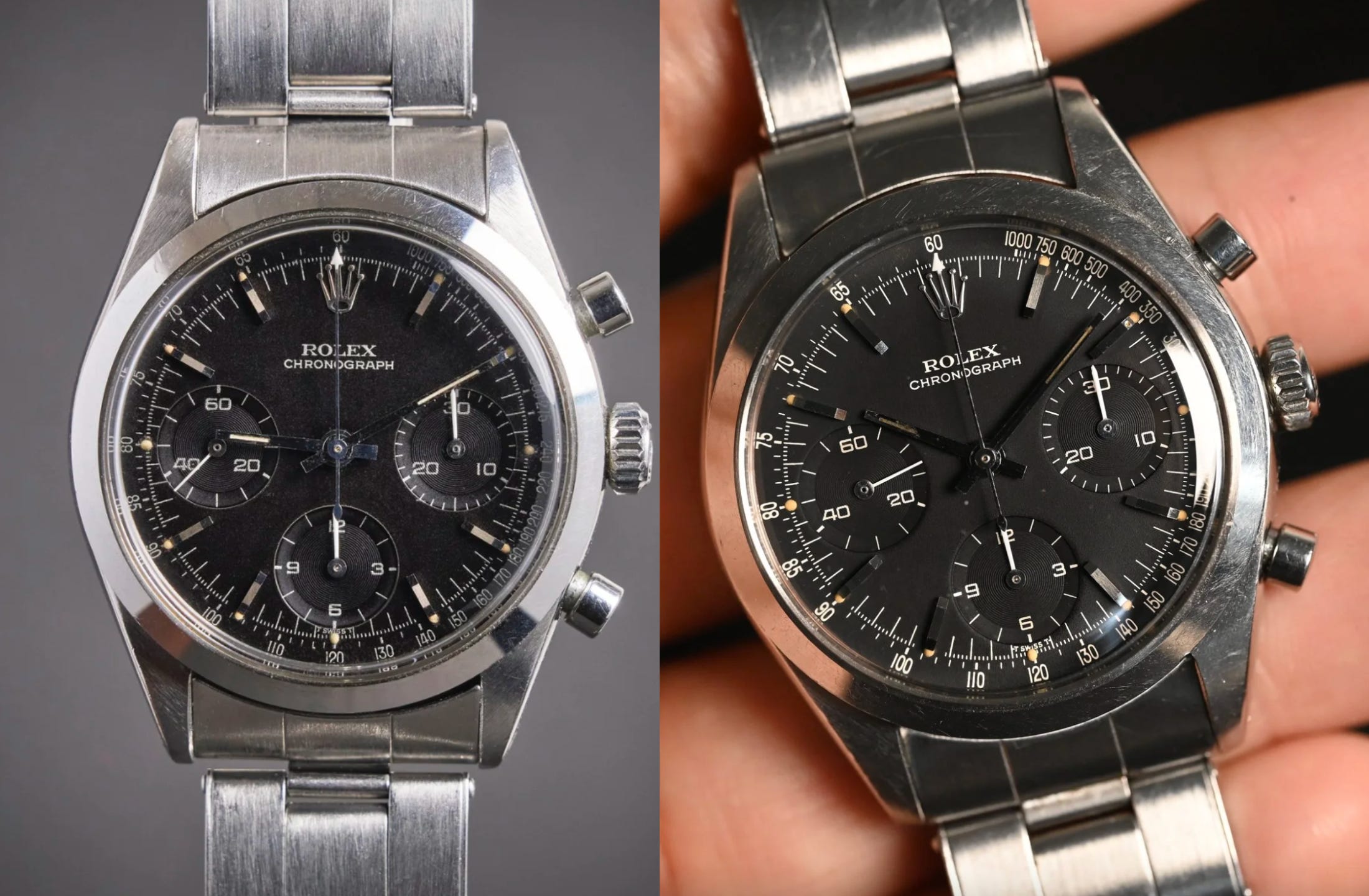
Further, black 6238s can have either galvanic (gilt) print, or stamped print with matte texture—galvanic is much rarer.1
Hands: Check the hands before sending that wire. Not just whether the lume matches, but also whether the size and length make sense given the serial number. Le Monde Edmond has more thoroughly documented 6238 handsets here.
The Dark Knight: I reached out to dealer John Yu, who recently sold a beautiful galvanic “Dark Knight” (above). Here’s what he said about the black 6238:
“The so-called ‘Dark Knights’ are a complete minefield. Early on, they traded at a significant premium—roughly double Newmans. As a result, black service dials surfaced, and many silver dials were swapped for black. On top of that, countless dealers and collectors have transplanted black galvanic dials into better cases without properly studying serial-number batches. The end result is a landscape full of inconsistencies.”
He says legit galvanic examples tend to cluster around the 1.20m and 1.22m serials, and added that some dials described as galvanic aren’t necessarily so when examined in person. True galvanic dials have a vibrancy and depth in the light.
In addition to the 6238 he recently sold, he pointed to a galvanic 6238 sold at Phillips in 2024 for $406k as a “nice benchmark.”
Collector’s tip: While the diameter might be the same as the Daytona (37mm), the lugs are typically thinner and the bezel more domed, meaning the 6238 can wear slightly smaller.
As for the market: It’s more of a niche than the Daytona proper, but the numbers get big pretty quickly, especially for black dials. Think $140-175k for matte black, and $200k+ for galvanic.
“Pre-Daytonas really appeal to the advanced buyer who probably already has everything else,” Michael says. “The typical buyer probably already has a 6239, a Paul Newman, maybe a Big Red.” It isn’t usually your first watch in this genre.
Rarity: Most estimates put 6238 production at about 3,000 examples, with maybe 10% of those in gold.
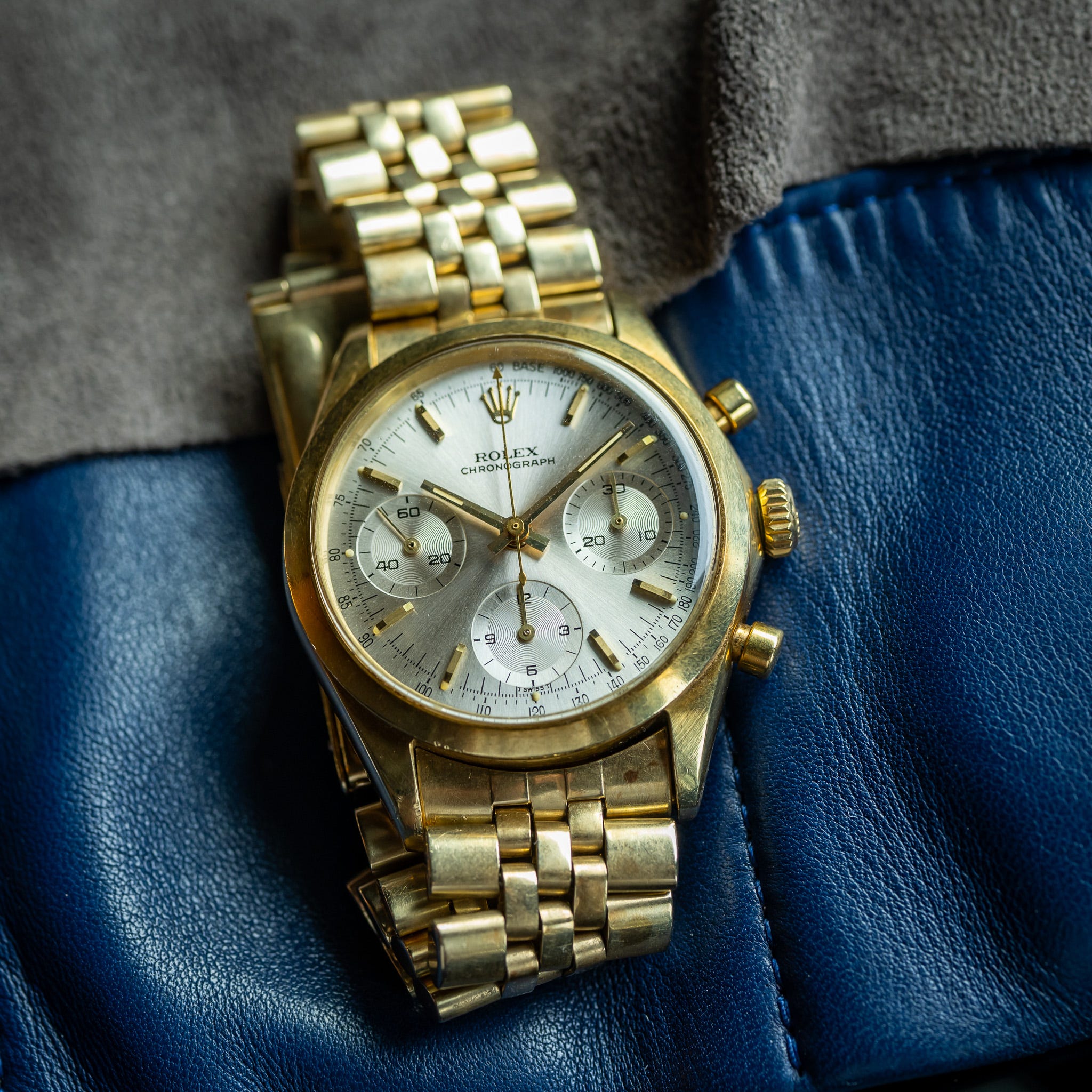
Btw, it’s fair to assume we’re talking about stainless steel unless I say otherwise. But a pause here to say that the 6238 was also made in gold. Here’s a favorite I’ve seen recently, 14kt on a Jubilee bracelet.
Pump Pusher Era: 6239 and 6241
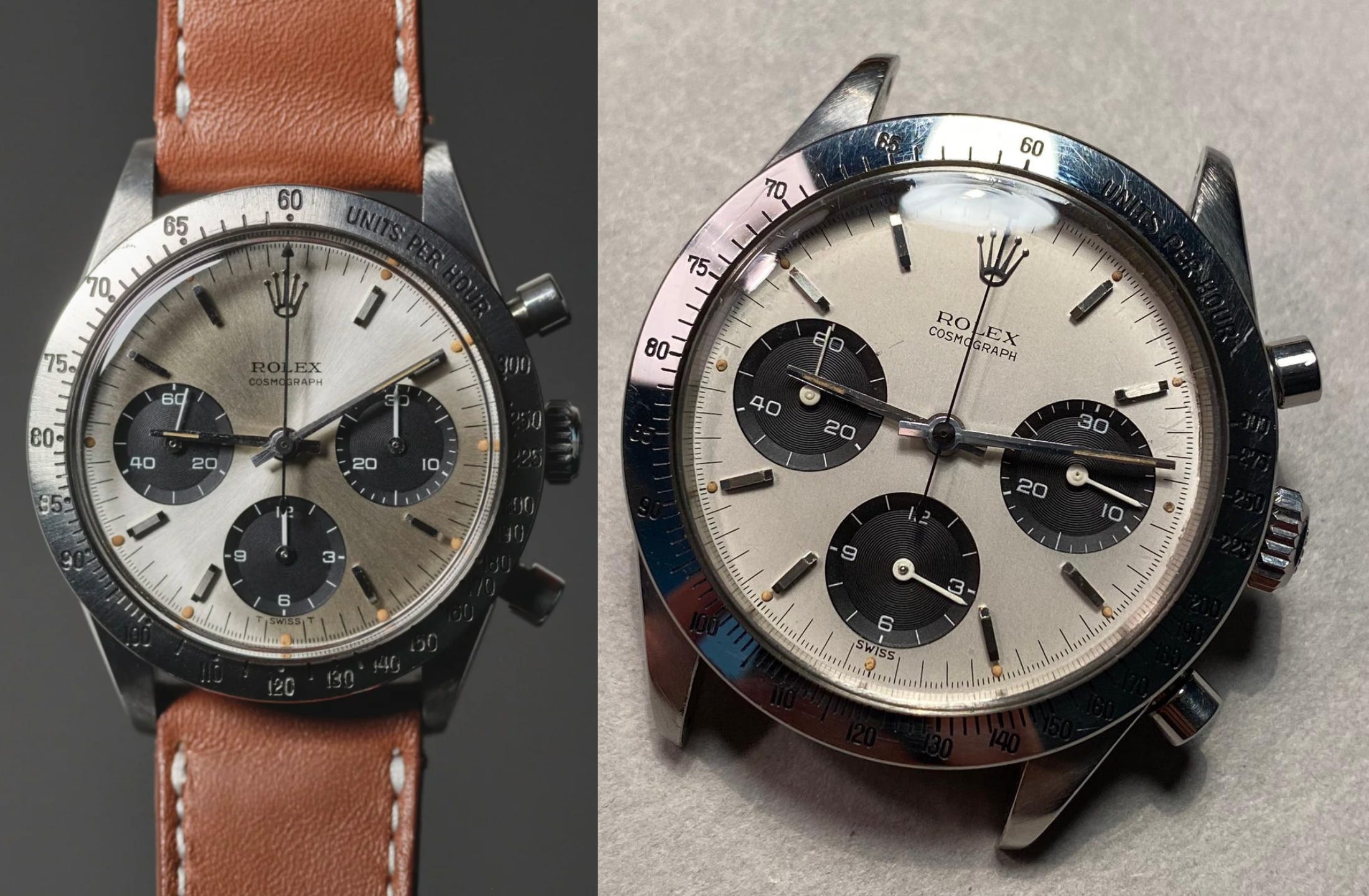
First Daytona: Ref. 6239
In 1963, Rolex introduced the first Daytona ref. 6239. It’s the one Paul Newman wore. At first, it wasn’t called the Daytona.
“It’s called Le Mans,” the first ads read.2 But as Rolex pushed into the American market, it began sponsoring races at Daytona Speedway and renamed its new chronograph.
It’s a clear evolution of the 6238: Pump pushers, a steel bezel with engraved tachymeter, and silver or black dial, now with contrasting subdials.
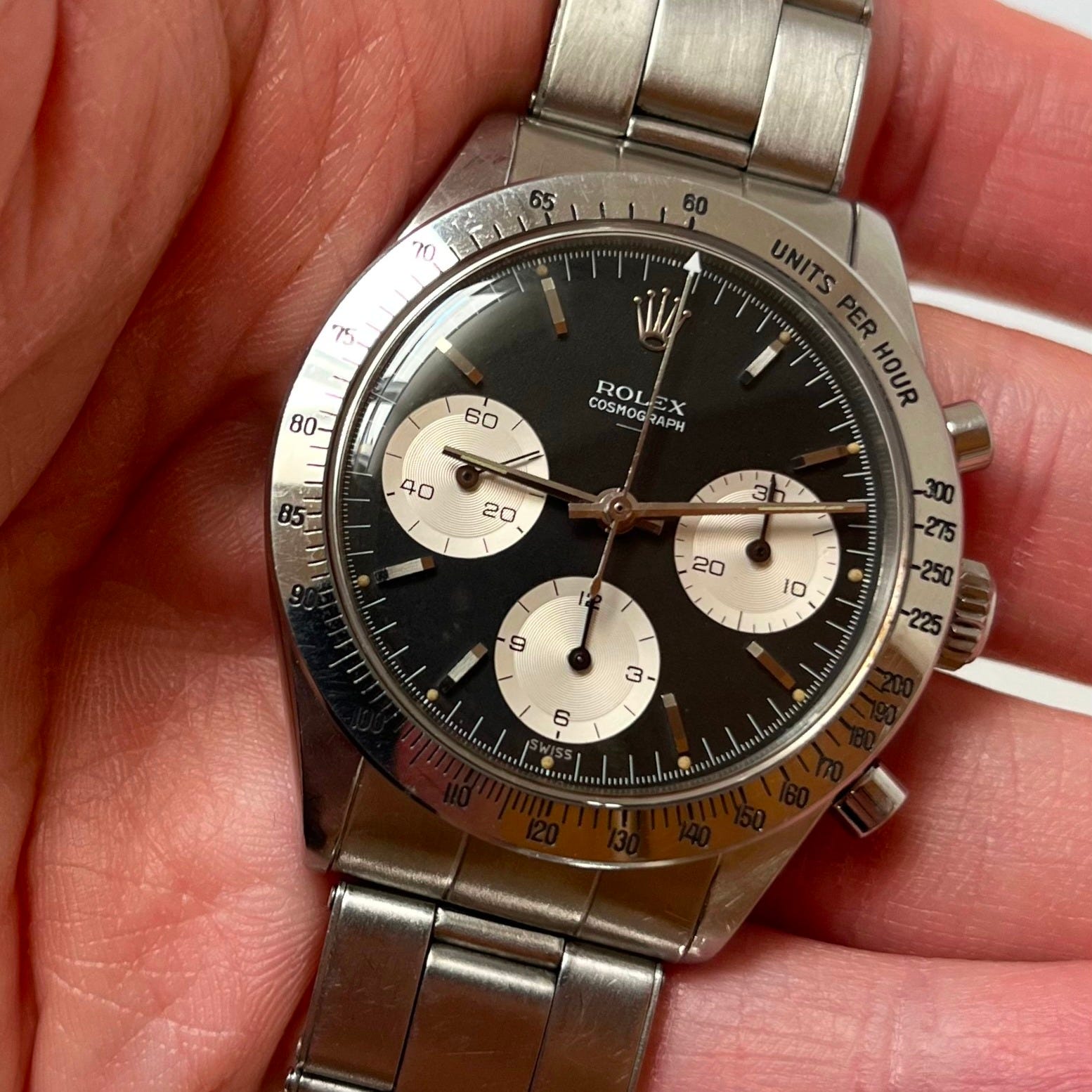
The early Double Swiss Underline 6239 is the most well-known variation, perhaps because Ben wrote about it for the Mothership, and most of us are sheep. But there’s a lot to discover in 6239 land.
“There are a lot of different variations, especially in early 6239s,” Michael says. He points to early examples with a pearlescent dial (above), different from the more common sunburst silver finish, as his favorite. In these early ones in particular, it seems like production was less standardized for the new reference.
Other key components:
Hands: Early 6239s have long, slender hands. Starting in about 1965, the hands got thicker and shorter. See the 6239s above for the early handset.
Mark 1 bezel: The first bezels have “275” marked on the tachymeter—later bezels skip the 275.
Period correct: As we discuss on the pod, the Daytona was one of the first truly collectible, mass-produced wristwatches. That means parts have been swapped, changed, and swapped again for the past ~30 years. It’s often hard to know if something is truly original. Often, the best you can do is learn what’s generally accepted as “period correct” for a specific reference and era: Matching serial number, pushers, and hands, along with a bracelet. It’s also important to remember that back in the day, it wasn’t exactly easy to sell a manual-wind chronograph. While there are patterns and accepted rules, always leave room for exceptions.
‘Experimental’: Ref. 6240
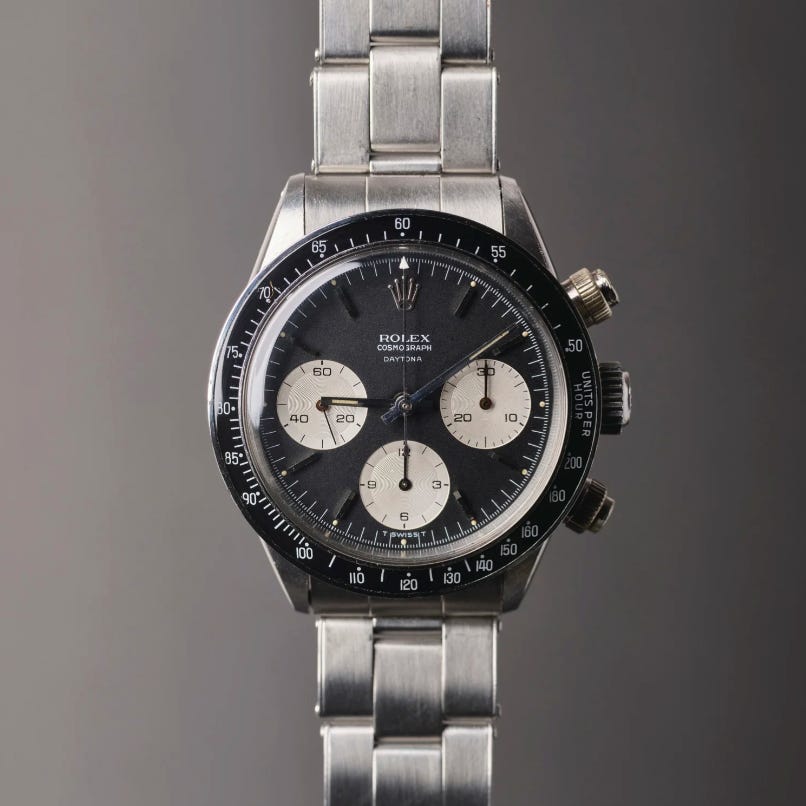
Two years later, we get the ref. 6240. It’s an oddball, something of an experiment because it’s the first time we see screw-down pushers.
In Daytona speak: That means it’s a true Oyster. At the time, this upped water resistance from 50m to 100m.
Let’s talk about those screw-down pushers: From the 6240 through the final screw-down Daytonas from the late 80s, we see four pusher variations: